
OTC Trading System Development
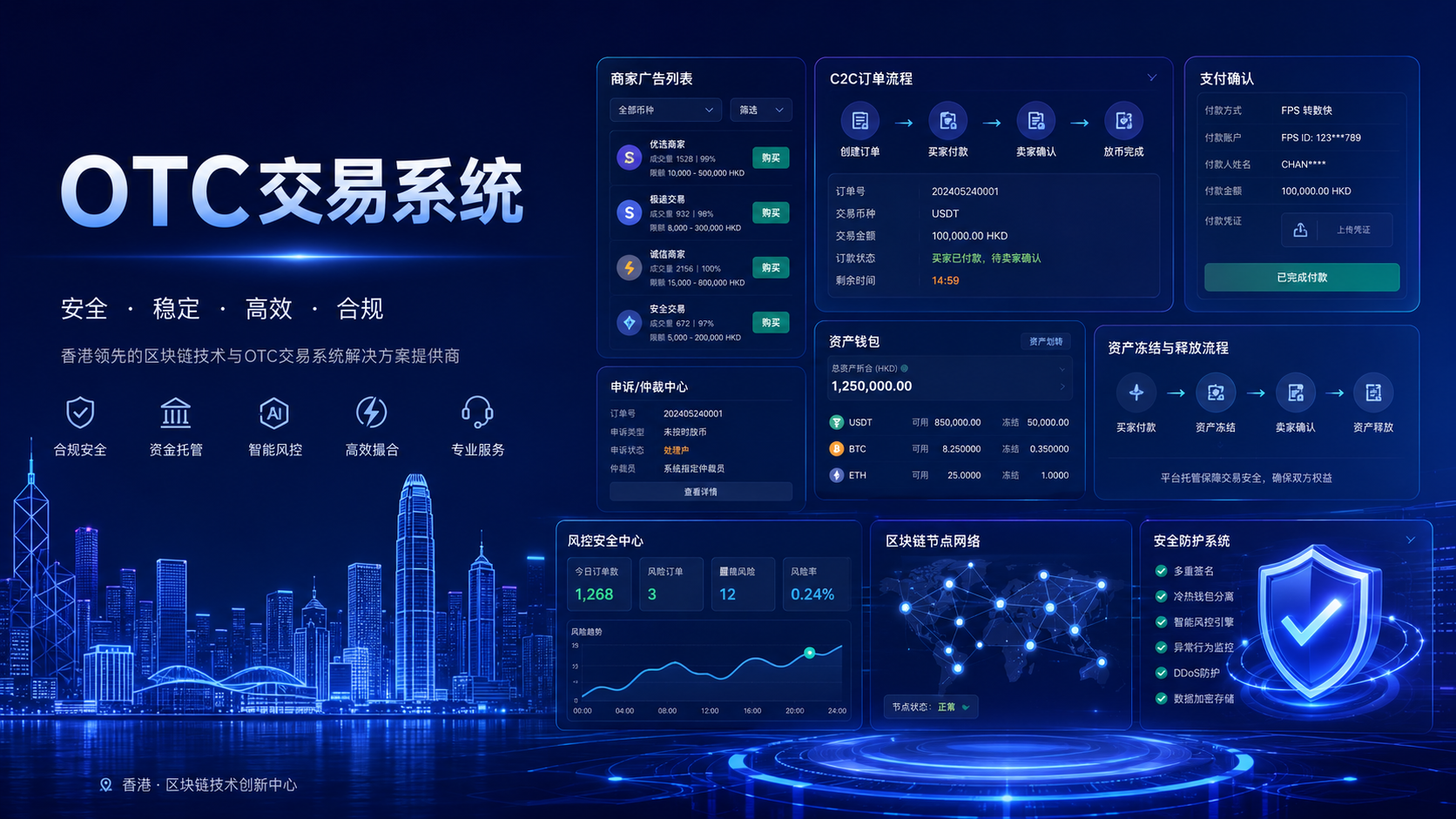
OTC Trading System Development: Enterprise-Grade Digital Asset P2P Exchange Platform Custom Solutions
HK DragonChain provides OTC trading system development, digital asset OTC/P2P exchange platform development, C2C trading systems, merchant trading systems, ad listing systems, order matching systems, fiat trading systems, trade escrow systems, dispute arbitration systems, merchant admin panels, wallet asset systems, risk control review systems, and enterprise-grade blockchain trading platform customization services. Based on project business models, trading workflows, merchant frameworks, asset management, security requirements, risk control rules, and long-term operational planning, we offer secure, stable, and scalable OTC trading system development solutions for digital asset platforms, exchange systems, Web3 projects, and blockchain financial applications.
What Is an OTC Trading System
An OTC trading system is a business system within digital asset trading platforms for over-the-counter trading, merchant quotes, order matching, payment confirmation, coin release processing, and dispute management. Unlike spot trading systems, OTC trading emphasizes order workflows, payment proofs, trade escrow, fund freezes, manual review, and risk control between users and merchants. Users can choose to buy or sell digital assets based on merchant advertisements, while the platform ensures orderly transaction processes through order systems, asset systems, and risk control admin.
A complete OTC trading system typically includes user-facing modules, merchant modules, ad systems, order systems, wallet systems, asset freeze modules, payment confirmation modules, dispute arbitration modules, merchant review modules, risk control admin, and operations admin. Each module is related to user experience and asset security. If the process design is unclear, issues such as order disputes, abnormal coin releases, inconsistent asset records, and low admin processing efficiency are likely to arise.
In the OTC trading system development process, HK DragonChain prioritizes trading workflows, asset freezes, merchant management, order statuses, payment proofs, dispute handling, admin permissions, and risk review. We don't just build a simple buy/sell page but construct a complete system architecture suitable for digital asset OTC trading, centered around long-term platform operational needs.
Which Projects Are Suitable for OTC Trading Systems
OTC trading systems are suitable for projects requiring digital asset OTC trading, merchant matching, fiat channels, user trade escrow, and platform-based order management. If an enterprise is planning a digital asset exchange, comprehensive trading platform, wallet trading platform, C2C trading platform, Web3 financial service platform, or enterprise-grade blockchain trading business, OTC trading systems can supplement more flexible trading scenarios.
Digital Asset Exchanges
Suitable for adding OTC trading entry points to exchange systems, supporting users in completing buy/sell orders, order confirmations, and asset transfers through merchant advertisements.
C2C Trading Platforms
Suitable for peer-to-peer trading scenarios between users and merchants, supporting ad publishing, price settings, order matching, payment confirmation, and dispute handling.
Merchant Trading Systems
Suitable for platforms establishing merchant frameworks, supporting merchant onboarding, collateral management, ad management, order statistics, trading limits, and merchant ratings.
Comprehensive Trading Platforms
Suitable for platforms simultaneously deploying OTC trading, spot trading, futures trading, wallet systems, and risk control admin, forming a more complete digital asset trading ecosystem.
HK DragonChain OTC Trading System Development Services
HK DragonChain provides complete OTC trading system development services, covering OTC trading workflow design, merchant system development, ad listing systems, order management systems, payment confirmation workflows, asset freeze and release mechanisms, wallet asset systems, dispute arbitration systems, risk control review admin, operations admin, and launch maintenance. We design OTC trading systems suitable for long-term operation based on client platform positioning and business processes.
1. OTC Trading Workflow Design
Before OTC trading system development, user buy/sell processes, merchant quotes, order workflows, payment confirmation, asset freezes, coin release rules, dispute conditions, and admin handling methods must be clarified. HK DragonChain maps complete trading workflows based on project business logic, ensuring clear correspondence between user-facing modules, merchant modules, and admin management.
2. Merchant Onboarding and Management System
The merchant system is an important component of OTC platforms. The system can support merchant applications, document reviews, collateral configuration, trading permissions, payment methods, ad quotas, order statistics, service statuses, and merchant ratings. Platforms can implement tiered merchant management through the admin panel, improving OTC trading service stability.
3. Ad Listing and Quoting System
OTC trading typically involves merchants publishing buy or sell ads, with users selecting trading counterparts based on price, limits, payment methods, and merchant reputation. The system can support ad publishing, price settings, dynamic quotes, trading limits, payment method configuration, listing/unlisting management, and ad sorting, making trading entry points clearer.
4. Order Workflow and Payment Confirmation
The OTC order system needs to accurately handle statuses such as pending, awaiting payment, paid, awaiting coin release, completed, canceled, and under dispute. After completing payment, users can upload proofs or confirm payment, and merchants complete coin release after review. The system needs to fully track order times, payment statuses, and operation records to reduce trade disputes.
5. Asset Freeze and Trade Escrow
To ensure transaction security, OTC systems typically need to freeze corresponding digital assets after order creation and release them to buyers after transaction completion. If orders are canceled or enter dispute workflows, the system needs to handle asset unfreezing, manual review, and exception records according to rules. Asset freeze and release logic must be accurate to avoid user asset status errors.
6. Dispute Arbitration and Risk Control Admin
OTC transactions may involve payment disputes, timeout coin release failures, unclear payment proofs, or user misoperations, so the system needs to provide dispute arbitration features. Admin personnel can view order records, payment proofs, chat logs, asset statuses, and operation logs, handling them according to platform rules. The risk control admin can also be used for abnormal order monitoring, merchant risk assessment, and user behavior analysis.
Core Functional Modules of OTC Trading Systems
A mature OTC trading system needs to balance user trading experience, merchant operations, asset security, order statuses, and platform risk control. HK DragonChain performs modular development based on actual project requirements, ensuring clear system structure, stable features, and convenient future maintenance and expansion.
- User System: Supports registration/login, identity verification, account security, fund passwords, transaction records, payment methods, and security settings.
- Merchant System: Supports merchant applications, merchant reviews, collateral management, ad management, transaction statistics, merchant ratings, and permission configuration.
- Ad System: Supports buy ads, sell ads, price settings, dynamic quotes, trading limits, payment methods, and listing/unlisting management.
- Order System: Supports order placement, payment confirmation, coin release confirmation, order cancellation, timeout handling, status tracking, and historical order queries.
- Asset System: Supports asset freezes, asset releases, balance management, fund flows, trade escrow, and abnormal asset handling.
- Payment Proofs: Supports payment descriptions, proof uploads, proof viewing, payment countdowns, receiving accounts, and order notes.
- Dispute Arbitration: Supports user disputes, merchant disputes, customer service intervention, proof review, order adjudication, and handling records.
- Risk Control Admin: Supports abnormal order monitoring, merchant risk management, user behavior records, withdrawal reviews, permission management, and operation logs.
- Operations Admin: Supports token configuration, trading parameters, fee settings, announcement management, data analytics, merchant management, and system configuration.
OTC Trading System Development Process
OTC trading systems involve user trading, merchant ads, order workflows, asset freezes, dispute handling, and admin risk control, requiring systematic planning. HK DragonChain adopts a standardized process to help clients progressively complete platform construction from requirements analysis to official launch.
Requirements Gathering
Clarify platform type, trading modes, supported tokens, merchant frameworks, order workflows, payment methods, risk control requirements, and launch plans.
Solution Planning
Plan OTC system architecture, merchant rules, ad rules, order statuses, asset freezes, dispute workflows, and admin management modules.
Interface Design
Design OTC homepages, ad lists, order placement pages, order detail pages, merchant centers, user centers, and admin panel interfaces.
System Development
Develop user-facing modules, merchant modules, ad systems, order systems, asset systems, dispute systems, risk control admin, and operations admin.
Testing & Acceptance
Conduct order placement testing, payment workflow testing, coin release testing, asset freeze testing, dispute testing, permission testing, and exception flow testing.
Launch & Maintenance
Complete server deployment, environment configuration, data monitoring, security hardening, feature upgrades, system optimization, and long-term technical support.
Differences Between OTC Trading Systems and Spot Trading Systems
Both OTC trading systems and spot trading systems are important modules of digital asset trading platforms, but they differ in trading methods and operational focuses. Spot trading relies primarily on order books and matching engines for spot trading, while OTC trading emphasizes merchant ads, user order placement, payment confirmation, trade escrow, and dispute handling.
| Comparison Item | OTC Trading System | Spot Trading System |
|---|---|---|
| Trading Method | Users place orders based on merchant ads, completing payment confirmation and coin release workflows | Users place limit/market orders through order books, automatically matched by matching engines |
| Core Modules | Merchant system, ad system, order workflows, asset freezes, and dispute arbitration | Matching engine, trading pairs, order book, market data/K-line, and asset ledger |
| Admin Focus | Merchant reviews, order disputes, payment proofs, trading limits, and risk control records | Trading pair configuration, fees, matching monitoring, market data, and asset flows |
| User Experience | Emphasizes trading workflows, payment instructions, merchant reputation, and order communication | Emphasizes price changes, order speed, order book depth, and execution efficiency |
| Applicable Scenarios | OTC trading, C2C trading, merchant trading, and fiat channels | Spot trading, trading pair markets, and platform token trading |
Key Considerations in OTC Trading System Development
The first consideration in OTC trading system development is order status and asset freeze rules. The platform needs to clarify how assets are frozen after order placement, how payment is confirmed, when merchants release coins, how timeout orders are canceled, and how assets are handled during disputes. Only with clear workflows can trade disputes and asset disagreements be minimized.
Second, merchant management and risk control review must be prioritized. OTC trading typically relies on merchants providing quotes and trading services, so the platform needs to establish merchant admission, collateral, ratings, trading limits, abnormal monitoring, and violation handling mechanisms. A sound merchant framework can improve user trust and reduce platform operational risks.
Additionally, OTC systems cannot neglect admin processing efficiency. Customer service or operations personnel need to quickly view order details, payment proofs, user records, merchant information, and asset statuses. HK DragonChain combines order systems, asset systems, and risk control admin in development to help platforms form complete OTC trading management closed loops.
Why Choose HK DragonChain
HK DragonChain specializes in blockchain development, OTC trading system development, exchange system development, spot trading systems, futures exchange development, exchange wallets, DApp development, smart contract development, NFT systems, DeFi systems, anti-counterfeit traceability, and digital copyright system customization. In OTC trading system development, we focus not only on complete user order pages but also on merchant frameworks, asset freezes, order workflows, dispute arbitration, admin risk control, and long-term operations.
For digital asset exchanges, we provide OTC modules, spot trading, futures trading, wallet systems, and admin management. For C2C trading platforms, we provide merchant onboarding, ad publishing, order processing, and dispute arbitration. For enterprise-grade trading platforms, we provide system architecture planning, API development, data analytics, and long-term operations support.
We insist on customizing OTC trading system solutions based on actual project business, avoiding unnecessary feature stacking. Clear trading workflows, stable asset freezes, secure wallet management, comprehensive dispute mechanisms, and controllable risk control admin are the keys to long-term stable OTC trading platform operation.
Related Blockchain Services
OTC trading systems are typically used in conjunction with exchange systems, spot trading systems, futures exchanges, exchange wallets, Web3 wallets, DApp development, smart contract development, DeFi system development, and public/mainnet chain development. If you are planning an OTC trading system, digital asset OTC/P2P exchange platform, C2C trading platform, or comprehensive blockchain trading platform, you can continue to explore HK DragonChain's blockchain development services. We will provide a more implementable OTC trading system development solution based on your project business processes.
OTC Trading System FAQs
Is merchant management always required for an OTC trading system?
If the platform adopts a merchant ad publishing and user order placement model, a merchant management system is typically required for merchant reviews, ad management, collateral configuration, transaction statistics, and risk control.
Can an OTC trading system be used together with a spot trading system?
Yes. The OTC trading system can serve as the OTC module of an exchange platform, together with spot trading, futures trading, wallet systems, and admin management to form a comprehensive trading platform.
How does an OTC trading system handle trade disputes?
The system can provide dispute arbitration features. Admin personnel can view order statuses, payment proofs, user records, merchant information, and asset freeze statuses, handling them according to platform rules.
Can more payment methods be added to an OTC trading system later?
Yes. As long as the initial architecture is properly planned, later expansions can include more payment methods, more tokens, more trading limit rules, and more merchant operational features.
Get an OTC Trading System Development Solution
If you are planning OTC trading system development, digital asset OTC/P2P exchange platforms, C2C trading systems, merchant trading systems, ad listing systems, dispute arbitration systems, exchange wallets, or comprehensive blockchain trading platforms, you are welcome to discuss your project requirements with HK DragonChain. We will provide a more implementable OTC trading system development solution based on your trading workflows, merchant frameworks, asset rules, risk control requirements, and launch plans.