
Contract Exchange Development
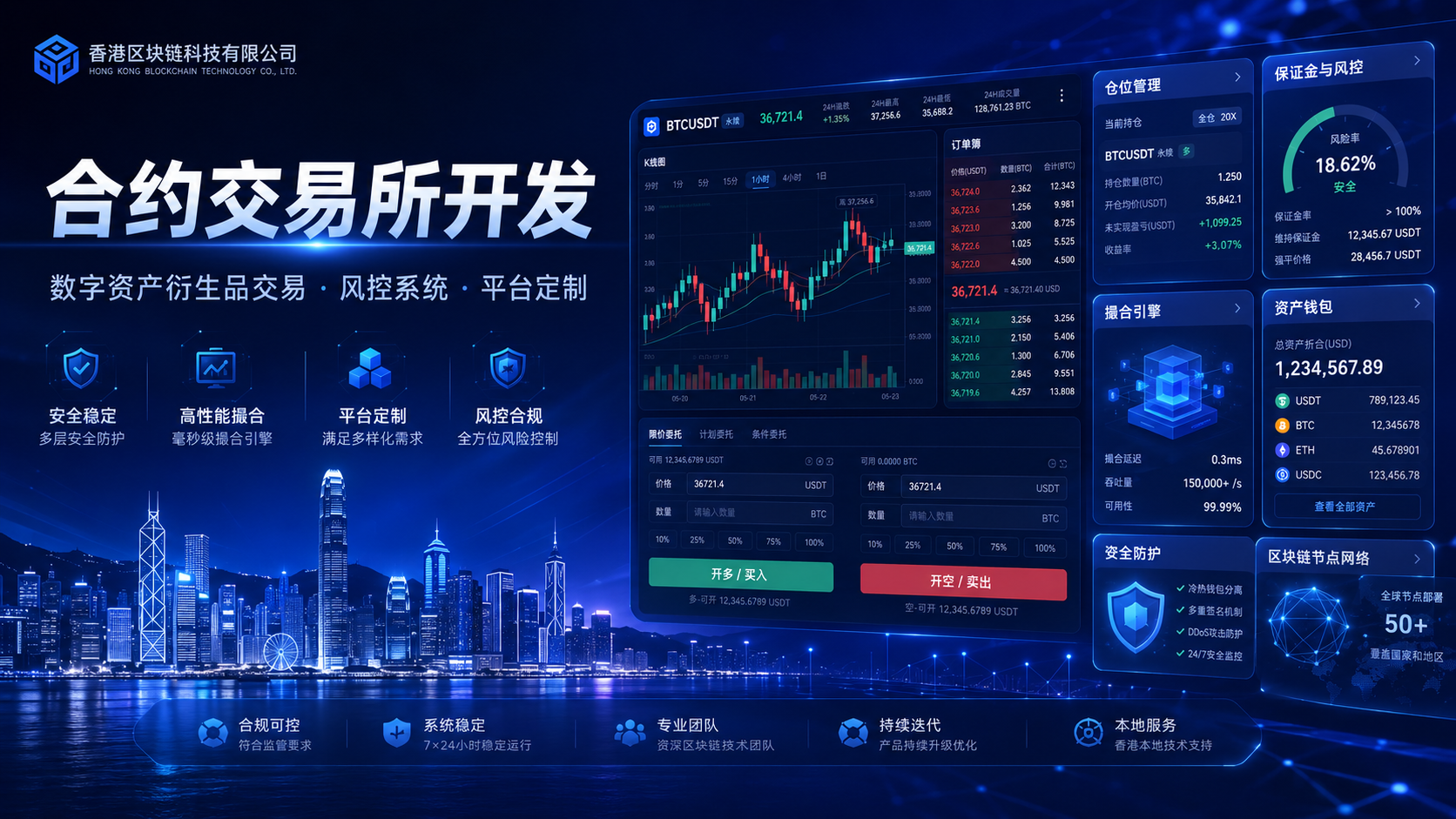
Futures Exchange Development: Enterprise-Grade Digital Asset Contract Trading Platform Custom Solutions
HK DragonChain provides futures exchange development, digital asset contract trading systems, perpetual contract trading platforms, USDT-margined contract systems, coin-margined contract systems, leveraged trading systems, matching engine systems, market data and K-line systems, contract risk control systems, position management systems, margin systems, liquidation systems, funding rate systems, exchange wallets, and admin management system customization services. Based on project trading models, product rules, matching performance, asset security, risk control strategies, and long-term operational planning, we offer secure, stable, and scalable futures exchange development solutions for digital asset platforms, Web3 projects, fintech enterprises, and blockchain trading scenarios.
What Is a Futures Exchange
A futures exchange is a platform system centered on digital asset contract trading, where users can participate in perpetual contracts, delivery contracts, USDT-margined contracts, coin-margined contracts, or other derivatives trading. Unlike ordinary spot trading, futures exchanges need to handle not only buy/sell orders but also complex logic such as margin, positions, leverage, profit/loss, liquidation, funding rates, risk limits, and real-time market data.
A complete futures exchange system typically includes user-facing trading pages, a matching engine, position system, margin system, risk control system, market data system, K-line system, funding rate module, wallet asset system, admin management system, and data monitoring modules. Each module is closely related to user assets, order statuses, and trading results, so the system architecture must be clear and data processing must be accurate.
In the futures exchange development process, HK DragonChain prioritizes matching efficiency, position calculation, margin rules, liquidation logic, market data stability, asset ledgers, admin permissions, and risk control strategies. We don't just provide trading pages but build a complete contract trading system from order matching to risk control, centered around long-term platform operational needs.
Which Projects Are Suitable for Futures Exchanges
Futures exchanges are suitable for platforms that need to provide digital asset derivatives trading, margin trading, leveraged trading, perpetual contract trading, or comprehensive trading services. If an enterprise is planning a digital asset exchange, contract trading platform, Web3 financial platform, trading service system, or multi-product trading ecosystem, a futures exchange system can build more complete trading business capabilities.
Perpetual Contract Platforms
Suitable for mainstream digital asset perpetual contract trading, supporting multiple trading pairs, leverage configuration, position management, funding rates, liquidation rules, and real-time profit/loss calculation.
USDT-Margined Contract Systems
Suitable for contract trading models using stablecoins as margin and settlement units, allowing users to more intuitively view margin, profit/loss, and account asset statuses.
Coin-Margined Contract Systems
Suitable for contract scenarios using corresponding tokens as margin and settlement assets, supporting different token contract rules, position calculations, and settlement logic.
Comprehensive Trading Platforms
Suitable for platforms simultaneously deploying spot trading, contract trading, OTC trading, wallet systems, and risk control admin, forming a complete digital asset trading ecosystem.
HK DragonChain Futures Exchange Development Services
HK DragonChain provides complete futures exchange development services, covering contract trading rule design, matching system development, position systems, margin systems, liquidation systems, market data and K-line systems, wallet asset systems, risk control admin, operations admin, user-facing trading pages, data analytics, and launch maintenance. We design contract trading platforms suitable for long-term operation based on client project positioning and operational strategies.
1. Contract Trading Rule Design
Before futures exchange development, trading product types, margin models, leverage ranges, position opening rules, position closing rules, fee rules, funding rates, risk limits, and liquidation logic must be clarified. HK DragonChain maps trading workflows based on platform business models, ensuring clear relationships between orders, positions, assets, and risk control.
2. Matching Engine System Development
The matching engine is one of the core modules of a futures exchange, responsible for processing user order placement, cancellations, order queues, execution generation, execution callbacks, and depth data updates. Contract trading has higher requirements for matching speed and data consistency, so the system needs to maintain accurate order statuses under high concurrency, avoiding execution delays and status anomalies.
3. Position and Margin System
A futures trading system needs to accurately handle position opening, position addition, position reduction, position closing, isolated margin, cross margin, margin adjustments, unrealized profit/loss, and realized profit/loss. The margin system needs to calculate user available balances, frozen amounts, risk ratios, and liquidation prices based on platform rules, allowing both users and admin to clearly view account risk statuses.
4. Liquidation and Risk Control System
The liquidation system is used to execute risk handling when user margin is insufficient or risk ratio triggers conditions. The system needs to combine mark prices, index prices, position quantities, margin balances, maintenance margin ratios, and risk limits for calculations. Reasonable liquidation rules can help platforms reduce systemic risks during extreme market conditions.
5. Market Data and K-Line Systems
Futures exchanges require stable market data and K-line systems, supporting real-time prices, bid/ask order books, trade records, depth charts, time-sharing charts, K-line periods, index prices, and mark price display. The market data system directly affects user trading decisions and risk control calculations, so data must be timely, accurate, and continuous.
6. Contract Trading Admin Management
The admin management system can be used to configure trading pairs, leverage multiples, fees, funding rates, risk parameters, token information, market data sources, user permissions, order records, position data, and exception monitoring. For long-term operational platforms, the admin panel is not only a management tool but also an important foundation for risk control, operations, and data analytics.
Core Functional Modules of Futures Exchanges
A mature futures exchange system needs to balance matching trading, position management, margin calculation, market data push, asset security, and risk control. HK DragonChain performs modular development based on actual project requirements, ensuring clear platform structure, stable features, and convenient future extensibility.
- Contract Trading: Supports perpetual contracts, USDT-margined contracts, coin-margined contracts, position opening, position closing, take-profit/stop-loss, and limit orders.
- Matching Engine: Supports limit orders, market orders, order queues, execution generation, cancellation processing, depth data, and high-concurrency matching.
- Position System: Supports isolated margin, cross margin, position details, position profit/loss, margin adjustments, position merging, and risk ratio calculation.
- Margin System: Supports available balances, frozen funds, maintenance margin, initial margin, risk limits, and liquidation price calculation.
- Liquidation System: Supports mark prices, liquidation triggers, risk handling, exception status recording, and liquidation process data tracking.
- Funding Rate: Supports funding rate configuration, settlement cycles, fee collection, fee distribution, and funding rate historical records.
- Market Data & K-Line: Supports real-time prices, K-line charts, depth charts, order book data, trade records, index prices, and mark prices.
- Wallet Assets: Supports deposits, withdrawals, asset transfers, fund flows, freezes/unfreezes, fee deductions, and account balance inquiries.
- Risk Control Admin: Supports abnormal transaction monitoring, withdrawal reviews, order monitoring, position monitoring, permission management, operation logs, and risk alerts.
Futures Exchange Development Process
Futures exchange systems involve matching trading, position calculation, asset ledgers, market data, and risk control, requiring systematic planning. HK DragonChain adopts a standardized project process to help clients progressively complete platform construction from requirements communication to launch and maintenance.
Requirements Gathering
Clarify platform type, contract products, supported tokens, margin models, leverage rules, risk control requirements, admin features, and launch plans.
Solution Planning
Plan trading architecture, matching services, position systems, margin rules, liquidation logic, market data solutions, and admin management modules.
Interface Design
Design contract trading pages, market data and K-line pages, position pages, asset pages, order pages, user centers, and admin panel interfaces.
System Development
Develop matching engines, contract trading systems, position systems, margin systems, market data systems, wallet systems, and risk control admin.
Testing & Acceptance
Conduct order testing, matching testing, profit/loss testing, liquidation testing, asset flow testing, concurrency testing, and exception flow testing.
Launch & Maintenance
Complete server deployment, environment configuration, market data integration, data monitoring, security hardening, feature upgrades, and long-term technical support.
Differences Between Futures Exchanges and Spot Trading Systems
Both futures exchanges and spot trading systems are digital asset trading platforms, but they differ significantly in trading rules, risk control, fund calculations, and admin management. Spot trading focuses on buying and selling spot assets, while contract trading needs to handle more complex rules such as margin, leverage, positions, liquidation, and funding rates.
| Comparison Item | Futures Exchange | Spot Trading System |
|---|---|---|
| Trading Mode | Based on margin, positions, leverage, and contract rules | Based on spot asset buying/selling and trading pair matching |
| Core Modules | Position system, margin system, liquidation system, funding rate, and risk control admin | Matching system, order book, trade records, asset balances, and market data system |
| Risk Focus | Liquidation prices, margin ratios, position risks, abnormal market data, and funding rates | Asset balances, order statuses, deposits/withdrawals, and matching accuracy |
| Admin Configuration | Leverage multiples, risk limits, liquidation rules, margin parameters, and funding rates | Trading pairs, fees, price precision, quantity precision, and trading statuses |
| Applicable Scenarios | Perpetual contracts, USDT-margined contracts, coin-margined contracts, and digital asset derivatives platforms | Spot trading, token exchanges, trading pair markets, and ordinary digital asset trading |
Key Considerations in Futures Exchange Development
The first consideration in futures exchange development is the accuracy of position and margin calculations. Every user position opening, closing, addition, reduction, and margin adjustment affects account risk and platform asset data. If calculation rules are unclear, the system is prone to position anomalies or asset disputes during market fluctuations.
Second, liquidation rules and risk control mechanisms must be prioritized. Contract trading is a high-risk trading mode, so the system needs clear risk ratio calculation, liquidation price calculation, risk limits, abnormal market handling, and admin monitoring capabilities. For platform operators, the risk control admin must be able to promptly detect abnormal orders, abnormal positions, and abnormal fund changes.
Additionally, market data and matching performance are critical. Contract trading users are more sensitive to price changes and order feedback, so the system needs stable market data pushes, continuous K-lines, fast matching, and accurate order statuses. HK DragonChain combines matching systems, market data systems, position systems, and risk control admin in development to help projects build complete contract trading closed loops.
Why Choose HK DragonChain
HK DragonChain specializes in blockchain development, futures exchange development, exchange system development, spot trading systems, OTC trading systems, exchange wallets, DApp development, smart contract development, NFT systems, DeFi systems, anti-counterfeit traceability, and digital copyright system customization. In futures exchange development, we focus not only on complete trading pages but also on matching architecture, position calculation, margin rules, liquidation logic, asset ledgers, and risk control admin.
For perpetual contract platforms, we provide contract trading pages, matching engines, position systems, liquidation systems, and funding rate modules. For comprehensive trading platforms, we combine spot trading, OTC trading, wallet systems, and admin risk control. For enterprise-grade digital asset platforms, we provide trading architecture planning, API development, data analytics, and long-term maintenance support.
We insist on customizing futures exchange solutions based on actual project business, avoiding unnecessary feature stacking. Clear trading rules, stable matching engines, accurate position systems, secure wallet assets, and comprehensive risk control admin are the keys to long-term stable futures exchange operation.
Related Blockchain Services
Futures exchanges are typically used in conjunction with exchange systems, spot trading systems, OTC trading systems, exchange wallets, Web3 wallets, DApp development, smart contract development, DeFi system development, and public/mainnet chain development. If you are planning a futures exchange, perpetual contract platform, digital asset derivatives system, or comprehensive blockchain trading platform, you can continue to explore HK DragonChain's blockchain development services. We will provide a more implementable futures exchange development solution based on your project business processes.
Futures Exchange FAQs
Is a futures exchange the same as an ordinary exchange system?
Not exactly. Ordinary exchange systems primarily handle spot matching, orders, and asset balances, while futures exchanges also need to handle margin, positions, profit/loss, liquidation, funding rates, and risk parameters.
Can a futures exchange support both USDT-margined and coin-margined contracts?
Yes. The system can support USDT-margined contracts, coin-margined contracts, perpetual contracts, and more trading rules based on project requirements, but different modes need separate margin and settlement logic design.
Does a futures exchange require an independent risk control admin?
An independent risk control admin is recommended for monitoring position risks, abnormal orders, asset changes, liquidation records, user behavior, and admin operation logs.
Can spot and OTC trading be added to a futures exchange later?
Yes. As long as the initial architecture is properly planned, later expansions can include spot trading, OTC trading, wallet systems, wealth management modules, DeFi modules, and more operational features.
Get a Futures Exchange Development Solution
If you are planning futures exchange development, perpetual contract trading platforms, USDT-margined contract systems, coin-margined contract systems, digital asset derivatives trading platforms, matching engine systems, exchange wallets, or enterprise-grade blockchain trading platforms, you are welcome to discuss your project requirements with HK DragonChain. We will provide a more implementable futures exchange development solution based on your trading modes, margin rules, risk control requirements, admin features, and launch plans.