NFT System Development Process
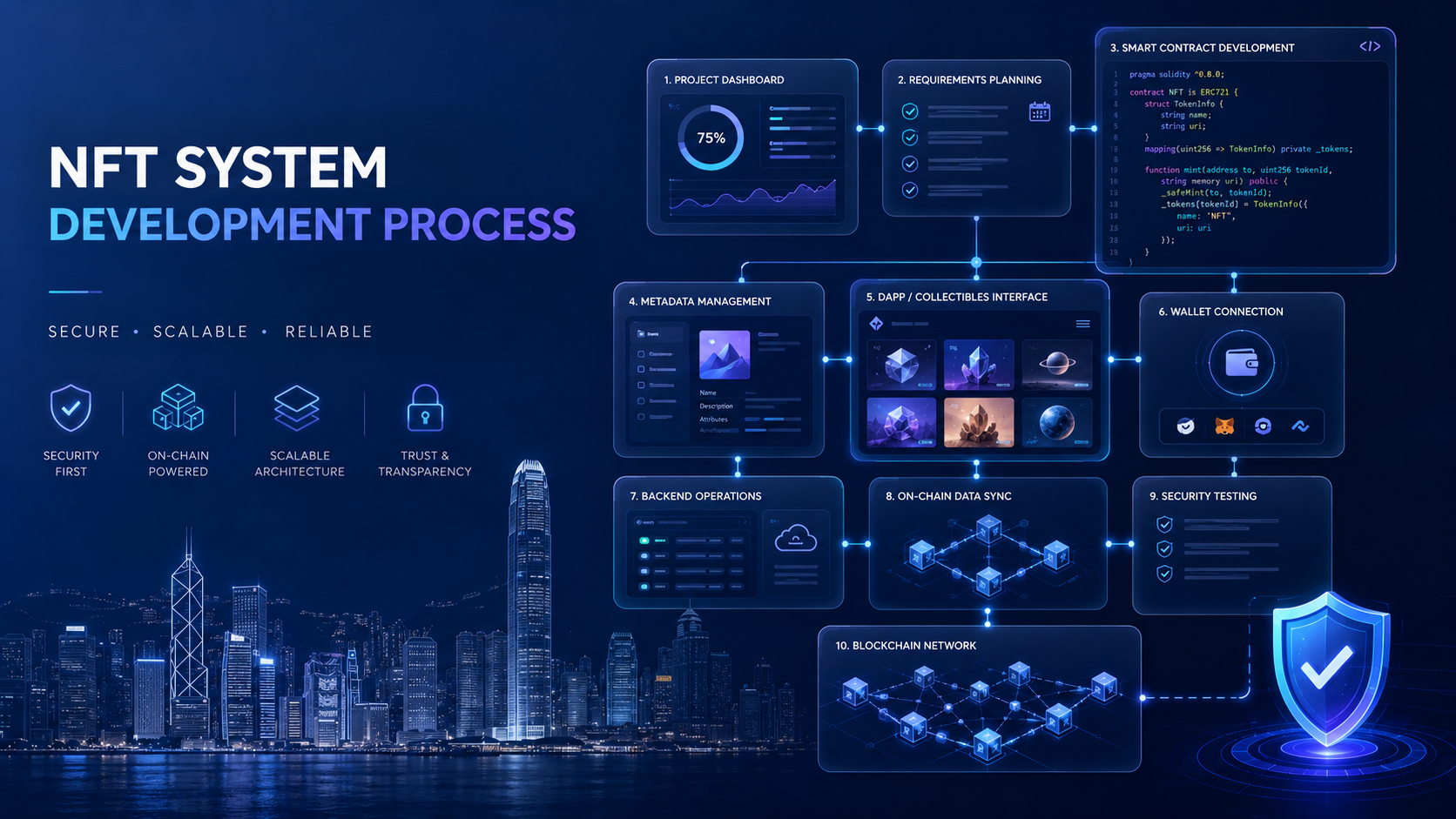
NFT System Development Process: Technical Implementation from Planning to Launch & Operations
NFT system development is not simply about creating a digital collectible display page. It requires establishing a complete technical process around digital asset rules, smart contracts, wallet connections, DApp interactions, metadata management, admin operations, on-chain data synchronization, and security testing. Based on enterprise project types, asset issuance methods, contract rules, supported chains, user interactions, and long-term operational requirements, HK DragonChain provides clients with integrated implementation solutions covering NFT system development process planning, NFT platform technical architecture, NFT contract development, NFT marketplace systems, digital collectible systems, wallet connections, and admin management.
Why NFT System Development Requires a Clear Process
NFT systems are typical blockchain application projects. They include both the user-facing modules, admin panels, databases, order systems, and file management found in ordinary internet platforms, as well as technical modules such as smart contracts, wallet signatures, on-chain assets, metadata, transaction hashes, on-chain events, and blockchain node interfaces. If the project process is unclear, later stages often encounter issues such as unadjustable contract rules, unsynchronized collectible data, failed wallet interactions, inoperable admin panels, and abnormal user asset display.
A mature NFT system requires confirmation before development of what assets the NFTs represent, whether transfers are allowed, whether marketplace trading is needed, whether blind boxes are supported, whether whitelists are required, whether airdrops are needed, whether copyright credentials are bound, whether wallet integration is required, whether multi-chain support is needed, and whether admin review and data analytics are required. Only when these rules are clarified early can subsequent smart contract development, DApp page design, and admin system construction be more stable.
In the NFT system development process, HK DragonChain starts with business rules and technical architecture, then proceeds to contract development, page design, API development, on-chain integration, testing and acceptance, and launch and maintenance. This approach helps project parties reduce repetitive modification costs and makes NFT systems more suitable for long-term operations.
What Requirements Should Be Clarified Before NFT System Development
Before NFT system development, project parties need to clarify their business positioning. NFT rules differ across project types. Digital collectible platforms, NFT marketplaces, on-chain copyright systems, membership benefit platforms, gaming asset platforms, and brand activity platforms all have distinct differences in asset structure, user workflows, and admin management.
Asset Types
Clarify whether NFTs represent images, videos, music, digital certificates, membership cards, game items, copyright credentials, or brand benefits. Different asset types affect metadata structure and display methods.
Issuance Rules
Clarify whether NFTs are limited issuance, batch issuance, user minting, admin minting, event claims, airdrop distribution, or whitelist priority purchases.
On-Chain Interactions
Clarify whether wallet connections, signature authorizations, on-chain minting, on-chain transfers, contract queries, asset verification, and transaction record display are needed.
Admin Operations
Clarify whether the admin panel needs to manage collectible series, orders, users, activities, whitelists, airdrop tasks, contract addresses, and on-chain data.
NFT System Development Technical Process
NFT system development can typically be divided into several stages: requirements analysis, architecture design, contract development, metadata design, DApp development, wallet integration, admin development, testing and acceptance, and launch and operations. Each stage needs to be designed around real business rules, not just surface-level features.
1. Requirements Analysis and Business Rule Confirmation
The first step in NFT system development is requirements analysis. Project parties need to clarify which users the system targets, how NFT assets are generated, how users obtain NFTs, how the platform manages NFTs, whether NFTs can be transferred, whether purchase workflows are needed, whether blind box mechanics are supported, whether whitelist eligibility is required, whether on-chain copyright credentials are needed, and whether more series and more activities will be added later.
HK DragonChain organizes user-facing workflows, admin workflows, on-chain workflows, and exception workflows based on client business scenarios. For example, digital collectible systems require confirmation of collectible issuance, purchase, viewing, and claiming workflows. NFT marketplace systems require confirmation of product listing, order payment, asset distribution, and inventory management. On-chain copyright systems require confirmation of work upload, hash attestation, copyright certificates, and NFT association rules.
2. NFT System Architecture Design
Architecture design determines whether the NFT system will remain stable later. A complete NFT system typically includes user front-ends, DApp interaction layers, smart contract layers, wallet connection modules, admin management systems, metadata services, on-chain data synchronization services, databases, and file storage systems. Clear boundaries between different modules are needed to avoid system chaos during later feature expansion.
In the technical architecture phase, supported chains, contract standards, wallet integration methods, API structures, admin permissions, file storage methods, on-chain event listening solutions, and security strategies need to be confirmed. If the project may later expand to multiple chains, multiple series, multiple platform entry points, or more digital asset types, the initial architecture needs to reserve expansion space.
3. NFT Smart Contract Development
The NFT smart contract is one of the core modules of the system, responsible for defining NFT asset IDs, holders, minting rules, transfer rules, authorization rules, metadata URIs, royalty rules, and permission boundaries. Common NFT contracts can reference ERC-721, ERC-1155, or similar asset standards, customized based on project requirements.
Before contract development, it is necessary to clarify who controls minting permissions, whether users can mint independently, whether batch minting is allowed, whether burning is supported, whether pause mechanisms are needed, whether whitelist verification is required, whether royalty splits are needed, whether blind box random distribution is supported, and whether later upgrades are needed. Contract functions involving asset changes require focus on permission validation, state checks, parameter restrictions, and event logging.
4. Metadata and Digital Asset Content Design
NFTs are not just on-chain IDs. They also need to associate with metadata such as images, videos, names, descriptions, attributes, series, rarity, copyright statements, and external resource URIs. Improper metadata structure design can affect NFT display, asset queries, on-chain verification, and later maintenance.
When developing NFT systems, enterprises need to plan metadata fields, resource storage methods, image compression strategies, file access rules, and update mechanisms in advance. For digital copyright, digital collectible, and gaming asset projects, the correspondence between work information, copyright credentials, asset attributes, and user display pages also needs to be considered.
5. DApp Front-End and User Interaction Development
The user-facing side of NFT systems typically needs to include homepages, collectible lists, collectible details, wallet connections, purchase pages, minting pages, user asset centers, activity pages, and benefit description pages. The DApp front-end needs to help users clearly understand each step, such as connecting wallets, signing authorizations, confirming transactions, waiting for on-chain confirmations, and viewing asset results.
For ordinary users, wallet signatures, transaction hashes, and on-chain confirmations may be unfamiliar, so pages must have clear prompts. HK DragonChain prioritizes optimizing user operation paths in DApp development, helping users understand what operation they are performing, whether asset changes are involved, whether the transaction is successful, and what the failure reason is.
6. Wallet Connection and On-Chain Interaction Integration
NFT systems typically need to integrate wallet connection features, supporting users through wallet login, signatures, authorizations, minting, purchases, asset viewing, and on-chain transaction confirmations. The wallet connection module needs to handle network identification, address reading, signature confirmation, transaction submission, status returns, and exception prompts.
The integration phase requires focus on testing whether wallet connections are stable, whether users are prompted after network switching, whether transaction failures return reasons, whether the front-end synchronizes status after on-chain confirmations, and whether the admin panel can record transaction hashes and NFT IDs. Only when wallet, contract, front-end, and admin data remain consistent can the NFT system operate stably.
7. NFT Admin Management System Development
Enterprise-grade NFT systems must include admin management. The admin panel is not just for uploading collectibles but also for managing contract addresses, collectible series, issuance activities, order records, user assets, whitelist lists, airdrop tasks, blind box inventory, metadata, on-chain events, and system parameters.
Admin permissions are also very important. Different roles should have different operation scopes. For example, operations personnel can configure activities, finance personnel can view orders, technical personnel can manage contract parameters, and super administrators can configure critical system settings. Operations involving assets, contracts, and user data should all record operation logs.
8. On-Chain Data Synchronization and Asset Display
After NFT system launch, on-chain data needs to be continuously synchronized. The system needs to listen for on-chain events such as NFT minting, transfers, authorizations, burning, purchases, and claims, and synchronize corresponding data to the platform database for front-end display and admin management.
If on-chain data and platform data are not synchronized, users may see missing assets, incorrect statuses, or inconsistent transaction results. Therefore, on-chain event listening, failure retry, data validation, and status callback mechanisms are critical. HK DragonChain designs on-chain data synchronization solutions based on project requirements, ensuring more accurate user asset statuses.
9. Security Testing and Launch Acceptance
Before NFT system launch, complete testing is required. Testing content includes contract testing, wallet testing, minting testing, purchase testing, transfer testing, whitelist testing, airdrop testing, blind box testing, order testing, admin permission testing, and exception flow testing. Functions involving assets and transactions must be repeatedly verified.
Security testing focuses not only on contract vulnerabilities but also on admin permissions, API security, data validation, duplicate submission, inventory over-issuance, order exceptions, file access, and wallet authorization prompts. Before launch, multiple rounds of simulation operations should be completed in the test environment to confirm system logic stability before deploying to the production environment.
10. Launch Deployment and Post-Launch Operations
NFT system official launch requires completion of server deployment, database configuration, API deployment, contract deployment, domain configuration, admin initialization, wallet configuration, on-chain parameter configuration, and security hardening. After launch, interface statuses, on-chain events, order data, user feedback, and system logs need continuous monitoring.
In the post-launch operations phase, project parties may need to add new NFT series, add new activity mechanics, expand blind boxes, integrate more wallets, add more chains, optimize admin reports, or upgrade contract modules. Therefore, the initial system structure must have extensibility capabilities and cannot only satisfy a one-time launch.
NFT System Development Process Overview
To help project parties better understand the NFT system development rhythm, the following process can be followed. Different project timelines will be adjusted based on feature complexity, supported chains, contract quantity, and launch requirements.
Requirements Planning
Clarify NFT asset types, issuance rules, user workflows, wallet needs, admin features, chain selection, and launch goals.
Architecture Design
Plan NFT contracts, DApp front-ends, admin management, metadata services, on-chain synchronization, and overall API system architecture.
Contract Development
Develop smart contract features for NFT minting, transfers, authorizations, airdrops, whitelists, blind boxes, royalties, and permission management.
System Development
Develop NFT platform front-ends, wallet connections, marketplace orders, user asset centers, admin management, and data synchronization modules.
Testing & Acceptance
Conduct contract testing, wallet testing, minting testing, order testing, admin testing, and on-chain data synchronization testing.
Launch & Operations
Complete official deployment, contract configuration, data monitoring, security maintenance, activity configuration, and subsequent version upgrades.
Technical Focus Points in NFT System Development
The most easily overlooked aspect in NFT system development is the relationship between contract rules and admin operations. Many projects only focus on whether NFTs can be minted without considering whether issuance quantities, inventory management, order statuses, asset distribution, on-chain confirmations, and admin queries remain consistent. A truly operable NFT system requires a stable closed loop between on-chain and off-chain systems.
| Technical Module | Key Content | Development Considerations |
|---|---|---|
| NFT Contract | Minting, transfers, authorizations, burning, metadata, permission controls | Confirm contract rules in advance to avoid frequent modifications after launch |
| Metadata Service | Images, videos, attributes, IDs, copyright statements, resource URIs | Ensure metadata structure stability to avoid affecting asset display and queries |
| Wallet Connection | Login signatures, transaction authorizations, network switching, status returns | Interaction prompts must be clear to reduce user errors |
| Admin Management | Collectible management, activity configuration, order records, user assets, airdrop tasks | Permission grading and operation logs must be comprehensive |
| On-Chain Sync | Minting events, transfer events, transaction hashes, asset statuses | Failure retry and data validation mechanisms need to be designed |
Development Differences Across Different NFT System Types
NFT systems are not a single product. Different business scenarios require different development focuses. Before starting, project parties should choose appropriate features based on their positioning, avoiding feature stacking that leads to system complexity but operational difficulty.
- Digital Collectible Systems: Focus on collectible issuance, serial number management, user holdings, event claims, on-chain credentials, and admin operations.
- NFT Marketplace Systems: Focus on product display, purchase orders, inventory management, asset distribution, payment workflows, and user asset centers.
- NFT Copyright Systems: Focus on work registration, hash attestation, copyright certificates, authorization records, and NFT copyright credential association.
- NFT Membership Systems: Focus on membership identities, benefit credentials, store verification, activity eligibility, and user tier systems.
- Gaming NFT Systems: Focus on item attributes, character assets, transfer rules, game interfaces, and cross-scenario asset usage.
- Brand NFT Platforms: Focus on brand display, limited activities, user operations, airdrop rewards, and long-term benefit accumulation.
Key Considerations in NFT System Development
First, attention must be paid to whether NFT contract rules are consistent with business operations. If the issuance quantity set in the admin panel does not match contract limits, or if order statuses are not synchronized with on-chain minting statuses, asset distribution anomalies are likely after launch. Therefore, contract rules, order rules, and admin rules must be unified before development.
Second, metadata stability must be prioritized. NFT display depends on metadata. If image URIs, attribute fields, or resource links change frequently, it will affect user asset viewing and platform later maintenance. Enterprise projects should plan resource storage methods and metadata update strategies in advance.
Additionally, wallet interactions and user prompts need attention. When NFT systems involve signature authorizations, transaction confirmations, and on-chain gas fees, pages must clearly inform users of the current operation content. For users unfamiliar with Web3, good prompts and guidance can significantly lower the barrier to entry.
Finally, admin operation capabilities cannot be overlooked. After NFT project launch, new series, new activities, new benefits, and new tasks typically need continuous issuance. If the admin panel cannot quickly configure activities, view data, and handle exceptions, project operations will be constrained.
Why Choose HK DragonChain
HK DragonChain specializes in blockchain development, NFT system development, NFT platform development, NFT marketplace systems, digital collectible systems, NFT contract development, DApp development, smart contract development, Web3 wallets, decentralized wallets, on-chain copyright attestation, and enterprise-grade blockchain application customization. In NFT system development, we focus not only on page effects but also on contract rules, on-chain data, wallet interactions, admin operations, and long-term maintenance.
For digital collectible projects, HK DragonChain provides collectible issuance, serial number management, user assets, and admin management. For NFT marketplace projects, we provide product display, order workflows, asset distribution, and wallet connections. For on-chain copyright projects, we provide work attestation, copyright certificates, and NFT copyright credentials. For brand membership projects, we provide NFT membership cards, benefit verification, and activity task features.
A stable NFT system requires clear requirements planning, secure smart contracts, reliable wallet interactions, accurate on-chain data synchronization, and a sustainably operable admin system. HK DragonChain customizes development processes based on client actual business, helping enterprises complete NFT system implementation more reliably.
Related Services
NFT system development processes typically involve multiple service directions including NFT platform development, NFT marketplace systems, digital collectible systems, NFT contract development, on-chain copyright attestation, DApp development, smart contract development, Web3 wallets, and blockchain application development. If you are planning an NFT system, you can continue to explore HK DragonChain's blockchain development services. We will provide a more implementable NFT system development solution based on your asset types, contract rules, user workflows, and launch plans.
NFT System Development Process FAQs
What should be prepared before NFT system development?
It is recommended to prepare project positioning, NFT asset types, issuance rules, user workflows, whether a wallet is needed, whether a marketplace is needed, whether an admin panel is needed, and launch plans.
Is a smart contract always required for an NFT system?
If the project requires on-chain minting, holder records, transfers, authorizations, or asset credentials, smart contracts are typically needed. If it is only a display page, going on-chain can be decided based on actual requirements.
Can blind boxes and airdrops be added to an NFT system later?
Yes. As long as the initial architecture is properly planned, later expansions can include blind boxes, airdrops, whitelists, membership benefits, copyright credentials, and more activity features.
Does an NFT system require maintenance after launch?
Yes. Post-launch maintenance is needed for on-chain data synchronization, wallet adaptations, admin configuration, server security, user feedback, and subsequent feature upgrades.
Get an NFT System Development Process Solution
If you are planning NFT system development, NFT platform development, NFT marketplace systems, digital collectible systems, NFT contract development, on-chain copyright attestation, or enterprise-grade Web3 digital asset platforms, you are welcome to discuss your project requirements with HK DragonChain. We will provide a complete NFT system development process solution from requirements planning to launch and operations based on your asset types, issuance rules, supported chains, security requirements, and launch plans.