
Blockchain Development Process
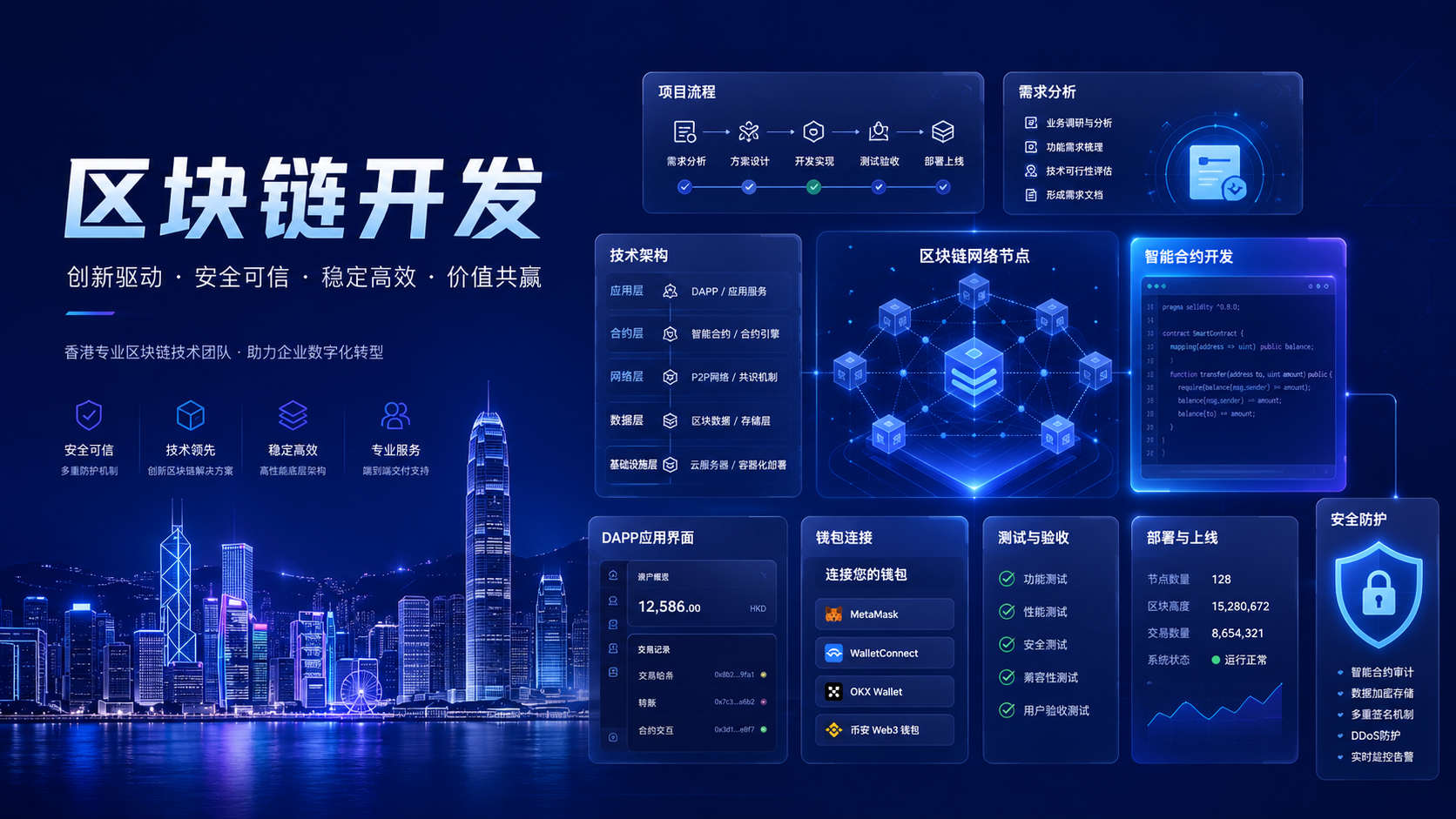
Blockchain Development Project Process: A Complete Implementation Plan from Requirements Analysis to System Launch
A blockchain development project usually involves multiple stages, including business model planning, on-chain architecture, smart contracts, wallet systems, DAPP applications, backend management, data synchronization, security testing, launch, and ongoing maintenance. Based on the project type, business scenario, supported chains, asset rules, security requirements, and operation plan, Hong Kong Longlian provides enterprises with a standardized, practical, and scalable blockchain development project process, helping businesses move step by step from early-stage requirement analysis to long-term system operation and maintenance.
Why Blockchain Development Requires a Complete Project Process
Blockchain development is different from ordinary website development or traditional management system development. A conventional system usually focuses on pages, backend functions, databases, and APIs, while a blockchain project also needs to consider on-chain data, smart contracts, wallet signatures, asset circulation, transaction confirmation, node interfaces, on-chain events, and security permissions. If the project process is unclear, problems such as inconsistent business rules, difficult contract modification, unstable wallet interaction, unsynchronized asset data, and high system maintenance costs may appear later.
A mature blockchain project needs to define business goals, user roles, the scope of data to be recorded on-chain, asset types, contract rules, backend permissions, interface methods, and launch environments before formal development begins. This is especially important for DAPP development, smart contract development, NFT systems, DeFi systems, wallet systems, exchange systems, and anti-counterfeiting traceability systems. The clearer the project process is, the higher the development efficiency will be, and the lower the later operational risk will be.
In blockchain development projects, Hong Kong Longlian usually does not enter code development directly. Instead, we first establish a complete project framework through requirement communication, solution planning, prototype design, technical architecture, contract rules, security strategies, and launch planning. This allows clients to clearly understand the system structure before development and helps the technical team maintain a consistent direction throughout the development process.
Which Scenarios Are Suitable for Blockchain Development Projects
Blockchain development projects can be applied to digital asset management, enterprise on-chain business, copyright proof, product traceability, wallet systems, DAPP applications, NFT platforms, DeFi systems, exchange systems, and multi-party collaboration platforms. Different projects have different business priorities, so the development process should also be adjusted according to actual needs.
DAPP Application Development
Suitable for on-chain tools, Web3 platforms, membership benefits, activity tasks, on-chain points, and user wallet interaction scenarios. It requires planning front-end pages, contract calls, and wallet signature processes.
Smart Contract Systems
Suitable for asset issuance, NFT minting, DeFi staking, revenue-sharing rules, on-chain voting, and automated business execution. The focus is on designing contract rules and security boundaries.
Wallet and Asset Systems
Suitable for multi-currency wallets, exchange wallets, Web3 wallets, and enterprise asset accounts. It requires planning deposit monitoring, withdrawal review, asset records, and hot and cold wallet strategies.
Enterprise On-Chain Platforms
Suitable for anti-counterfeiting traceability, digital copyright, supply chain collaboration, on-chain certificates, and data proof. It needs to combine backend management, user queries, and on-chain credential display.
Hong Kong Longlian Blockchain Development Project Process
Hong Kong Longlian divides blockchain development projects into several stages: requirement analysis, solution planning, prototype design, technical architecture, system development, testing and acceptance, launch deployment, and post-launch maintenance. Each stage has clear work objectives to ensure that the project maintains a clear path from concept to implementation.
1. Project Requirement Communication
Before the project starts, the first step is to clarify what problem the client wants to solve. A blockchain system should not be built simply for the sake of “putting data on-chain”; it must serve real business needs. Hong Kong Longlian communicates with clients about the project type, target users, business process, asset type, whether a wallet is required, whether smart contracts are required, whether backend management is required, whether multi-chain support is needed, and how the system will be operated after launch.
At this stage, the focus is not on technical details but on clarifying the business logic. For example, an anti-counterfeiting traceability project needs to define product batches, circulation nodes, and QR code query processes; an NFT platform needs to define asset types, issuance rules, and user purchase processes; an exchange system needs to define trading models, wallet architecture, and risk control rules; and a DAPP project needs to define how users connect wallets, sign transactions, and call contracts.
2. Business Process Sorting
After requirement communication is completed, the business needs to be divided into clear processes, including user-side processes, backend processes, on-chain processes, fund processes, data processes, and exception handling processes. Only when the process is clear can page design, API development, contract writing, and testing acceptance have a reliable basis.
For example, an on-chain points project needs to define how points are issued, how users receive them, whether points can be transferred, how points are consumed, whether the backend can make adjustments, and whether key changes are recorded on-chain. A wallet system needs to define how deposits are credited, how withdrawals are reviewed, how handling fees are calculated, how asset records are stored, and how abnormal transactions are handled.
3. Technical Solution Planning
Technical solution planning is an important stage in a blockchain development project. Based on business requirements, Hong Kong Longlian determines whether the system should use a public chain, consortium chain, private chain, or multi-chain architecture; whether smart contracts are required; whether node services are needed; whether a block explorer is needed; whether third-party wallets should be integrated; whether a self-owned wallet should be developed; and whether backend risk control and data statistics are required.
The technical solution also defines the boundaries between system modules, such as the user side, management backend, contract layer, wallet service, on-chain data service, API service, database, message notification, and security modules. For long-term operation projects, the technical architecture needs to reserve scalability, avoiding the need to rebuild the entire system when new functions are added later.
4. Product Prototype and Page Design
Blockchain projects also require a good product experience. Users may not be familiar with wallets, signatures, transaction hashes, on-chain confirmations, and contract authorization, so page design must make the operation process clear and easy to understand. Hong Kong Longlian designs user-side pages, DAPP pages, wallet pages, backend pages, data dashboards, and mobile adaptation effects based on project requirements.
Page design should not only be visually appealing but also consistent with business logic. For example, a wallet authorization page should clearly tell users what they are authorizing; an NFT detail page should display the contract address, collection number, and holder information; a traceability query page should display the product source and on-chain certificate; and a backend management page should allow operation staff to quickly find data, review, and configuration entries.
5. Smart Contract Design and Development
If a project involves on-chain assets, NFTs, DeFi, points, revenue sharing, voting, authorization, or automated execution rules, smart contracts need to be developed. Before smart contract development begins, contract functions, permission mechanisms, asset rules, event records, exception handling, and whether upgrade capability is required should be confirmed first.
In smart contract development, Hong Kong Longlian focuses on security boundaries and business consistency. Functions involving asset changes must clearly define permissions, parameter validation, status judgment, and event records. After contract development is completed, multiple rounds of testing are required in the test environment to verify normal processes, abnormal processes, and boundary conditions.
6. Front-End DAPP and Backend System Development
Smart contracts are only one part of a blockchain system. The systems that truly face users and operation staff also include the DAPP front end, management backend, and API services. The DAPP front end is responsible for wallet connection, signature authorization, transaction submission, on-chain data viewing, and business operations; the backend system is responsible for parameter configuration, user management, data review, report viewing, and exception handling.
Backend functions vary from project to project. A wallet system requires asset records, withdrawal review, and address management; an NFT system requires collection management, issuance activities, and order records; an anti-counterfeiting traceability system requires product codes, batches, and scan data; and an exchange system requires orders, trading pairs, wallets, risk control, and user management. Hong Kong Longlian customizes backend functions according to project business needs and does not stack unnecessary features.
7. Wallet Connection and On-Chain Interaction Integration
Blockchain systems usually need to be integrated with wallets, nodes, contracts, and on-chain data services. After users connect their wallets, the system needs to complete network identification, account reading, signature authorization, transaction submission, transaction confirmation, and status return. Every step requires clear prompts and exception handling.
During the integration stage, key checks include whether wallet connection is stable, whether signature content is clear, whether transaction failure has prompts, whether on-chain data is synchronized, whether transaction hashes can be queried, and whether backend status remains consistent. For ordinary users, the clearer the on-chain operation is, the lower the usage threshold will be.
8. System Testing and Security Review
A blockchain development project must undergo complete testing before launch. Testing includes functional testing, permission testing, contract testing, wallet testing, on-chain transaction testing, API testing, backend testing, data consistency testing, and abnormal process testing. For systems involving assets and transactions, special attention should also be paid to fund flow, asset freezing, withdrawal review, contract authorization, and operation logs.
Hong Kong Longlian prepares testing checklists according to project type. For example, an NFT system needs to test minting, transfer, airdrop, whitelist, and metadata; a DeFi system needs to test staking, redemption, reward calculation, and authorization; an exchange system needs to test order placement, order cancellation, matching, deposits, withdrawals, and asset records; and a traceability system needs to test QR code scanning, batches, on-chain proof, and abnormal code recognition.
9. Launch Deployment and Environment Configuration
After testing is passed, the project enters the launch deployment stage. Launch work includes server environment configuration, domain configuration, database deployment, API service deployment, contract deployment, node service configuration, backend account initialization, system parameter configuration, and security hardening. For projects involving smart contracts, it is also necessary to confirm the deployment network, contract address, administrator permissions, and initial parameters.
Launch deployment is not simply uploading code to a server. It must ensure that the system is stable, secure, and monitorable. Hong Kong Longlian configures logs, backups, monitoring, access permissions, and security strategies according to project needs, ensuring that problems can be discovered and handled in time after the system officially starts running.
10. Post-Launch Maintenance and Function Upgrades
After a blockchain project goes live, continuous maintenance is still required. Maintenance includes API monitoring, on-chain data synchronization, wallet adaptation, backend function optimization, server security, data backup, abnormal issue handling, and functional version upgrades. As project operations deepen, clients may need to add new chains, new assets, new campaigns, new contract modules, or new backend reports.
Hong Kong Longlian provides long-term technical support to help clients continuously optimize their systems based on business development. For enterprise-level blockchain projects, stable operation and continuous scalability are more important than one-time delivery.
Blockchain Development Project Process Overview
To help clients understand the project advancement method more intuitively, blockchain development can be planned according to the following process. The cycle of different projects will be adjusted according to system complexity, functional modules, and launch requirements.
Requirement Analysis
Define project goals, business scenarios, user roles, asset types, on-chain requirements, backend functions, and launch plans.
Solution Planning
Plan system architecture, chain selection, contract rules, wallet methods, data processes, security strategies, and expansion directions.
Prototype Design
Design user-side pages, DAPP pages, wallet interactions, backend management, data dashboards, and mobile page structures.
System Development
Develop smart contracts, DAPP front ends, backend systems, wallet services, API services, and on-chain data synchronization modules.
Testing and Acceptance
Conduct functional testing, contract testing, wallet testing, permission testing, asset testing, and abnormal process testing.
Launch and Maintenance
Complete deployment configuration, security hardening, data monitoring, issue handling, function optimization, and later version upgrades.
Key Issues to Consider in Blockchain Development Projects
First, the project owner needs to clarify which data truly needs to be recorded on-chain. Not all business data is suitable for direct on-chain writing. Many projects are better suited to a “on-chain proof + off-chain business system” model, where key data summaries, transaction records, or certificate information are written on-chain, while business details are managed by the platform system. This improves trust while balancing efficiency and privacy.
Second, smart contract rules need to be fully confirmed before development. Once a contract is deployed to the production environment, the cost of modification is usually higher than ordinary backend code. Therefore, asset issuance, permission control, reward calculation, minting rules, transfer rules, revenue-sharing ratios, and upgrade mechanisms all need to be planned in advance.
In addition, wallet interaction experience is very important. Many users are not familiar with wallet signatures, authorizations, and on-chain transactions. If page prompts are unclear, mistakes can easily occur. The system should display clear prompts before key operations, letting users know what action is being performed, whether asset changes are involved, and whether transaction fees need to be paid.
Finally, backend management should not be ignored. Many blockchain projects require continuous operation after launch. If the backend lacks data statistics, permission management, operation logs, exception handling, and parameter configuration, later maintenance will become very difficult. During development, Hong Kong Longlian pays attention to both on-chain contracts and off-chain backend systems, enabling the project to have complete operational capabilities.
Development Priorities for Different Blockchain Projects
Different types of blockchain projects have different development priorities. Before launching a project, the project owner needs to determine the core modules according to the business direction, avoiding too many functions with unclear priorities.
| Project Type | Development Focus | Core Modules |
|---|---|---|
| DAPP Development | User interaction, wallet connection, contract calls, and on-chain data display | DAPP front end, wallet signature, smart contracts, backend management |
| Wallet System | Asset security, deposits and withdrawals, address management, and fund records | Multi-currency wallets, exchange wallets, Web3 wallets, risk control backend |
| NFT System | Asset issuance, collection display, minting rules, and user asset management | NFT contracts, NFT marketplace, digital collectibles, backend operations |
| DeFi System | Asset authorization, staking rules, reward calculation, and risk control | Staking contracts, Swap exchange, liquidity pools, reward systems |
| Exchange System | Matching performance, wallet security, asset ledgers, and risk control backend | Spot trading, contract trading, OTC trading, exchange wallets |
| Anti-Counterfeiting Traceability System | One item one code, batch management, circulation tracking, and scan verification | Product codes, on-chain proof, scan pages, data dashboards |
Why Choose Hong Kong Longlian
Hong Kong Longlian focuses on blockchain development, public chain/mainnet development, blockchain application development, anti-counterfeiting traceability systems, digital copyright systems, wallet development, DAPP development, smart contract development, NFT systems, DeFi systems, exchange systems, and enterprise-level blockchain system customization. During project implementation, we focus not only on functional development, but also on business processes, system architecture, security strategies, backend operations, and future expansion.
For enterprise clients, Hong Kong Longlian can assist in sorting out project feasibility, technical routes, and implementation plans from the requirement analysis stage; provide smart contract, DAPP, wallet, backend, and API development during the development stage; provide deployment configuration, security hardening, and system testing during the launch stage; and provide function optimization, chain expansion, and long-term technical support during the operation stage.
A reliable blockchain development project requires a clear process, stable technical architecture, secure contract rules, a good user experience, and a sustainable operation backend. Hong Kong Longlian customizes the project process according to the client’s actual business, helping enterprises complete blockchain system implementation more steadily.
Related Services
The blockchain development project process usually involves public chain/mainnet development, blockchain application development, DAPP development, smart contract development, wallet development, NFT systems, DeFi systems, exchange systems, anti-counterfeiting traceability systems, and digital copyright systems. If you are planning a blockchain project, you can continue to learn about Hong Kong Longlian blockchain development services. We will provide a more suitable blockchain development project solution based on your business process, functional requirements, security requirements, and launch plan.
Frequently Asked Questions About Blockchain Development Project Processes
What should be prepared first for a blockchain development project?
It is recommended to prepare a project business description, user process, functional requirements, whether on-chain recording is needed, whether a wallet is needed, whether assets are involved, and backend management requirements. The clearer the materials are, the more accurate the solution planning will be.
Does every blockchain project require smart contracts?
Not necessarily. If the project only involves on-chain proof or data query, whether to develop a contract can be decided according to actual needs. If it involves asset issuance, NFTs, DeFi, DAPP interaction, or automated execution rules, smart contracts are usually required.
Does blockchain development need a backend system at the same time?
Most enterprise-level projects are recommended to have a supporting backend. The backend can be used to manage users, assets, contract addresses, business parameters, order records, on-chain data, review processes, and operation logs.
Can a blockchain project continue to expand after launch?
Yes. As long as the early architecture planning is reasonable, more chains, wallets, DAPP functions, NFT modules, DeFi modules, data reports, and backend operation functions can be expanded later.
Get a Blockchain Development Project Process Plan
If you are planning a blockchain development project, DAPP application, smart contract, wallet system, NFT platform, DeFi system, exchange system, anti-counterfeiting traceability system, or digital copyright system, you are welcome to communicate your project requirements with Hong Kong Longlian. We will provide a complete blockchain development process plan from requirement analysis to launch and maintenance based on your business scenario, on-chain rules, security requirements, and launch plan.