Public Chain & Mainnet Development
Public Chain / Mainnet Development
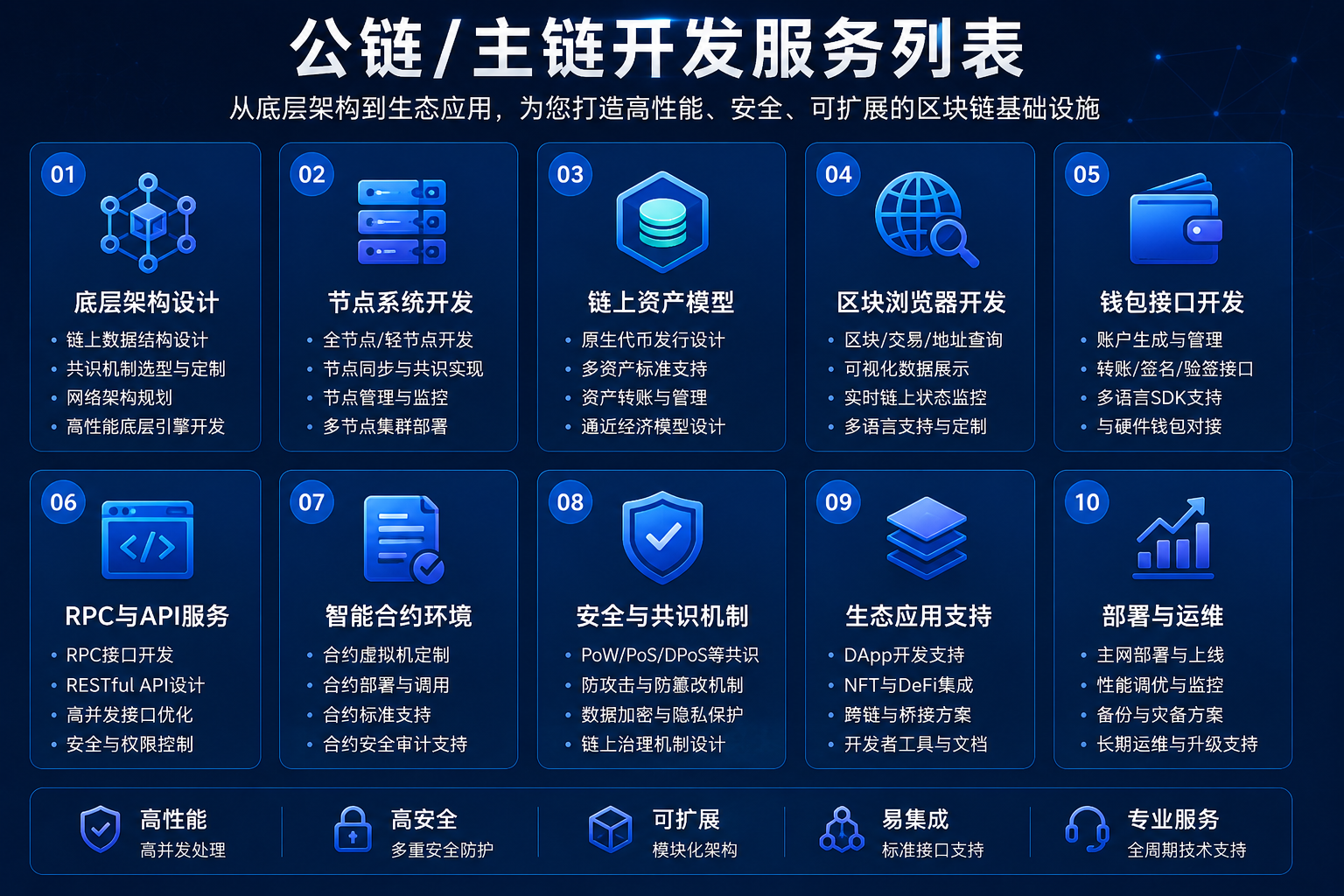
HK DragonChain provides public chain development, mainnet development, consortium chain development, blockchain underlying architecture design, node system deployment, on-chain asset modeling, block explorers, wallet APIs, smart contract environments, RPC interface services, and enterprise-grade custom blockchain mainnet system development. Based on project business objectives, on-chain application scenarios, performance requirements, security needs, and future ecosystem planning, we offer end-to-end public chain/mainnet development services from requirements analysis, technical architecture, underlying development, testing and deployment, to launch and operations maintenance.
What Is Public Chain / Mainnet Development
Public chain/mainnet development is a more underlying, infrastructure-focused technical service in blockchain system construction. Unlike typical DAPP development, wallet development, or smart contract development, public chain and mainnet development typically requires designing from the chain's underlying rules, including account systems, node networks, consensus mechanisms, block generation, transaction validation, asset models, fee structures, data storage, on-chain interfaces, block explorer queries, wallet integration, and ecosystem application extensibility.
For enterprises, choosing public chain or mainnet development often means the project is not just about building a standalone on-chain application, but about establishing an independent blockchain underlying system where subsequent wallets, DAPPs, NFTs, DeFi, on-chain points, anti-counterfeit traceability, digital copyright, trading platforms, or enterprise applications can all operate around the same on-chain infrastructure. Such systems are more suitable for projects with long-term plans for brand independence, asset issuance capabilities, node control capabilities, customized business rules, and ecosystem expansion.
In the public chain/mainnet development process, HK DragonChain first evaluates whether the project truly needs an independent mainnet. If the project is only for a single application, using an existing public chain or consortium chain may be more appropriate. If the project requires independent nodes, independent assets, independent block explorers, independent wallet APIs, independent transaction rules, and continuous ecosystem expansion, then a public chain or mainnet system can be planned. Proper technology selection can reduce later redundant development and lower post-launch operational maintenance costs.
Which Projects Are Suitable for Public Chain / Mainnet Development
Public chain/mainnet development is suitable for enterprises or platforms that need to build independent blockchain infrastructure. It can not only support digital asset transactions but also provide underlying capabilities for various on-chain applications. A complete mainnet system typically includes account generation, asset issuance, on-chain transfers, transaction confirmation, block recording, node synchronization, block explorer queries, and API calls, with the ability to further expand wallets, DAPPs, NFTs, DeFi, and enterprise applications.
Digital Asset Ecosystem Platforms
Suitable for projects requiring independent asset models, on-chain transfers, node synchronization, wallet APIs, and ecosystem application expansion, providing underlying support for subsequent DAPPs, NFTs, DeFi, or trading systems.
Enterprise Consortium Chain Systems
Suitable for multi-enterprise, multi-institution, multi-department collaboration scenarios for data attestation, supply chain coordination, business process tracking, permission verification, and trusted data sharing.
On-Chain Attestation Platforms
Suitable for digital copyright, anti-counterfeit traceability, electronic credentials, contract attestation, data rights confirmation, and other use cases, improving data trustworthiness and traceability through on-chain records.
Ecosystem Blockchain Projects
Suitable for platform-type projects planning long-term development of wallets, block explorers, developer APIs, application marketplaces, on-chain assets, and partner ecosystems.
HK DragonChain Public Chain / Mainnet Development Services
Public chain/mainnet development is not a single feature development but a complete underlying system engineering effort. HK DragonChain plans underlying architecture, on-chain rules, node deployment, interface capabilities, wallet integration, block explorer systems, and admin management modules based on project requirements, ensuring the mainnet system meets current launch needs while reserving room for future expansion.
1. Blockchain Underlying Architecture Design
Underlying architecture determines the stability, scalability, and maintainability of the mainnet system. Based on project business scale, transaction frequency, data structure, node count, asset types, and security requirements, we plan on-chain account systems, block structures, transaction structures, consensus mechanisms, data synchronization logic, API call methods, and system deployment solutions. For enterprise-level projects, we also consider permission controls, node management, data backups, log tracking, and exception recovery mechanisms.
2. Node System Development and Deployment
Nodes are the foundation of public chain/mainnet operation. HK DragonChain provides node program development, node deployment, node synchronization, node monitoring, node management, node permission configuration, and node runtime environment setup. Depending on project type, we can design public nodes, validator nodes, management nodes, archive nodes, or enterprise internal nodes to ensure stable data synchronization and long-term operational capability.
3. On-Chain Asset Model Design
Mainnet systems typically need to support on-chain asset issuance and transfer. Asset model design includes asset name, asset symbol, issuance rules, total supply rules, decimal precision settings, transfer rules, fee structures, freeze rules, burn rules, and permission management. For platforms that will later integrate with wallets, exchanges, DAPPs, or NFT systems, the asset model must be clearly designed early to avoid issues with inconsistent data structures or hard-to-adjust business rules after launch.
4. Block Explorer Development
The block explorer is an important gateway for the mainnet system to display on-chain data to the public. Users and administrators can query block heights, transaction hashes, wallet addresses, asset balances, transfer records, node information, and on-chain status through the explorer. HK DragonChain can customize block explorer pages, data query APIs, search functionality, transaction detail pages, address detail pages, and statistics display modules based on project requirements, improving on-chain data transparency.
5. Wallet and RPC Interface Services
Public chain/mainnet systems need to provide stable interfaces for wallets, admin panels, DAPPs, and third-party platforms. We can develop RPC interfaces, APIs, wallet connection services, address generation services, asset query services, transfer broadcast services, transaction record services, and node data services to facilitate subsequent application integration. Interface design focuses on security validation, access permissions, request frequency limits, exception returns, data formats, and future extensibility.
6. Smart Contract Runtime Environment
If the project needs to support DAPPs, NFTs, DeFi, on-chain points, or automated business logic, a smart contract runtime environment must be planned. HK DragonChain provides contract deployment, contract calls, contract permissions, event listening, on-chain interactions, and admin management features based on project goals, helping projects expand more business applications on the mainnet.
Core Functional Modules of Public Chain / Mainnet Systems
A complete public chain/mainnet system requires foundational operational capabilities, data query capabilities, asset management capabilities, interface service capabilities, and security operations capabilities. HK DragonChain performs modular development based on actual project conditions to avoid chaotic system structures and facilitate later maintenance and upgrades.
- Account System: Supports address generation, account identification, asset balances, transaction records, permission management, and user identity extensions.
- Node Network: Supports node deployment, node synchronization, node status monitoring, node permission configuration, and abnormal node handling.
- Block Generation: Supports block packaging, transaction confirmation, block height recording, on-chain data storage, and state synchronization.
- Transaction System: Supports transfer transactions, fee structures, transaction broadcasting, transaction confirmation, transaction hash queries, and failure records.
- Asset Issuance: Supports on-chain asset creation, total supply, precision settings, transfer rules, burn rules, and freeze rules.
- Block Explorer: Supports block queries, transaction queries, address queries, asset queries, node information, and on-chain data display.
- Interface Services: Supports RPC, APIs, wallet interfaces, DAPP interfaces, admin interfaces, and third-party system integration.
- Admin Panel: Supports system configuration, node management, asset management, data analytics, log viewing, and permission controls.
- Security Operations: Supports server deployment, data backups, exception monitoring, version upgrades, log tracking, and operational maintenance.
Differences Between Public Chain, Mainnet, and Consortium Chain
When planning blockchain projects, many enterprises encounter concepts such as public chain, mainnet, consortium chain, and private chain simultaneously. Different chain types suit different business scenarios. HK DragonChain helps clients choose the more appropriate development path based on whether the project needs an open ecosystem, node access controls, enterprise collaboration, asset transfer emphasis, higher performance requirements, or management permissions.
| Chain Type | Applicable Scenarios | Key Characteristics |
|---|---|---|
| Public Chain | Open ecosystem, digital assets, DAPP applications, developer platforms | Highly open, suitable for long-term ecosystem building. Users and developers can extend applications around the on-chain system. |
| Mainnet | Independent projects, platform ecosystems, asset systems, on-chain infrastructure | Emphasizes independent underlying capabilities, allowing customization of asset models, node rules, and interface services based on project needs. |
| Consortium Chain | Enterprise collaboration, supply chain, government-enterprise data, inter-institutional trusted sharing | More controlled node admission, suitable for multi-party collaboration, permission management, and trusted data exchange scenarios. |
| Private Chain | Internal enterprise management, data attestation, internal process tracking | Centralized management permissions, suitable for combining enterprise internal business systems with blockchain capabilities. |
Public Chain / Mainnet Development Process
Public chain/mainnet development involves underlying architecture and long-term operations, so focusing solely on front-end display is insufficient. HK DragonChain adopts a clear project process to ensure each stage has defined deliverables, allowing clients to understand the complete journey from planning to launch.
Requirements Analysis
Understand project positioning, on-chain business, asset types, user scale, node requirements, performance needs, and long-term ecosystem planning to determine whether public chain, mainnet, consortium chain, or other solutions are appropriate.
Architecture Planning
Plan account systems, node structures, consensus rules, asset models, interface services, block explorer systems, admin panels, and server deployment solutions.
Underlying Development
Develop on-chain core programs, node services, transaction structures, asset rules, interface modules, block explorer data services, and admin management features.
Interface Integration
Integrate with wallets, DAPPs, block explorers, admin panels, third-party platforms, and business systems to ensure on-chain data can be stably accessed.
Testing & Deployment
Conduct testnet deployment, functional testing, stress testing, security checks, node synchronization testing, API testing, and pre-launch acceptance.
Launch & Operations
Complete production environment deployment, node monitoring, data backups, log analysis, version upgrades, exception troubleshooting, and post-launch technical maintenance.
Key Considerations for Public Chain / Mainnet Development
Public chains and mainnets are the underlying foundation of blockchain projects. Once the system goes live, subsequent applications such as wallets, DAPPs, NFTs, DeFi, exchanges, and on-chain attestation will depend on this infrastructure. Therefore, early planning must prioritize stability, security, scalability, and operational capabilities. If the underlying design is unreasonable, later stages may encounter issues such as unstable node synchronization, abnormal API calls, chaotic asset rules, inaccurate block explorer data, difficult wallet integration, and high system upgrade costs.
Before development begins, enterprises need to clarify several key questions: Does the project need an independent mainnet? Does it need open nodes? Does it need to issue on-chain assets? Does it need a smart contract environment? Does it need to support high-frequency trading? Does it need to integrate with wallets and exchanges? Does it need to establish developer APIs? Only after these questions are clearly answered can a reasonable technical solution be formulated. HK DragonChain conducts detailed requirements analysis before the project starts to help clients avoid blind development.
Security is also a critical aspect of public chain/mainnet development. The system needs to address node security, interface security, asset security, permission security, server security, and data backups. For projects involving asset issuance, wallet APIs, and transaction data, clear permission management, exception logging, operation logs, and risk control mechanisms are particularly important. HK DragonChain considers security issues comprehensively from the architecture layer, interface layer, admin layer, and operations layer during development.
Why Choose HK DragonChain for Public Chain / Mainnet Development
HK DragonChain, headquartered in Shenzhen's Longhua District, specializes in blockchain development, wallet systems, DAPP applications, smart contracts, contract exchanges, public chains/mainnets, NFT systems, anti-counterfeit traceability, and digital copyright system customization. We focus not only on whether on-chain features can function but also on whether the system is easy to maintain, supports extensibility, and suits real business operations.
In public chain/mainnet development services, we provide different levels of support based on project stages. Startup projects can start with testnet, basic wallet APIs, block explorers, and core asset models. Mature projects can undergo mainnet upgrades, node expansion, performance optimization, interface restructuring, and ecosystem application integration. Enterprise-level projects can integrate on-chain attestation, permission management, data tracking, and asset transfer capabilities into existing business systems.
We prioritize project implementation, avoiding unnecessary feature stacking and not recommending clients blindly choose complex solutions. The right chain type, clear system structure, stable interface services, and sound operational mechanisms are the foundation for long-term public chain/mainnet project development.
Related Blockchain Development Services
Public chain/mainnet development is typically used in conjunction with wallet development, DAPP development, smart contract development, NFT system development, exchange system development, anti-counterfeit traceability systems, and digital copyright systems. If your project requires complete blockchain ecosystem construction, you can learn more about HK DragonChain's blockchain development services. We can provide overall planning and phased development solutions based on project goals.
Public Chain / Mainnet Development FAQs
Does an enterprise necessarily need to develop its own public chain?
Not necessarily. Whether a public chain is needed depends on project objectives. If it's just a single DAPP or on-chain attestation, using an existing chain or consortium chain may be more suitable. If independent assets, independent nodes, independent block explorers, and long-term ecosystem building are required, then public chain/mainnet development can be considered.
How long does public chain/mainnet development typically take?
The development timeline depends on system complexity. A basic mainnet, block explorer, wallet APIs, and admin panel require a certain development and testing period. If smart contract environments, ecosystem applications, trading systems, and multi-node deployment are also involved, the timeline will be extended accordingly.
Can wallets and DAPPs be integrated after mainnet development?
Yes. Mainnet systems typically need to provide RPC interfaces, APIs, wallet address services, asset query services, and transaction broadcast services to facilitate subsequent integration with wallets, DAPPs, block explorers, admin panels, and third-party systems.
Can public chains/mainnets be upgraded after launch?
Yes, but upgrade capabilities must be fully considered during early architecture design. HK DragonChain reserves interface extensibility, node extensibility, asset rule extensibility, and admin management extensibility based on project requirements to facilitate later maintenance and upgrades.
Get a Public Chain / Mainnet Development Solution
If you are planning public chain development, mainnet development, consortium chain development, blockchain underlying systems, node systems, block explorers, wallet APIs, or on-chain ecosystem platforms, you are welcome to discuss your project requirements with HK DragonChain. We will provide a more implementable public chain/mainnet development solution based on your business scenarios, technical objectives, functional scope, and launch plans.