
Blockchain Application Development
Blockchain Application Development
HK DragonChain provides blockchain application development, DApp application development, on-chain system customization, digital asset applications, membership points systems, data attestation platforms, anti-counterfeit traceability applications, digital copyright applications, NFT applications, and enterprise-grade blockchain software development services. Based on business processes, user scenarios, data structures, and operational requirements, we offer end-to-end blockchain application development solutions—from requirements analysis, product design, and system development, to on-chain integration, testing and deployment, and post-launch maintenance.
What Is Blockchain Application Development
Blockchain application development refers to the integration of blockchain technology with specific business scenarios to create usable application systems. It differs from pure public chain development or simply writing smart contracts. Blockchain application development is more focused on business implementation, including user systems, on-chain data recording, wallet connections, smart contract interactions, admin panels, asset display, permission controls, data queries, and multi-platform application experiences.
In the process of digital transformation, enterprises often need to address issues such as data trustworthiness, process transparency, asset transfer, copyright protection, anti-counterfeit verification, and multi-party collaboration. Traditional systems can handle data entry and business management but have limitations in multi-party participation, tamper-proof data, on-chain records, and public verification. Blockchain application development can provide enterprises with more trustworthy, transparent, and secure system support through on-chain attestation, smart contracts, distributed ledgers, and digital identities.
In the blockchain application development process, HK DragonChain first analyzes the client's industry attributes, business processes, user roles, and operational goals before determining whether features such as on-chain attestation, wallet connections, DApp interactions, NFT issuance, digital asset management, points systems, traceability queries, or copyright confirmation are needed. We don't simply apply templates but design system structures based on real business needs, ensuring blockchain capabilities truly serve enterprise operations.
Which Scenarios Are Suitable for Blockchain Application Development
Blockchain applications are suitable for enterprises or platforms with requirements for data trustworthiness, process traceability, asset manageability, identity verifiability, and record auditability. Different business scenarios have different blockchain needs. Some projects emphasize on-chain data attestation, others focus on digital asset transfer, some require wallet connections and contract interactions, and others aim to enhance brand credibility and user engagement through blockchain.
On-Chain Data Attestation
Suitable for contracts, credentials, copyright, certificates, transaction records, business processes, and important data preservation, enhancing data credibility through on-chain hashes and timestamps.
Enterprise Membership Points
Suitable for membership operations, points incentives, user benefits, activity rewards, and platform ecosystem development, supporting points issuance, usage, transfer, and admin management.
Anti-Counterfeit Traceability Applications
Suitable for branded goods, agricultural products, beverages, pharmaceuticals, supply chains, and retail industries, supporting unique product codes, QR code queries, batch tracking, and anti-counterfeit verification.
Digital Copyright Applications
Suitable for images, videos, music, articles, design works, and digital content platforms, supporting work rights confirmation, authorization records, on-chain attestation, and copyright tracking.
HK DragonChain Blockchain Application Development Services
HK DragonChain provides complete blockchain application system development services, covering front-end pages, back-end APIs, on-chain interactions, wallet integration, smart contracts, admin panels, data attestation, and system deployment. We decompose functional modules based on project requirements, ensuring clear system structure, controllable features, and convenient future extensibility.
1. DApp Application Development
DApp applications are an important direction in blockchain application development, typically requiring wallet connections, on-chain authorizations, smart contract calls, asset display, transaction records, and user interaction features. HK DragonChain can develop DApp applications suitable for WEB, mobile, or multi-platform access based on client requirements, supporting on-chain asset management, contract interactions, user centers, data display, and admin operations management.
2. On-Chain Attestation System Development
On-chain attestation systems can create trusted records from important business data, document digests, copyright information, contract credentials, transaction records, or process nodes. The system can support data hashing, timestamps, user identities, attestation IDs, query verification, and admin management. For businesses that need to prove data existence time and content integrity, on-chain attestation has high application value.
3. Digital Asset Application Development
Digital asset application development includes asset issuance, asset display, transfer records, wallet addresses, user asset centers, transaction records, and admin asset management. HK DragonChain can design asset models, account systems, API services, and management admin panels based on project planning, helping enterprises build clearer digital asset operation platforms.
4. Blockchain Points System Development
Blockchain points systems are suitable for membership operations, platform incentives, activity rewards, and ecosystem benefit scenarios. The system can support points issuance, points distribution, points consumption, points records, user tiers, activity rules, and admin analytics. Compared with traditional points systems, on-chain points can enhance record transparency and user trust.
5. Enterprise On-Chain Management Platform
Enterprise on-chain management platforms are suitable for integrating blockchain capabilities into existing business systems, such as supply chain management, contract management, copyright management, product traceability, customer benefits, membership systems, and data collaboration. HK DragonChain can customize admin management systems, API services, permission roles, and data query features for enterprises, making blockchain applications more aligned with internal management needs.
Core Functional Modules of Blockchain Application Development
A complete blockchain application system typically consists of multiple functional modules rather than just a display page. HK DragonChain plans front-end, back-end, on-chain, admin, and operations modules based on project complexity, ensuring stable application operation.
- User System: Supports registration/login, identity authentication, user profiles, role permissions, account security, and operation records.
- Wallet Connection: Supports Web3 wallets, on-chain authorizations, address binding, signature verification, asset reading, and transaction confirmations.
- Smart Contract Interaction: Supports contract calls, contract event listening, on-chain rule execution, asset operations, and data returns.
- On-Chain Attestation: Supports data hashing, attestation IDs, timestamps, document digests, business credentials, and query verification.
- Asset Management: Supports digital asset display, balance queries, transfer records, asset details, and admin reviews.
- Admin Panel: Supports user management, content management, data analytics, permission configuration, system settings, and operations management.
- API Services: Supports integration with APPs, mini-programs, WEB platforms, third-party systems, and on-chain node interfaces.
- Security Risk Control: Supports permission isolation, sensitive operation reviews, log tracking, anomaly alerts, and data backups.
Blockchain Application Development Process
Blockchain application development involves business logic, on-chain rules, user experience, and system security, requiring clear planning before development. HK DragonChain adopts a standardized development process to help clients clarify work content at each stage and improve project delivery efficiency.
Requirements Analysis
Understand the client's business model, application scenarios, user roles, functional requirements, on-chain data scope, and system launch goals.
Product Planning
Plan page structures, functional modules, user workflows, admin permissions, data structures, and on-chain interaction logic.
Architecture Design
Determine the overall architecture of front-end, back-end, smart contracts, wallet APIs, databases, servers, and on-chain services.
System Development
Complete development of front-end pages, back-end APIs, contract interactions, wallet connections, admin panels, and data attestation features.
Testing & Deployment
Conduct functional testing, API testing, on-chain interaction testing, security checks, server deployment, and pre-launch acceptance.
Maintenance & Upgrades
Provide post-launch issue troubleshooting, system optimization, feature expansion, version upgrades, and long-term technical maintenance services.
Differences Between Blockchain Applications and Traditional Software Applications
Traditional software applications primarily rely on centralized servers and databases for business processing, with data modifications, permission controls, and record queries typically managed uniformly by the platform. Blockchain applications can write critical data, important records, or business rules on-chain, making data more verifiable and traceable. For projects requiring multi-party collaboration, trusted records, public verification, and asset transfer, blockchain applications can provide more suitable technical support.
| Comparison Item | Traditional Software Application | Blockchain Application |
|---|---|---|
| Data Recording | Primarily stored in centralized databases | Critical data can form trusted records through on-chain attestation |
| Business Rules | Controlled by back-end programs and platform rules | Some rules can be automatically executed through smart contracts |
| Asset Management | Recorded by internal platform account systems | Can be managed through wallets, on-chain addresses, and asset contracts |
| Data Queries | Relies on platform admin queries | Some on-chain data can be verified through explorers or query APIs |
| Applicable Scenarios | General business management, information display, internal systems | Data attestation, asset transfer, copyright protection, anti-counterfeit traceability, multi-party collaboration |
Key Considerations in Blockchain Application Development
Before developing blockchain applications, enterprises need to clarify which data should be on-chain and which is better stored in traditional databases. Not all information is suitable for direct on-chain recording. Without proper design, it may increase system costs, reduce query efficiency, or complicate business processes. HK DragonChain reasonably divides on-chain and off-chain data boundaries based on project requirements, ensuring the system possesses blockchain trust capabilities while maintaining good operational efficiency.
Additionally, blockchain application development must prioritize security design. Wallet connections, smart contracts, admin permissions, API calls, asset operations, and user data all require strict controls. For systems involving digital assets, points, NFTs, transaction records, or copyright attestation, permission isolation, log recording, anomaly alerts, and data backups are particularly important to avoid operational risks later.
User experience is equally important. Many blockchain projects fail not because the technology cannot be implemented, but because operations are complex, processes unclear, pages unfriendly, or admin panels difficult to manage. During development, HK DragonChain considers both front-end experience and admin efficiency, making user-facing interfaces easy to use and operational ends convenient to manage.
Why Choose HK DragonChain
HK DragonChain, headquartered in Shenzhen's Longhua District, specializes in blockchain development, blockchain application development, DApp development, smart contract development, wallet systems, exchange systems, NFT systems, anti-counterfeit traceability, and digital copyright system customization. We focus not only on technical implementation but also on whether the system can operate stably long-term and whether it suits real enterprise business needs.
In blockchain application development services, we provide flexible solutions based on client project stages. Startup projects can start with basic versions to validate business models and user needs. Mature projects can undergo feature expansion, contract upgrades, API optimization, and admin enhancements. Traditional enterprises can integrate existing systems with on-chain attestation, anti-counterfeit traceability, digital copyright, or membership points features.
We insist on clear architecture, stable development, secure deployment, and ongoing services to help clients reduce development communication costs and improve project implementation efficiency. For platforms requiring long-term operations, HK DragonChain also provides server deployment, API maintenance, version upgrades, feature expansion, and technical support services.
Related Blockchain Services
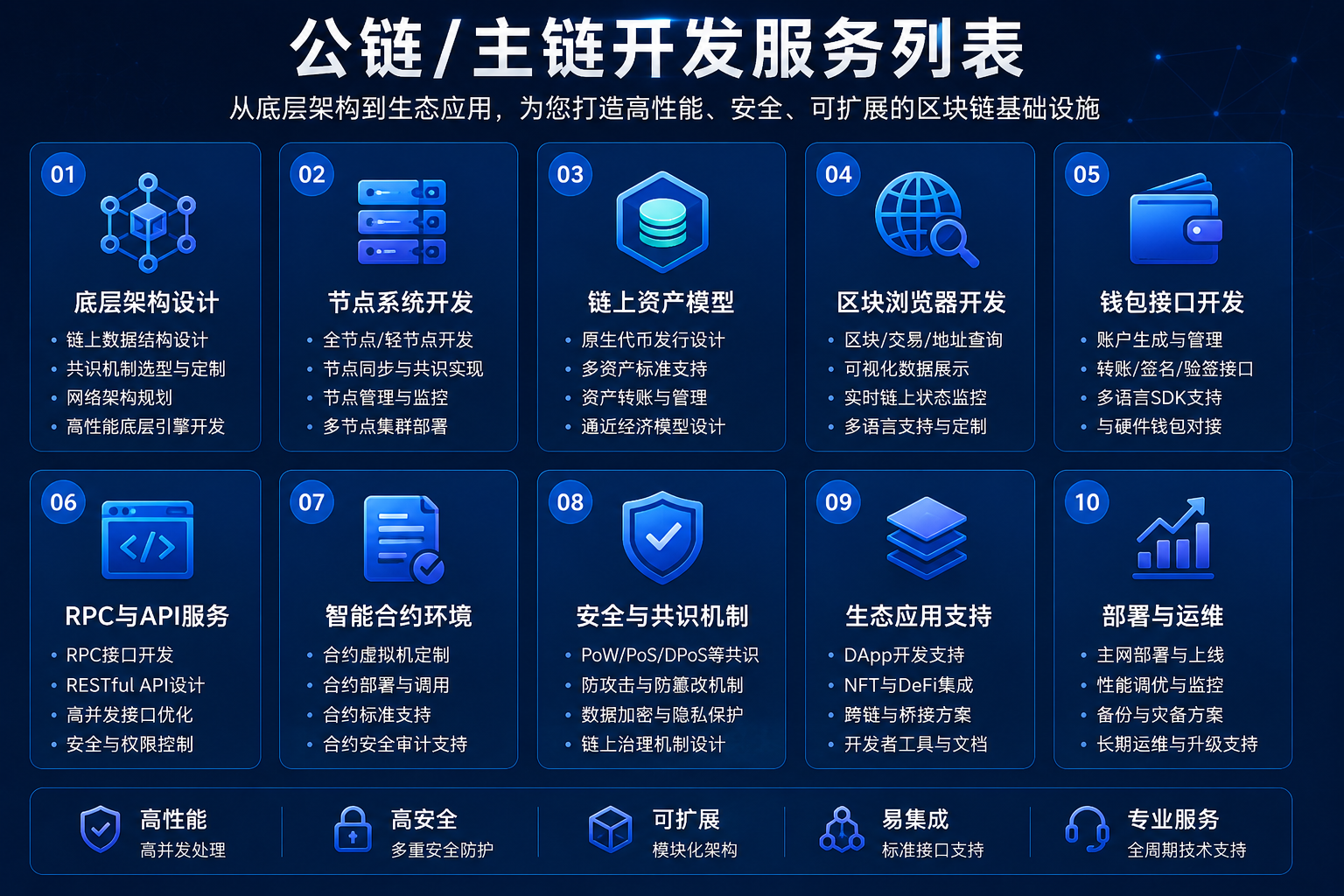
Blockchain application development is typically used in conjunction with public/mainnet chain development, wallet development, DApp development, smart contract development, NFT system development, anti-counterfeit traceability systems, and digital copyright systems. If you are planning a complete on-chain application platform, you can continue to explore HK DragonChain's blockchain development services. We will provide a more implementable development solution based on your project goals.
Blockchain Application Development FAQs
Is a wallet always required for blockchain application development?
Not necessarily. If the application only involves data attestation or admin management, wallet connection may not be required. However, if it involves on-chain assets, DApp interactions, NFTs, or authorization signatures, wallet functionality is typically needed.
Can blockchain applications integrate with existing systems?
Yes. Blockchain applications can integrate with existing enterprise systems, APPs, mini-programs, WEB platforms, admin systems, or third-party services through API interfaces.
How long does blockchain application development take?
The development timeline depends on feature complexity. Basic attestation applications have shorter timelines, while projects involving wallets, contracts, assets, admin panels, multiple platforms, and third-party APIs require longer timelines.
Can blockchain applications be expanded after launch?
Yes. As long as the initial architecture is well-designed, later expansions can include wallets, NFTs, points, traceability, copyright, trading, admin management, and data analytics features.
Get a Blockchain Application Development Solution
If you are planning blockchain application development, DApp applications, on-chain attestation, digital asset systems, anti-counterfeit traceability, digital copyright, NFT applications, membership points, or enterprise on-chain management platforms, you are welcome to discuss your project requirements with HK DragonChain. We will provide a more implementable blockchain application development solution based on your business scenarios, functional scope, and launch plans.