Digital Copyright System Development: Enterprise-Grade On-Chain Copyright Confirmation and Copyright Management Platform Customization
Hong Kong Longlian provides digital copyright system development, on-chain copyright confirmation systems, copyright proof platforms, work registration systems, digital content authorization systems, copyright certificate systems, NFT copyright credentials, copyright trading platforms, and enterprise-grade blockchain copyright management system customization services. Based on each enterprise’s work types, copyright business processes, proof requirements, authorization rules, user roles, and backend operation management needs, we provide secure, trusted, and traceable digital copyright system development solutions for cultural and creative platforms, content organizations, copyright service companies, digital collectible platforms, brands, and enterprise content asset management projects.
What Is a Digital Copyright System
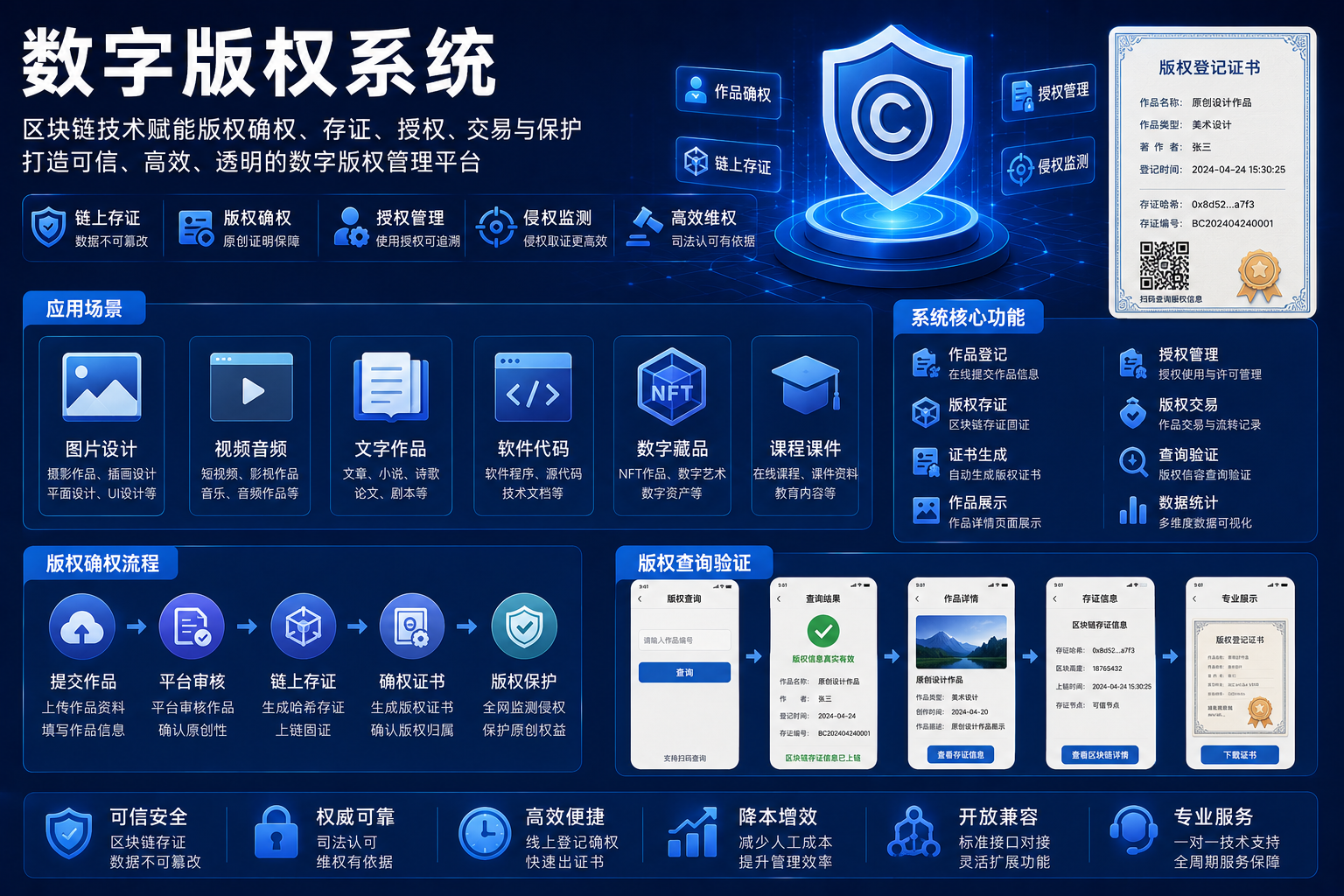
A digital copyright system is an integrated platform for managing digital works, original content, copyright assets, and intellectual property. It is mainly used for work registration, copyright confirmation, on-chain proof, authorization management, copyright certificate generation, usage record tracking, and copyright data queries. It helps enterprises build clear copyright archives for images, videos, music, articles, design drafts, photography works, software code, digital collectibles, brand materials, and other content assets.
Compared with traditional copyright management methods, a digital copyright system places more emphasis on standardized data, online workflows, and traceable evidence. The platform can record upload time, author information, work hashes, copyright statements, authorization status, transaction records, and on-chain proof credentials, giving enterprises clearer data support for content distribution, copyright cooperation, authorization usage, and rights protection.
In digital copyright system development, Hong Kong Longlian combines blockchain proof, smart contracts, DAPP applications, backend management, file storage, copyright certificates, and data query modules to build copyright management platforms suitable for long-term operation, rather than simply creating a basic work upload page.
Which Scenarios Are Suitable for Digital Copyright Systems
Digital copyright systems are suitable for enterprise projects that need to manage original content, digital assets, copyright credentials, and authorization records. If a platform involves work registration, content ownership confirmation, copyright certificates, authorization cooperation, content distribution, digital collectibles, NFT copyright credentials, or intellectual property protection, a digital copyright system can help establish a clearer copyright management process.
Copyright Management for Cultural and Creative Works
Suitable for illustrations, photography, music, videos, design drafts, articles, IP characters, and brand material management. It supports work registration, author information, copyright statements, and proof credentials.
Copyright Confirmation for Content Platforms
Suitable for content communities, media platforms, short video platforms, digital publishing platforms, and knowledge payment platforms, helping platforms build copyright archives for original content.
NFT Copyright Credential System
Suitable for NFT platforms, digital collectible platforms, and brand digital asset projects. It supports work copyright information, on-chain credentials, NFT associations, and user holding records.
Copyright Authorization and Trading
Suitable for copyright authorization platforms, copyright agencies, and enterprise content asset platforms. It supports authorization contracts, usage scope, authorization periods, and transaction record management.
Hong Kong Longlian Digital Copyright System Development Services
Hong Kong Longlian provides complete digital copyright system development services, covering work registration, copyright confirmation, on-chain proof, copyright certificates, authorization management, copyright queries, NFT copyright credentials, backend management, and data statistics. The system can be customized according to client business requirements and adapted to different copyright business processes.
1. Work Registration and Content Management
The system supports users or administrators uploading work files and filling in work names, author information, work types, creation time, copyright ownership, work descriptions, and attachment materials. The platform can build copyright archives for different types of content, including images, audio, videos, text, design drafts, code files, and digital collectibles.
2. On-Chain Copyright Confirmation and Proof
After calculating the hash of a work, the system can write the work summary, registration time, copyright subject, proof number, and key credential information onto the blockchain. Through on-chain proof, the platform can create searchable, verifiable, and traceable copyright records for works, improving the credibility of copyright information.
3. Digital Copyright Certificate Generation
The system can automatically generate digital copyright certificates based on work registration information. Certificate content can include the work name, author, copyright ownership, registration number, proof time, on-chain hash, contract address, transaction hash, and query entry. Users can view, download, or share copyright certificates online.
4. Authorization Management and Usage Records
A digital copyright system can manage the copyright authorization process, including authorized parties, authorization scope, authorization time, authorization price, usage scenarios, contract numbers, and authorization status. The platform can record each copyright authorization and usage activity, making it easier for enterprises to track content usage later.
5. NFT Copyright Credentials and Digital Asset Association
If the project involves NFTs or digital collectibles, the system can associate work copyright information with NFT assets and display NFT numbers, holders, copyright descriptions, authorization scope, and on-chain credentials. This makes digital asset displays more complete and also helps distinguish work copyright from asset holding rights.
6. Backend Management and Data Statistics
An enterprise-grade digital copyright system requires supporting backend management for reviewing works, managing users, configuring copyright categories, viewing proof records, processing authorization orders, counting work quantities, and tracking abnormal data. The backend system can form a complete operational closed loop for copyright business from registration and review to authorization.
Core Functional Modules of a Digital Copyright System
A mature digital copyright system needs to cover work management, copyright confirmation, on-chain proof, authorization workflows, certificate queries, backend operations, and security control. Hong Kong Longlian develops modular systems according to client project requirements, ensuring a clear structure, stable functions, and room for future expansion.
- Work Management: Supports work uploads, work categories, author information, copyright ownership, work descriptions, attachment materials, and work status management.
- Copyright Registration: Supports copyright registration numbers, registration time, registration subject, review status, copyright statements, and work archive generation.
- On-Chain Proof: Supports work hashes, proof numbers, transaction hashes, block height, contract addresses, and on-chain query entries.
- Copyright Certificates: Supports digital copyright certificate generation, online viewing, downloads, certificate verification, and QR code queries.
- Authorization Management: Supports authorized parties, authorization scope, authorization periods, authorization prices, contract records, and authorization status tracking.
- NFT Association: Supports NFT numbers, digital collectibles, holder information, copyright descriptions, on-chain assets, and the relationship between works and copyright.
- Backend Review: Supports work review, user management, content categories, proof records, order management, permission roles, and operation logs.
- Data Statistics: Supports work quantities, proof quantities, authorization counts, certificate query volume, user data, and copyright business reports.
- Security Control: Supports file verification, permission levels, duplicate submission prevention, data backup, log tracing, and abnormal operation alerts.
Digital Copyright System Development Process
Digital copyright system development first requires clarification of work types, copyright business processes, proof methods, authorization rules, and backend operation needs. Hong Kong Longlian uses a standardized development process to help clients move step by step from requirement planning to system launch.
Requirement Communication
Clarify work types, copyright subjects, registration processes, proof requirements, authorization methods, user roles, backend functions, and launch goals.
Solution Planning
Plan the system architecture, copyright data model, on-chain proof method, certificate templates, authorization workflow, and backend management modules.
Interface Design
Design work registration pages, copyright certificate pages, copyright query pages, authorization management pages, user centers, and backend management interfaces.
System Development
Develop work management, on-chain proof, certificate generation, authorization records, NFT association, backend review, and data statistics functions.
Testing and Acceptance
Conduct upload testing, hash verification, proof testing, certificate testing, authorization workflow testing, permission testing, and data consistency verification.
Launch and Maintenance
Complete system deployment, on-chain configuration, security reinforcement, data monitoring, function optimization, and future version upgrade support.
Differences Between Digital Copyright Systems and Ordinary Copyright Management Systems
Ordinary copyright management systems mainly register work information in the backend and save it in databases, while digital copyright systems place more emphasis on trusted work credentials, on-chain records, authorization circulation, and long-term verifiability. For platforms that need to display copyright credibility to users, institutions, or partners, blockchain copyright proof can provide a clearer evidence chain.
| Comparison Item | Digital Copyright System | Ordinary Copyright Management System |
|---|---|---|
| Data Records | Supports on-chain proof, hash records, transaction hashes, and verifiable credentials | Mainly relies on platform databases to store copyright information |
| Certificate Format | Can generate digital copyright certificates with on-chain credentials | Usually ordinary electronic certificates or backend records |
| Authorization Management | Supports authorization scope, authorization periods, usage records, and on-chain credential association | Usually based on contracts or manual records |
| NFT Association | Can be associated with NFTs, digital collectibles, and on-chain assets | Usually does not have on-chain asset management capabilities |
| Applicable Scenarios | Cultural and creative copyright, content platforms, NFT platforms, digital assets, and enterprise content asset management | Traditional copyright archives, internal material management, and basic registration systems |
What Should Be Considered in Digital Copyright System Development
First, it is necessary to distinguish between work copyright and digital asset ownership. Especially in NFT and digital collectible scenarios, holding an NFT does not necessarily mean owning full copyright. Therefore, the system needs to clearly display copyright ownership, authorization scope, and user rights to avoid future disputes.
Second, metadata and file storage stability should be taken seriously. In a digital copyright system, work files, hash summaries, certificate information, and on-chain credentials need to remain consistent. If file addresses, metadata structures, or work numbers change frequently, later queries and verification may be affected.
In addition, a copyright system should not only focus on front-end display. Backend review and permission management are also important. Work registration, proof recording on-chain, authorization publishing, certificate generation, and data export should all have clear permission boundaries, and key operations should retain logs for future tracing.
Why Choose Hong Kong Longlian
Hong Kong Longlian focuses on blockchain development, digital copyright system development, on-chain copyright proof, NFT system development, digital collectible systems, DAPP development, smart contract development, anti-counterfeiting traceability systems, wallet systems, and enterprise-grade blockchain application customization. In digital copyright system development, we not only focus on page display, but also on copyright data structures, on-chain proof, certificate verification, authorization management, and backend operations.
For cultural and creative platforms, we can provide work registration, copyright certificates, and authorization management. For content platforms, we can provide original content confirmation, on-chain credentials, and author archives. For NFT platforms, we can provide NFT copyright credentials, digital collectible association, and on-chain asset display. For enterprise clients, we can provide internal copyright asset management, data statistics, and evidence retention systems.
A stable digital copyright system requires clear copyright rules, trusted on-chain credentials, complete backend management, and a sustainable technical architecture. Hong Kong Longlian customizes digital copyright system development solutions according to each client’s real business process, helping enterprises manage and protect digital content assets more efficiently.
Related Blockchain Services
Digital copyright systems are usually used together with on-chain copyright proof, NFT systems, NFT platform development, digital collectible systems, NFT marketplace systems, DAPP development, smart contract development, blockchain application development, and anti-counterfeiting traceability systems. If you are planning a digital copyright system, copyright proof platform, or NFT copyright credential project, you can continue to learn about Hong Kong Longlian blockchain development services , and we will provide a more suitable system development solution according to your work types, copyright business processes, and launch plan.
Frequently Asked Questions About Digital Copyright Systems
What types of works can a digital copyright system manage?
It can manage images, videos, music, articles, photography works, design drafts, software code, IP characters, brand materials, digital collectibles, NFT-related works, and many other types of digital content.
Does a digital copyright system have to connect to blockchain?
Not necessarily, but if the project needs to improve copyright record credibility, proof traceability, and certificate verification capability, it is recommended to integrate a blockchain proof module.
Can a digital copyright system be integrated with an NFT system?
Yes. The system can associate work copyright information with NFT assets and display copyright descriptions, on-chain credentials, NFT numbers, and holder information.
Does an enterprise digital copyright system need a backend?
A backend management system is recommended for work review, copyright registration, certificate management, authorization management, user management, proof records, and data statistics.
Get a Digital Copyright System Development Solution
If you are planning digital copyright system development, an on-chain copyright confirmation system, a copyright proof platform, a digital copyright certificate system, NFT copyright credentials, a copyright authorization platform, or an enterprise-grade content asset management system, you are welcome to communicate your project requirements with Hong Kong Longlian. We will provide a digital copyright system development solution that is more suitable for implementation based on your work types, copyright rules, proof requirements, authorization workflow, and launch plan.