
Exchange Wallet Development
Exchange Wallet
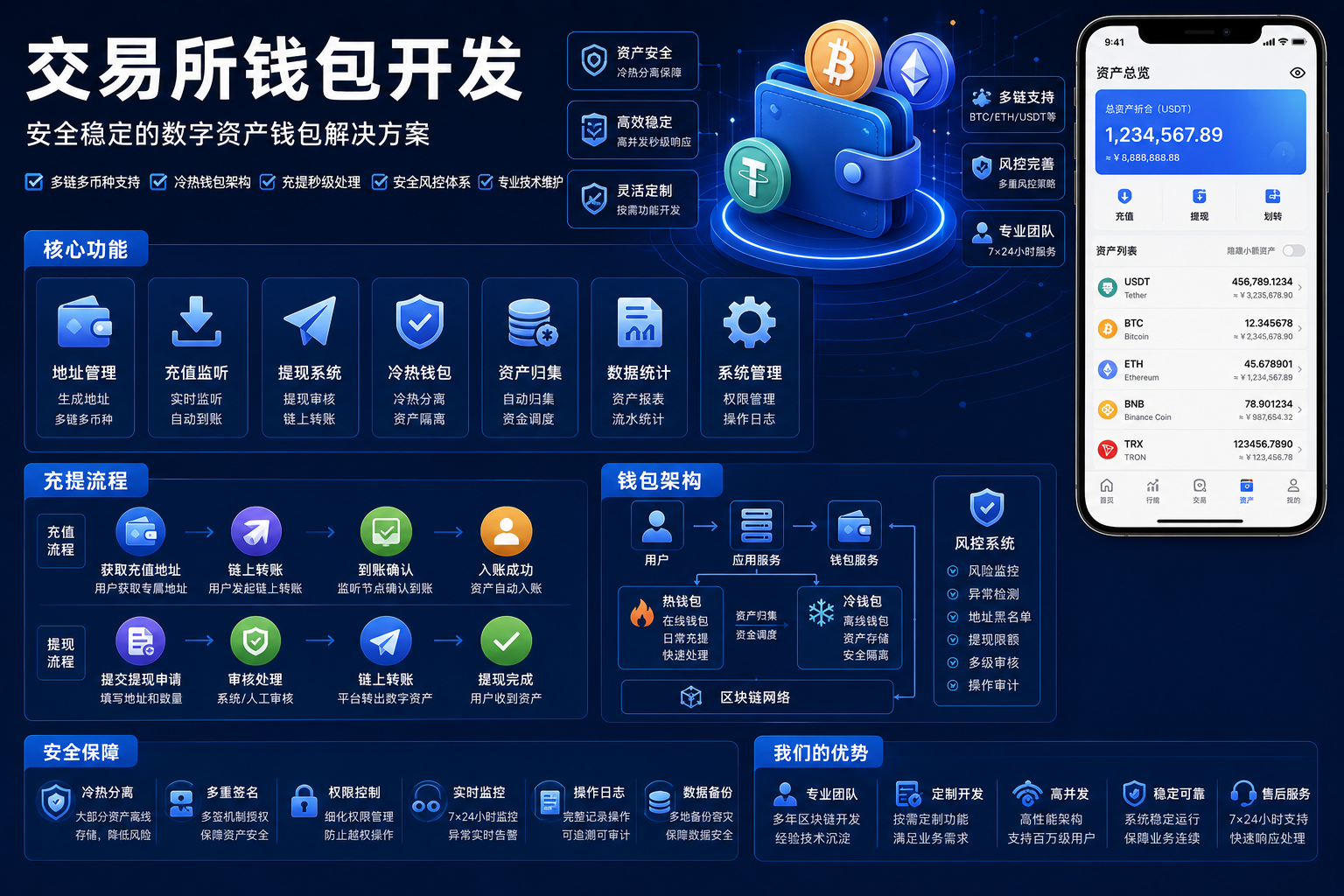
HK DragonChain provides exchange wallet development, digital asset wallet systems, hot/cold wallet separation, multi-signature wallets, on-chain deposits and withdrawals, automated aggregation, asset reconciliation, wallet risk control, block monitoring, currency management, and enterprise-grade wallet admin customization services. Through secure wallet architecture, stable on-chain monitoring services, clear account ledger systems, and comprehensive admin management capabilities, we help digital asset trading platforms, OTC platforms, Web3 financial platforms, and blockchain asset service providers build more secure, stable, and scalable wallet systems.
What Is an Exchange Wallet
An exchange wallet is the core infrastructure system of a digital asset trading platform, primarily responsible for user deposit address generation, on-chain deposit monitoring, block confirmations, user balance crediting, withdrawal reviews, wallet signing, transaction broadcasting, asset aggregation, hot/cold wallet management, and financial reconciliation. For any platform involving digital asset deposits, withdrawals, custody, transfers, and settlements, the exchange wallet is a critical module for ensuring fund flow and asset security.
A mature exchange wallet is not simply a wallet address generation tool, but a complete digital asset management system. It needs to unify on-chain assets, platform accounts, user balances, admin ledgers, risk control rules, and wallet permissions. When users deposit digital assets to the platform, the system must automatically identify on-chain transactions and update account balances. When users initiate withdrawals, the system must complete balance verification, risk control assessment, manual or automated review, wallet signing, on-chain broadcasting, and order status synchronization.
In the exchange wallet development process, HK DragonChain provides custom designs based on client platform types, business scales, supported currencies, chain types, withdrawal rules, security levels, and admin management requirements. Whether for centralized exchanges, OTC systems, stablecoin payment platforms, Web3 financial platforms, digital asset custody platforms, or cross-border settlement platforms, an exchange wallet system can enhance asset management efficiency and platform security.
Which Scenarios Are Suitable for Exchange Wallets
Exchange wallets are suitable for any business that needs to manage user digital assets, support on-chain deposits and withdrawals, perform internal asset accounting, and enable digital asset circulation. Especially for platforms with large asset volumes, numerous users, multiple currency types, or high withdrawal frequencies, a customized exchange wallet system can significantly improve operational efficiency and security.
Digital Asset Trading Platforms
Suitable for spot trading, futures trading, and comprehensive trading platforms, supporting user deposits, withdrawals, internal transfers, asset balance display, and trading account settlement.
OTC Trading Systems
Suitable for buyer/seller asset custody, order freezing, transaction release, on-chain payment confirmation, and platform-guaranteed trading scenarios.
Stablecoin Payment Platforms
Suitable for USDT, USDC and other stablecoin deposits, withdrawals, merchant collections, batch payments, fund aggregation, and settlement reconciliation.
Digital Asset Custody Platforms
Suitable for institutional asset management, enterprise wallets, cold wallet custody, multi-signature approvals, large asset allocation, and secure storage services.
HK DragonChain Exchange Wallet Development Services
HK DragonChain provides complete exchange wallet development services, covering wallet architecture design, address generation, on-chain monitoring, deposit confirmation, withdrawal review, automated aggregation, hot/cold wallet separation, multi-signature management, currency management, wallet admin panels, asset reports, and risk control systems. We design wallet workflows based on client business models, ensuring the system meets both user experience requirements and platform asset security and long-term operational needs.
1. Multi-Currency Wallet Development
Exchange wallets can support mainstream chains and assets such as BTC, ETH, USDT, TRON, BSC, Polygon, Arbitrum, and Optimism. The system can design address generation, transaction monitoring, fee calculation, block confirmation, and withdrawal broadcast logic based on the technical characteristics of different chains. For stablecoins like USDT, the system can distinguish between different networks such as ERC20, TRC20, and BEP20 to prevent user mis-deposits and backend asset confusion.
2. User Deposit Address Management
The system can generate independent deposit addresses for users, or use address pool allocation, dynamic address binding, and batch address pre-generation methods. The admin panel can view address ownership, usage status, chain type, user accounts, deposit records, and aggregation status. Clear address management mechanisms help platforms track user deposit behavior and reduce manual verification costs.
3. On-Chain Deposit Monitoring
On-chain monitoring services are responsible for scanning new blocks, identifying platform addresses, reading transaction hashes, determining deposit currencies, recording transaction amounts, and tracking block confirmation counts. When the confirmation count reaches platform configuration requirements, the system automatically updates user balances and generates ledger entries. Monitoring services also need to handle node delays, on-chain reorganizations, duplicate transactions, failed contract token identification, and abnormal deposits.
4. Withdrawal Review and Risk Control System
Withdrawals are the highest risk link in exchange wallets. The system can support withdrawal requests, balance freezing, fee calculation, address verification, risk control assessment, manual review, multi-level approval, wallet signing, transaction broadcasting, and status synchronization. For large withdrawals, abnormal addresses, frequent withdrawals, new device logins, or blacklisted addresses, the system can automatically trigger enhanced review or manual re-verification.
5. Hot/Cold Wallet Separation Solution
Hot wallets are used for daily withdrawals, small transfers, and platform liquidity management. Cold wallets are used to store the majority of platform assets. The system can set hot wallet balance limits, automatic alerts, fund allocation rules, and cold wallet transfer strategies. Through hot/cold wallet separation, user withdrawal efficiency can be maintained while reducing exposure of large assets to risk.
6. Automated Aggregation and Asset Allocation
If assets in user deposit addresses remain scattered for long periods, it increases admin management and withdrawal scheduling difficulty. Automated aggregation systems can consolidate scattered assets into hot wallets, intermediate wallets, or cold wallets based on currency type, chain type, amount thresholds, fee costs, and platform strategies. For tokens like ERC20 and TRC20, the system also needs to handle main chain fee asset replenishment issues.
7. Wallet Admin Panel and Financial Reconciliation
The wallet admin panel can support asset overview, currency configuration, deposit records, withdrawal review, wallet balances, aggregation tasks, address management, on-chain transaction queries, user ledgers, fee statistics, anomaly alerts, and financial reports. Finance teams can use the admin panel to reconcile user balances, on-chain balances, platform ledgers, and deposit/withdrawal flows, reducing asset discrepancies and manual reconciliation pressure.
Core Functional Modules of Exchange Wallets
A complete exchange wallet system needs to cover multiple modules including address, deposit, withdrawal, aggregation, ledger, risk control, admin, and security. HK DragonChain performs modular development based on different platform business stages, allowing clients to start with basic deposit/withdrawal systems and expand to complete enterprise-grade digital asset wallet management platforms.
- Address Management: Supports multi-chain address generation, address pool management, user address binding, address status queries, and aggregation status recording.
- Deposit Monitoring: Supports block scanning, transaction identification, confirmation count tracking, automatic crediting, duplicate transaction filtering, and abnormal deposit handling.
- Withdrawal System: Supports withdrawal requests, balance freezing, fee calculation, address verification, review workflow, signature broadcasting, and status synchronization.
- Hot/Cold Wallets: Supports hot wallet daily operations, cold wallet large-value storage, fund allocation, balance alerts, and wallet tiered management.
- Multi-Signature Management: Supports multi-signature approval for large withdrawals, cold wallet transfer confirmations, permission grading, and critical operation reviews.
- Automated Aggregation: Supports scattered address aggregation, scheduled tasks, amount thresholds, fee control, aggregation failure retries, and task logs.
- Currency Configuration: Supports currency name, chain type, contract address, deposit switch, withdrawal switch, confirmation count, and fee rule configuration.
- Ledger System: Supports user balances, frozen balances, deposit flows, withdrawal flows, fee flows, and platform internal asset records.
- Risk Control System: Supports large withdrawal limits, blacklisted addresses, abnormal logins, frequent withdrawals, night withdrawals, and manual review rules.
- Admin Panel: Supports asset overview, deposit records, withdrawal review, wallet balances, aggregation tasks, financial reports, and permission management.
Exchange Wallet Development Process
Exchange wallet systems involve platform asset security, user account balances, on-chain transaction confirmations, and admin financial reconciliation. Therefore, business processes and security structures must be clearly planned before development. HK DragonChain develops wallet solutions based on client chain types, currency scope, trading platform models, and security requirements.
Requirements Analysis
Understand platform type, supported currencies, chain types, deposit/withdrawal processes, hot/cold wallet needs, risk control rules, and admin management requirements.
Architecture Planning
Plan address management, on-chain monitoring, user ledgers, withdrawal review, wallet signing, automated aggregation, and hot/cold wallet tiered structures.
Feature Design
Design user asset pages, deposit pages, withdrawal pages, wallet admin panels, review workflows, risk control strategies, and financial reconciliation pages.
System Development
Develop address generation, on-chain monitoring, deposit crediting, withdrawal review, signature broadcasting, automated aggregation, and admin management features.
Testing & Deployment
Conduct deposit testing, withdrawal testing, block confirmation testing, aggregation testing, permission testing, abnormal transaction testing, and server deployment.
Launch & Maintenance
Provide post-launch node monitoring, wallet security maintenance, currency expansion, system optimization, data backups, and version upgrade support.
Differences Between Hot/Cold Wallets and Ordinary Wallets
Ordinary wallets typically only focus on asset sending and receiving, while exchange wallets place greater emphasis on platform-level asset security, user ledgers, risk control review, and admin management. Especially in trading platform scenarios, wallet systems must have hot/cold tiering, multi-signature approval, asset aggregation, and financial reconciliation capabilities to support long-term operations.
| Comparison Item | Ordinary Wallet | Exchange Wallet System |
|---|---|---|
| Users | Individuals or small teams managing assets | Platforms managing digital assets for large user bases |
| Address Management | Manual management of a small number of addresses | Supports batch address generation, address pools, user binding, and admin queries |
| Deposit Processing | Manual checking of arrivals | On-chain monitoring, confirmation count assessment, automatic crediting, and flow recording |
| Withdrawal Processing | Direct transfer initiation | Balance freezing, risk control assessment, review workflow, signature broadcasting, and status synchronization |
| Asset Security | Relies on individual wallets or private keys | Supports hot/cold wallet separation, multi-signature approval, permission grading, and anomaly alerts |
| Operational Value | Focused on personal asset management | Can support trading platforms, OTC, payments, custody, and cross-border settlement businesses |
Key Considerations in Exchange Wallet Construction
When building exchange wallet systems, enterprises must first clarify which chains and currencies to support. Wallet structures vary significantly across different blockchains. For example, BTC-type assets use the UTXO model and require handling change addresses, UTXO selection, and fee estimation. ETH-type assets use the account model and require handling nonce, gas, ERC20 contract calls, and transaction status queries. TRON-type assets require handling TRC20, energy, bandwidth, and address format conversion.
Second, the relationship between platform ledgers and on-chain assets must be reasonably planned. The balances users see typically come from internal platform ledgers rather than real-time on-chain balances. The system must maintain ledger consistency across deposit crediting, withdrawal freezing, withdrawal completion, withdrawal failure, fee deduction, and internal transfer operations to avoid balance errors, duplicate crediting, or asset discrepancies.
Additionally, exchange wallets must prioritize private key security and permission controls. Private keys should not be stored in plain text or directly exposed on ordinary business servers. Signing services should be isolated from business systems. Large transfers should require multi-signature approval or manual review. Sensitive admin operations need to be logged and permission-graded. HK DragonChain designs corresponding wallet security solutions based on platform security levels to reduce asset risks.
Key Security Design Aspects of Exchange Wallets
Wallet systems directly impact platform asset security, so security design must run through the entire development process. Exchange wallets must not only prevent external attacks but also prevent internal misoperations, permission abuse, duplicate crediting, abnormal withdrawals, and on-chain data processing errors.
- Private Key Isolation: Private keys are not directly exposed on the frontend or ordinary business services. Signing services are deployed separately from business systems.
- Hot Wallet Limits: Hot wallets only retain assets needed for daily business. Amounts exceeding thresholds are transferred to cold wallets.
- Cold Wallet Protection: Cold wallets are used for large-value asset storage, supporting offline management, multi-signature approval, and manual review.
- Withdrawal Risk Control: Review rules are set for large withdrawals, abnormal addresses, frequent withdrawals, new account withdrawals, and blacklisted addresses.
- Operation Logs: All critical admin operations record administrator, time, IP, operation content, and results for audit tracking.
- Node Monitoring: Monitor node sync height, RPC status, transaction broadcast results, and on-chain confirmation status to reduce missed order risks.
- Data Backup: Regularly back up user ledgers, deposit records, withdrawal records, wallet configurations, and system logs.
Exchange Wallet Admin Panel Features
The wallet admin panel is the most frequently used management area for platform operations, finance, and risk control teams. A clear wallet admin panel helps platforms quickly view asset status, process user withdrawals, manage currency rules, check on-chain transactions, and complete financial reconciliation.
Asset Overview
Displays total platform assets, hot wallet balances, cold wallet balances, total user assets, frozen amounts, and pending confirmation amounts.
Deposit Records
View user accounts, currencies, chain types, deposit addresses, transaction hashes, block heights, confirmation counts, and settlement status.
Withdrawal Review
Supports withdrawal order viewing, risk control information display, manual review, withdrawal rejection, withdrawal approval, and status tracking.
Currency Management
Configure currency names, chain types, contract addresses, deposit switches, withdrawal switches, confirmation counts, and fee rules.
Aggregation Tasks
Manage automated aggregation rules, task status, aggregation amounts, fee consumption, failure retries, and task logs.
Financial Reports
Aggregate deposit amounts, withdrawal amounts, fee expenditures, user balances, on-chain balances, and platform asset discrepancies.
Why Choose HK DragonChain
HK DragonChain, headquartered in Shenzhen's Longhua District, specializes in blockchain development, exchange systems, wallet systems, DAPP applications, smart contracts, NFT platforms, anti-counterfeit traceability systems, digital copyright systems, and enterprise software customization. We focus not only on wallet feature completeness but also on platform asset security, admin usability, and system extensibility.
In exchange wallet development, HK DragonChain provides flexible solutions for different platforms. For startup trading platforms, we can first build basic deposit/withdrawal functions, currency management, and wallet admin panels. For platforms with larger asset volumes, we can add hot/cold wallet separation, multi-signature approval, automated aggregation, and financial reconciliation. For institutional service platforms, we can further expand custody wallets, enterprise accounts, multi-level permissions, and asset reports.
We prioritize security, stability, and practical implementation, building clear wallet architecture, reliable on-chain monitoring services, accurate ledger systems, comprehensive risk control workflows, and sustainable admin management platforms for clients. A well-designed wallet system is the foundation for long-term development of digital asset platforms.
Related Blockchain Services
Exchange wallets are typically used in conjunction with exchange systems, OTC systems, Web3 wallets, multi-currency wallets, decentralized wallets, payment systems, DAPP applications, and digital asset custody platforms. If you are planning a digital asset platform, trading platform wallet, stablecoin payment system, or on-chain fund management platform, you can continue to explore HK DragonChain's blockchain development services. We will provide a more implementable development solution based on your business model and asset management requirements.
Exchange Wallet FAQs
What functions does exchange wallet development typically include?
Exchange wallet development typically includes address generation, on-chain deposit monitoring, block confirmation, automatic crediting, withdrawal review, wallet signing, transaction broadcasting, automated aggregation, hot/cold wallet management, user ledgers, currency configuration, risk control rules, and admin panel functions.
Why is hot/cold wallet separation needed for exchange wallets?
Hot/cold wallet separation reduces platform asset risk. Hot wallets are used for daily withdrawals and business transfers, while cold wallets store large assets. Even if a hot wallet is compromised, overall platform asset exposure is minimized.
Can exchange wallets support USDT?
Yes. The system can support USDT across different networks such as ERC20, TRC20, and BEP20, with configurable deposit addresses, confirmation counts, fees, and withdrawal rules for each network.
Which exchange scenarios are multi-signature wallets suitable for?
Multi-signature wallets are suitable for large withdrawals, cold wallet transfers, platform fund allocation, institutional custody, and critical asset operations. Multi-signature mechanisms reduce the risk of excessive single private key or single administrator permissions.
How do exchange wallets prevent duplicate crediting?
Systems typically use transaction hashes, chain types, currencies, deposit addresses, and order status to establish unique records, using confirmation count assessment and crediting status control to prevent the same on-chain transaction from being processed multiple times.
Can new chains and currencies be added to exchange wallets later?
Yes. As long as the initial architecture is properly planned, new public chains, tokens, stablecoins, cross-chain assets, wallet APIs, and admin configuration rules can be added later.
Get an Exchange Wallet Development Solution
If you are planning an exchange wallet, digital asset wallet system, hot/cold wallet, multi-signature wallet, on-chain deposit/withdrawal system, automated aggregation system, stablecoin payment wallet, or enterprise-grade asset management platform, you are welcome to discuss your project requirements with HK DragonChain. We will provide a more implementable exchange wallet development solution based on your platform type, supported currencies, on-chain processes, security level, and launch plans.