
Web3 Wallet Development
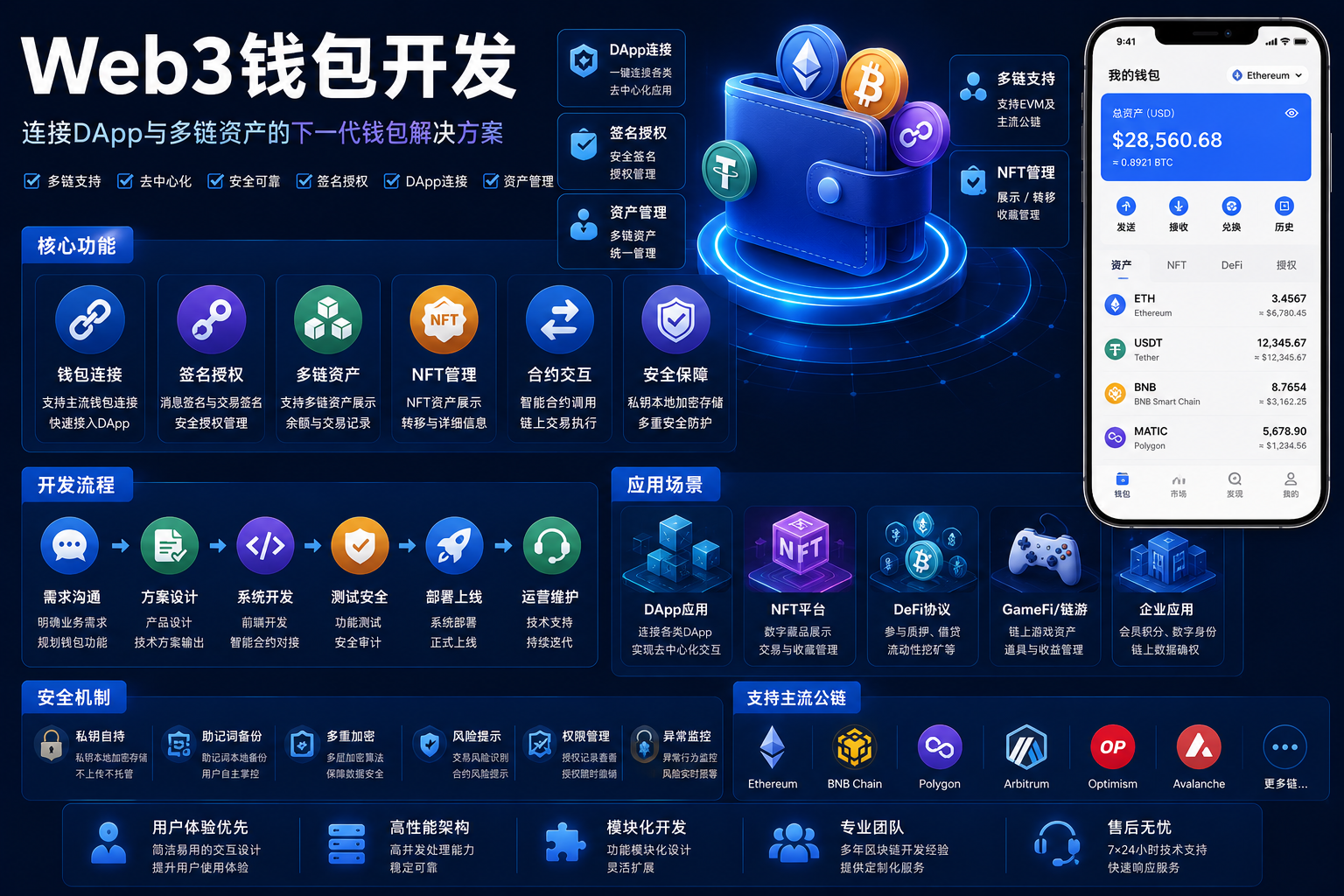
Web3 Wallet
Hong Kong Longlian provides Web3 wallet development, on-chain asset wallet systems, DAPP wallet connection, multi-chain asset management, decentralized wallets, signature authorization, on-chain transactions, NFT asset display, DeFi application access, and enterprise-grade Web3 wallet system customization services. Based on each project’s business scenario, supported chains, user asset types, security requirements, and application ecosystem plan, we provide secure, stable, and scalable Web3 wallet development solutions for DAPP platforms, NFT systems, DeFi projects, digital asset platforms, and enterprise on-chain applications.
What Is a Web3 Wallet
A Web3 wallet is an important entry point for users to access the blockchain application ecosystem. It can not only display digital asset balances, but also support DAPP login, on-chain signatures, contract authorization, asset transfers, NFT management, DeFi interaction, and multi-chain identity recognition. Compared with traditional account systems, Web3 wallets place more emphasis on users’ control over on-chain addresses, assets, and authorization actions, making them a key tool for connecting users, blockchain networks, and decentralized applications.
In Web3 applications, wallets usually serve as both an identity entry point and an asset entry point. Users can log in through wallet addresses, confirm identity through signatures, perform asset operations through on-chain transactions, and interact with smart contracts through authorization. For DAPPs, NFT platforms, blockchain games, DeFi systems, on-chain points platforms, and digital asset applications, a stable and easy-to-use Web3 wallet system can significantly improve user access efficiency.
During Web3 wallet development, Hong Kong Longlian plans wallet connection methods, multi-chain asset display, transaction signature processes, DAPP authorization logic, on-chain data reading, NFT asset display, backend configuration, and security prompts according to project requirements. We do not simply create a wallet connection button, but design the system around user experience, asset security, contract interaction, and future scalability.
Which Projects Are Suitable for Web3 Wallets
Web3 wallets are suitable for all projects that require on-chain identity, digital assets, smart contract interaction, and DAPP connection. They can be used as independent wallet products or as core functional modules in DAPPs, NFT platforms, DeFi systems, trading platforms, on-chain membership systems, or enterprise blockchain applications.
DAPP Application Platforms
Suitable for decentralized application platforms that require users to log in through wallets, sign authorizations, conduct on-chain transactions, and interact with contracts. It can support multi-chain DAPP connections and user asset display.
NFT Platform Systems
Suitable for digital collectibles, NFT marketplaces, NFT issuance platforms, and on-chain copyright projects. It supports NFT asset display, collectible transfers, minting authorization, and transaction record queries.
DeFi Application Systems
Suitable for staking, swaps, liquidity, on-chain wealth management, and asset interaction scenarios. It supports wallet authorization, contract calls, yield display, and on-chain operation confirmation.
Enterprise On-Chain Applications
Suitable for on-chain points, membership rights, digital asset management, supply chain proof, and enterprise data ownership platforms, helping enterprises build Web3-based user entry points.
Hong Kong Longlian Web3 Wallet Development Services
Hong Kong Longlian provides complete Web3 wallet development services, covering wallet connection, on-chain signatures, address binding, multi-chain asset display, DAPP authorization, smart contract interaction, NFT asset management, transaction records, risk prompts, backend configuration, and system deployment. We design wallet structures according to project goals, enabling wallets to meet current business needs while supporting future multi-chain ecosystem expansion.
1. Wallet Connection and Address Binding
Web3 wallet development first needs to solve user connection issues. The system can support users connecting wallets to DAPPs, completing address recognition, signature verification, account binding, and login status management. For platforms with existing user systems, traditional accounts can also be bound with on-chain wallet addresses, allowing users to use both account features and on-chain asset functions.
2. Multi-Chain Asset Display
Multi-chain asset display is an important function of Web3 wallets. The system can support unified display of different public chains, mainnet coins, contract tokens, NFT assets, and on-chain records. Users can view asset balances, asset types, transaction details, on-chain status, and contract asset information on the wallet page. For multi-ecosystem platforms, multi-chain support can improve future expansion capability.
3. Signature Authorization and Identity Verification
Web3 wallets usually use signatures to complete identity verification and operation confirmation. The system can support login signatures, message signatures, transaction signatures, contract authorization, permission confirmation, and authorization record management. Hong Kong Longlian designs clear signature prompts according to business scenarios to prevent users from making high-risk authorizations without understanding the operation, improving wallet security.
4. DAPP Contract Interaction
Web3 wallets need to interact with DAPPs and smart contracts. The system can support contract calls, transaction confirmation, event monitoring, on-chain returns, failure prompts, and transaction status tracking. Whether it is NFT minting, DeFi staking, asset swaps, on-chain points claiming, or digital copyright proof, users can complete on-chain operations through the wallet.
5. NFT Asset Management
For NFT platforms and digital collectible systems, Web3 wallets can display NFT assets held by users, including collectible names, images, numbers, contract addresses, on-chain records, transfer status, and transaction history. The system can also support NFT transfers, authorization, display, and favorites functions, improving users’ digital asset management experience.
6. Web3 Wallet Backend Management
Enterprise-grade Web3 wallet systems usually require backend management capabilities. The backend can support chain configuration, asset configuration, contract configuration, DAPP entry configuration, user address queries, transaction record viewing, authorization records, abnormal logs, API management, and operational data statistics. Through backend configuration, platforms can manage wallet functions and on-chain application entry points more flexibly.
Core Functional Modules of a Web3 Wallet
A mature Web3 wallet system needs to balance user-side experience, on-chain interaction capability, asset display, security prompts, and backend configuration. Hong Kong Longlian develops modular systems according to different business scenarios, ensuring clear structure, stable functions, and easy maintenance.
- Wallet Connection: Supports DAPP connection, address recognition, signature login, account binding, and connection status management.
- Multi-Chain Support: Supports multiple blockchain networks, mainnet coins, contract tokens, and on-chain asset display.
- Asset Management: Supports balance queries, asset lists, transaction records, transfer details, NFT assets, and on-chain status synchronization.
- Signature Authorization: Supports login signatures, message signatures, contract authorization, transaction confirmation, and authorization record queries.
- DAPP Interaction: Supports smart contract calls, transaction broadcasting, event monitoring, on-chain returns, and transaction status prompts.
- NFT Management: Supports NFT display, collectible details, number queries, authorization records, transfer records, and on-chain information display.
- Security Prompts: Supports risky authorization prompts, abnormal transaction alerts, contract risk prompts, and user operation confirmation.
- Backend Configuration: Supports chain management, asset management, contract management, DAPP entry points, transaction logs, and system parameter configuration.
- API Services: Supports integration with DAPPs, NFT platforms, DeFi systems, enterprise backends, and third-party applications.
Web3 Wallet Development Process
Web3 wallets involve user identity, on-chain assets, smart contracts, DAPP interaction, and secure authorization. Before development, the project type, supported chains, asset types, user flow, and risk control methods need to be clarified. Hong Kong Longlian uses a standardized development process to help clients clearly move projects toward implementation.
Requirement Communication
Understand the project type, supported chains, user asset types, DAPP interaction methods, NFT or DeFi requirements, and wallet usage scenarios.
Solution Planning
Plan wallet connection methods, signature processes, multi-chain structures, asset display, contract interaction, backend configuration, and security prompt rules.
Interface Design
Design wallet connection pages, asset homepages, transaction record pages, NFT display pages, authorization confirmation pages, DAPP entry points, and backend management pages.
System Development
Develop wallet connection, asset queries, signature authorization, contract calls, NFT display, transaction status, backend configuration, and API services.
Testing and Deployment
Conduct wallet connection testing, signature testing, contract interaction testing, multi-chain asset testing, abnormal transaction testing, and server deployment.
Launch and Maintenance
After launch, provide node monitoring, API maintenance, version upgrades, chain expansion, DAPP integration, and long-term technical support.
Differences Between Web3 Wallets and Exchange Wallets
Web3 wallets and exchange wallets both belong to digital asset wallet systems, but their functional priorities are different. Exchange wallets focus more on platform custody, deposits and withdrawals, hot and cold wallets, and asset collection. Web3 wallets focus more on user-controlled connection, on-chain signatures, DAPP interaction, and decentralized asset display. Before developing a wallet, enterprises need to choose a suitable wallet solution according to the project type.
| Comparison Item | Web3 Wallet | Exchange Wallet |
|---|---|---|
| Use Scenario | DAPPs, NFTs, DeFi, on-chain applications | Trading platforms, OTC systems, contract exchanges |
| User Identity | Identifies users through wallet addresses and signatures | Manages user assets through platform accounts and wallet addresses |
| Asset Control | Focuses more on user authorization and on-chain operations | Focuses more on platform custody, review, and fund scheduling |
| Core Functions | Wallet connection, signature authorization, contract interaction, multi-chain assets | Deposit monitoring, withdrawal review, asset collection, hot and cold wallets |
| Backend Focus | Chain configuration, contract configuration, DAPP entry points, transaction logs | Asset review, deposit and withdrawal records, collection management, risk control backend |
What Should Be Considered in Web3 Wallet Development
Web3 wallet development should first focus on user authorization security. When users sign, authorize, or confirm transactions in DAPPs, they need to clearly understand what operation they are performing. If authorization prompts are unclear, users may make mistakes. Therefore, the system should provide clear transaction descriptions, contract prompts, risk warnings, and operation confirmation processes.
Secondly, multi-chain compatibility needs to be planned in advance. Different blockchains have different address formats, asset standards, contract call methods, and transaction confirmation mechanisms. If expansion is handled temporarily later, development costs and maintenance complexity will increase. During Web3 wallet development, Hong Kong Longlian reserves multi-chain asset, contract configuration, and API expansion capabilities according to project planning.
In addition, Web3 wallets should also focus on user experience. Many users are not familiar with on-chain operations. If page processes are complicated, asset display is confusing, or signature prompts are unclear, user conversion will be affected. A good Web3 wallet system should allow users to connect quickly, view assets clearly, confirm transactions with confidence, and receive accurate prompts when exceptions occur.
Why Choose Hong Kong Longlian
Hong Kong Longlian is headquartered in Longhua District, Shenzhen, and focuses on blockchain development, Web3 wallet development, exchange wallets, DAPP applications, smart contracts, NFT systems, DeFi systems, anti-counterfeiting traceability, digital copyright, and enterprise software customization. In Web3 wallet development, we not only focus on whether wallet functions are usable, but also on whether on-chain interaction is stable, authorization processes are clear, user experience is smooth, and future expansion is convenient.
For DAPP projects, we can provide wallet connection, signature login, contract interaction, and on-chain transaction functions. For NFT platforms, we can provide NFT asset display, collectible authorization, and on-chain record queries. For DeFi systems, we can provide staking, swaps, yield display, and transaction confirmation. For enterprise on-chain applications, we can provide on-chain identity, membership rights, digital assets, and backend management functions.
We insist on customizing Web3 wallet structures according to project business needs and avoid blindly stacking functions. Clear signature processes, stable on-chain APIs, secure authorization prompts, easy-to-use asset display, and scalable backend configuration are the keys to long-term stable operation of a Web3 wallet system.
Related Blockchain Services
Web3 wallets are usually used together with DAPP development, smart contract development, NFT platform development, DeFi system development, multi-currency wallets, decentralized wallets, and public chain/mainnet development. If you are planning a Web3 wallet, on-chain asset wallet, DAPP entry point, or multi-chain asset management platform, you can continue to learn about Hong Kong Longlian blockchain development services , and we will provide a more suitable Web3 wallet development solution according to your project business process.
Frequently Asked Questions About Web3 Wallets
Is a Web3 wallet always a decentralized wallet?
Not necessarily. A Web3 wallet usually emphasizes on-chain connection and user authorization. It can be a non-custodial wallet or a built-in wallet connection module within a platform, depending on the project business and security design.
Can a Web3 wallet support NFT display?
Yes. The system can read NFT assets under a user address and display collectible images, numbers, contract information, on-chain records, and transfer status.
Can a Web3 wallet connect with a DAPP system?
Yes. A Web3 wallet itself is an important entry point for DAPPs and can support wallet login, signature authorization, contract calls, transaction confirmation, and on-chain data reading.
Can more chains be added to a Web3 wallet later?
Yes. As long as the early-stage architecture is reasonable, more chains, more assets, more DAPP entry points, and more contract interaction functions can be expanded later.
Get a Web3 Wallet Development Solution
If you are planning Web3 wallet development, on-chain asset wallets, DAPP wallet connection, multi-chain asset management, NFT wallets, DeFi wallets, decentralized wallets, or enterprise-grade Web3 application entry points, you are welcome to communicate your project requirements with Hong Kong Longlian. We will provide a Web3 wallet development solution that is more suitable for implementation according to your business scenario, supported chains, security requirements, and launch plan.