
Multi-Currency Wallet Development
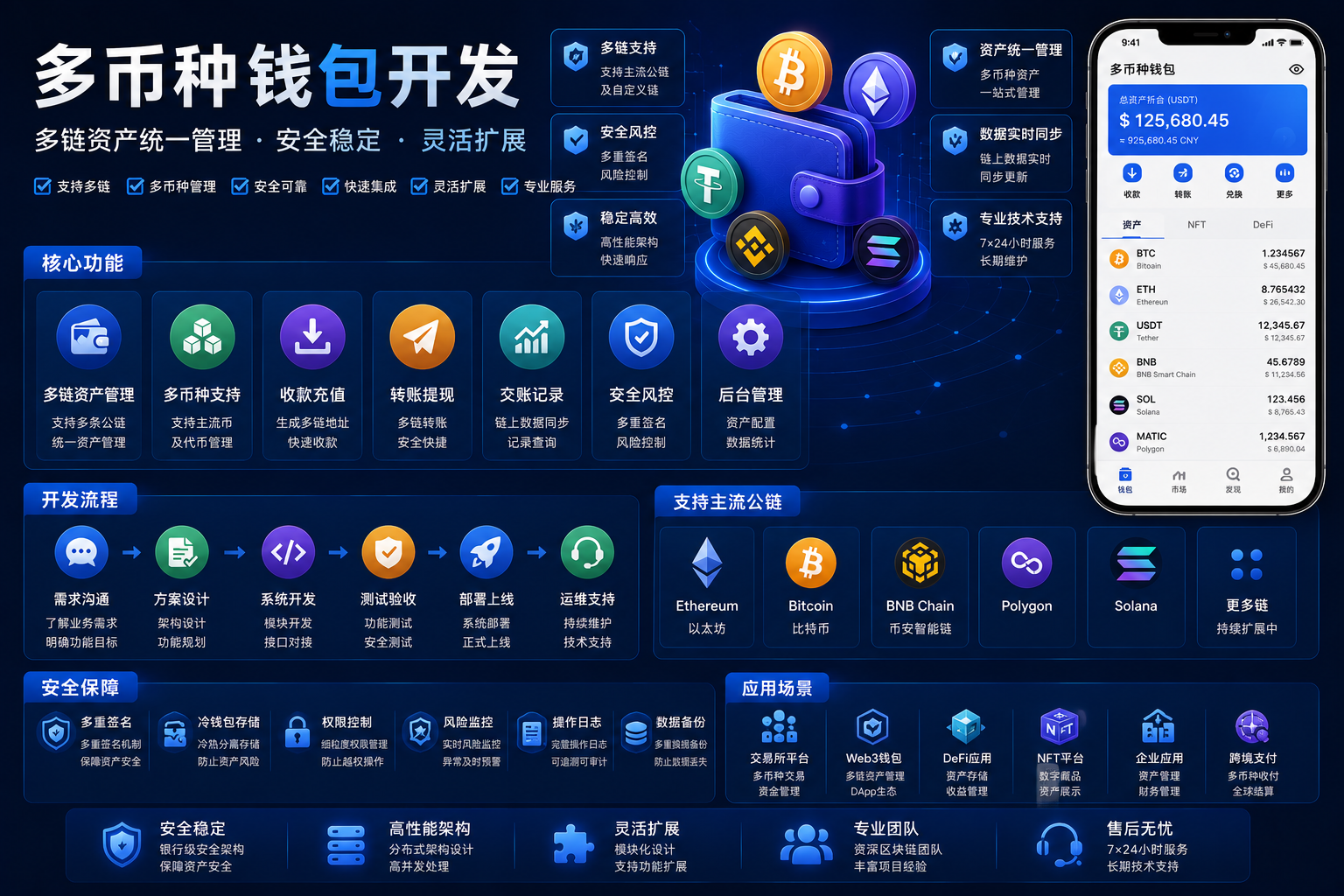
Multi-Currency Wallet
HK DragonChain provides multi-currency wallet development, multi-chain wallet systems, digital asset wallets, mainstream public chain asset integration, token management, on-chain balance queries, transfers and receipts, transaction history, multi-currency asset admin panels, and enterprise-grade wallet system customization services. Based on platform business scenarios, supported chains, currency types, asset security requirements, and future expansion plans, we offer secure, stable, and scalable multi-currency wallet development solutions for trading platforms, Web3 applications, DAPP systems, NFT platforms, DeFi projects, and enterprise digital asset management platforms.
What Is a Multi-Currency Wallet
A multi-currency wallet is a wallet system that can simultaneously support multiple blockchains, multiple mainnet coins, multiple token contracts, and different types of digital assets. Compared to single-currency wallets, multi-currency wallets need to handle different address formats, asset standards, fee structures, transaction architectures, confirmation mechanisms, and API call methods across different chains. This imposes higher requirements on system architecture, API stability, and admin management capabilities.
A complete multi-currency wallet system is not simply about displaying multiple asset names. It needs to support user address management, asset balance queries, deposit collections, transfers and withdrawals, transaction history, on-chain status synchronization, fee configuration, multi-chain node integration, admin asset analytics, and security risk control management. For trading platforms, digital asset platforms, Web3 applications, and enterprise asset systems, multi-currency wallets help users manage assets across different chains in a unified manner, improving platform efficiency.
In the multi-currency wallet development process, HK DragonChain plans supported chains, asset types, account systems, user-facing pages, admin panels, API services, and security strategies based on client business requirements. We prioritize later extensibility to avoid issues such as chaotic architecture, duplicate API development, and inconsistent asset data when adding new chains or currencies later.
Which Projects Are Suitable for Multi-Currency Wallets
Multi-currency wallets are suitable for platforms and applications that need to manage multiple digital assets in a unified manner. Whether centralized trading platforms, decentralized applications, Web3 wallets, NFT platforms, DeFi systems, cross-chain applications, or enterprise digital asset management systems, any project involving multi-chain asset display, deposits/withdrawals, transfers, or asset analytics can benefit from a multi-currency wallet system.
Digital Asset Trading Platforms
Suitable for spot trading, futures trading, OTC platforms, and digital asset exchanges, supporting multi-currency deposits/withdrawals, asset balances, address allocation, deposit monitoring, and withdrawal reviews.
Web3 Asset Wallets
Suitable for DAPPs, NFT platforms, on-chain applications, and decentralized services, supporting users viewing multi-chain assets, connecting wallets, signing authorizations, and on-chain interactions.
Enterprise Asset Management Platforms
Suitable for internal enterprise digital asset management, project fund management, on-chain account management, and multi-department permission approvals, supporting asset analytics, operation records, and admin reviews.
DeFi and Cross-Chain Applications
Suitable for staking, swaps, liquidity, cross-chain asset display, and on-chain yield platforms, supporting multi-asset display, contract interactions, transaction history, and yield data.
HK DragonChain Multi-Currency Wallet Development Services
HK DragonChain provides complete multi-currency wallet development services, covering multi-chain integration, asset management, address generation, balance queries, deposit monitoring, withdrawal reviews, transfers and receipts, transaction history, fee rules, admin panels, and security risk control. We design reasonable wallet architectures based on project development stages, ensuring the wallet system meets current business needs while supporting future addition of more chains and assets.
1. Multi-Chain Asset Integration
Multi-currency wallets typically need to integrate multiple mainstream public chains or enterprise-owned chains. Different chains have different address rules, transaction structures, node APIs, and confirmation mechanisms, requiring standardized handling in system architecture. HK DragonChain can plan multi-chain asset integration solutions based on project requirements, supporting unified management of mainnet coins, token contracts, stablecoins, platform coins, NFT assets, and other on-chain assets.
2. User Address Generation and Management
The wallet system needs to generate or bind wallet addresses for users on corresponding chains. The system can support single-chain addresses, multi-chain addresses, unified accounts, multi-asset addresses, address status management, address import, address binding, and address extension. For trading platforms, address management must coordinate with deposit monitoring, confirmation detection, asset aggregation, and admin reviews. For Web3 wallets, greater emphasis is placed on user connections, signatures, and on-chain identity recognition.
3. Asset Balances and Transaction History
Multi-currency wallets need to accurately display user asset balances across different chains, currencies, and accounts. The system can support balance queries, asset details, equivalent value display, transaction history, transfer records, deposit records, withdrawal records, and on-chain status synchronization. For multi-chain platforms, asset data must be clear and unified; otherwise, users may misunderstand as asset loss or inaccurate balances.
4. Deposit Collections and Arrival Monitoring
For trading platforms and custodial wallets, multi-currency wallets need to support deposit collection functions. The system can set deposit addresses, confirmation count rules, arrival monitoring, transaction hash records, deposit status, abnormal deposit handling, and arrival notifications based on different chains. HK DragonChain designs monitoring rules based on different currency characteristics to ensure accurate asset arrival records.
5. Withdrawals, Transfers, and Risk Control Reviews
When users withdraw or transfer, the system needs to verify asset balances, withdrawal addresses, fees, on-chain status, and risk control rules. Platforms can set withdrawal limits, manual reviews, multi-level approvals, blacklisted addresses, anomaly alerts, and operation logs. After approval, the system completes on-chain transaction broadcasting, status tracking, and result callbacks, forming a complete withdrawal workflow.
6. Multi-Currency Wallet Admin Panel
The multi-currency wallet admin panel can support chain configuration, currency configuration, asset configuration, fee configuration, deposit records, withdrawal records, user assets, address management, transaction hashes, node status, asset analytics, permission management, and log tracking. Through the admin panel, platforms can more conveniently maintain different currencies and on-chain assets.
Core Functional Modules of Multi-Currency Wallets
A stable multi-currency wallet system needs to simultaneously possess user-side asset display, on-chain data synchronization, admin management, API services, and security risk control capabilities. HK DragonChain performs modular development based on project requirements, ensuring clear system structure, easy maintenance, and future extensibility.
- Multi-Chain Management: Supports integration of multiple blockchain networks, chain configuration, node APIs, network status, and on-chain data synchronization.
- Currency Management: Supports configuration of mainnet coins, token contracts, stablecoins, platform coins, NFT assets, and more digital assets.
- Address Management: Supports user address generation, address binding, multi-chain addresses, address status, address queries, and address extension.
- Asset Display: Supports asset balance, asset details, equivalent value display, transaction history, deposit records, and withdrawal record display.
- Deposit Monitoring: Supports on-chain deposit identification, confirmation count assessment, transaction hash recording, arrival notifications, and exception handling.
- Withdrawals and Transfers: Supports withdrawal requests, address verification, fee calculation, review workflow, transaction broadcasting, and status callbacks.
- Fee Configuration: Supports fee rules and admin adjustments for different chains, currencies, and transfer methods.
- Admin Analytics: Supports user asset analytics, platform asset reports, deposit/withdrawal data, currency data, and operational analysis.
- Security Risk Control: Supports permission controls, withdrawal limits, anomaly alerts, blacklisted addresses, operation logs, and multi-level reviews.
Multi-Currency Wallet Development Process
Multi-currency wallets involve multiple chains, multiple assets, and multiple API rule sets. Before development, current platform requirements and future expansion plans must be clarified. HK DragonChain helps clients map out supported chains, asset types, account systems, user workflows, admin permissions, and security strategies in the early project phase.
Requirements Gathering
Clarify project type, supported chains, currency scope, user asset scenarios, deposit/withdrawal processes, admin management needs, and security requirements.
Architecture Planning
Plan multi-chain structure, account systems, asset models, address rules, node APIs, data synchronization, and admin management modules.
Interface Design
Design asset homepages, currency detail pages, receive pages, transfer pages, transaction history, user centers, and admin management pages.
Feature Development
Develop address generation, balance queries, deposit monitoring, withdrawal transfers, multi-currency management, API services, and risk control admin.
Testing & Deployment
Conduct multi-chain testing, asset synchronization testing, deposit testing, withdrawal testing, API testing, exception testing, and server deployment.
Maintenance & Expansion
Provide post-launch chain expansion, new currency addition, node maintenance, data reconciliation, version upgrades, and long-term technical support.
Differences Between Multi-Currency and Single-Currency Wallets
Single-currency wallets typically only need to handle one chain or one asset, making system structures relatively simple. Multi-currency wallets need to handle multiple asset standards, multiple on-chain interfaces, multiple fee rules, and different transaction confirmation mechanisms, resulting in higher system complexity and greater demands on architecture design and maintenance capabilities.
| Comparison Item | Single-Currency Wallet | Multi-Currency Wallet |
|---|---|---|
| Asset Scope | Typically supports only a single chain or single asset | Supports multiple chains, multiple currencies, multiple asset types |
| API Complexity | API rules are relatively uniform | Needs to adapt to different chain node, transaction, and query rules |
| Admin Management | Currency configuration and asset management are simpler | Requires unified management of chains, currencies, fees, assets, and nodes |
| Extensibility | Later addition of assets may require significant rework | Can continuously expand to more chains and assets through modular architecture |
| Applicable Scenarios | Single-asset projects or simple payment scenarios | Trading platforms, Web3 applications, DAPPs, NFTs, and enterprise asset platforms |
Key Considerations in Multi-Currency Wallet Development
The most important consideration in multi-currency wallet development is architectural extensibility. If only designed for a single currency initially, later addition of chains can lead to chaotic APIs, scattered asset data, and difficult admin configuration. Therefore, multi-currency wallets should plan chain management, currency management, asset models, fee configuration, and a unified API layer from the very beginning.
Second, asset data accuracy must be prioritized. Different chains have different confirmation mechanisms, and transaction statuses may experience delays or failures. The system needs to set confirmation counts, fee rules, transaction statuses, exception handling, and data reconciliation mechanisms based on different currencies to avoid missed deposits, inconsistent withdrawal statuses, or incorrect balance displays.
Additionally, security risk control must be comprehensive. Multi-currency wallets involve multiple assets and multiple chains, requiring clear design of admin permissions, withdrawal reviews, address verification, blacklist management, operation logs, and anomaly alerts. HK DragonChain plans different security strategies based on project scale in multi-currency wallet development to help platforms enhance asset management capabilities.
Why Choose HK DragonChain
HK DragonChain, headquartered in Shenzhen's Longhua District, specializes in blockchain development, multi-currency wallet development, Web3 wallets, exchange wallets, DAPP applications, smart contracts, NFT systems, DeFi systems, anti-counterfeit traceability, and digital copyright system customization. In multi-currency wallet development, we focus not only on whether assets can be displayed but also on API stability, data accuracy, admin usability, and system extensibility.
For trading platforms, we provide multi-currency deposits/withdrawals, asset aggregation, hot/cold wallets, and risk control admin panels. For Web3 projects, we provide multi-chain asset display, wallet connections, signature authorizations, and DAPP interactions. For enterprise asset systems, we provide multi-account asset management, permission approvals, operation logs, and data reports.
We insist on planning wallet systems based on business requirements without unnecessary feature stacking. Clear asset models, stable on-chain APIs, accurate balance synchronization, comprehensive admin configuration, and reliable security risk control are the keys to long-term stable multi-currency wallet operation.
Related Blockchain Services
Multi-currency wallets are typically used in conjunction with exchange wallets, Web3 wallets, decentralized wallets, DAPP development, smart contract development, NFT platform development, and DeFi system development. If you are planning a multi-chain wallet, multi-currency asset platform, or enterprise digital asset management system, you can continue to explore HK DragonChain's blockchain development services. We will provide a more implementable multi-currency wallet development solution based on your project business processes.
Multi-Currency Wallet FAQs
What assets can a multi-currency wallet support?
Multi-currency wallets can support mainnet coins, token contracts, stablecoins, platform coins, NFT assets, and more on-chain digital assets based on project requirements. The specific support scope can be determined based on business planning.
Can new currencies be added to a multi-currency wallet later?
Yes. As long as the initial architecture is properly designed, new chains, currencies, asset standards, fee rules, and admin configurations can be added later.
Is a multi-currency wallet suitable for exchanges?
Yes. Exchanges typically need to support multiple asset deposits/withdrawals, arrival monitoring, withdrawal reviews, asset aggregation, and admin analytics. A multi-currency wallet can serve as the core asset module.
What is the relationship between multi-currency wallets and Web3 wallets?
Web3 wallets can include multi-currency asset display and multi-chain management features, while multi-currency wallets emphasize unified management of multiple assets. Both can be developed together to form a complete wallet system.
Get a Multi-Currency Wallet Development Solution
If you are planning multi-currency wallet development, multi-chain wallet systems, digital asset wallets, trading platform asset management, Web3 multi-chain wallets, DAPP asset wallets, or enterprise digital asset management platforms, you are welcome to discuss your project requirements with HK DragonChain. We will provide a more implementable multi-currency wallet development solution based on your supported chains, currency scope, security requirements, and launch plans.