
Decentralized Wallet Development
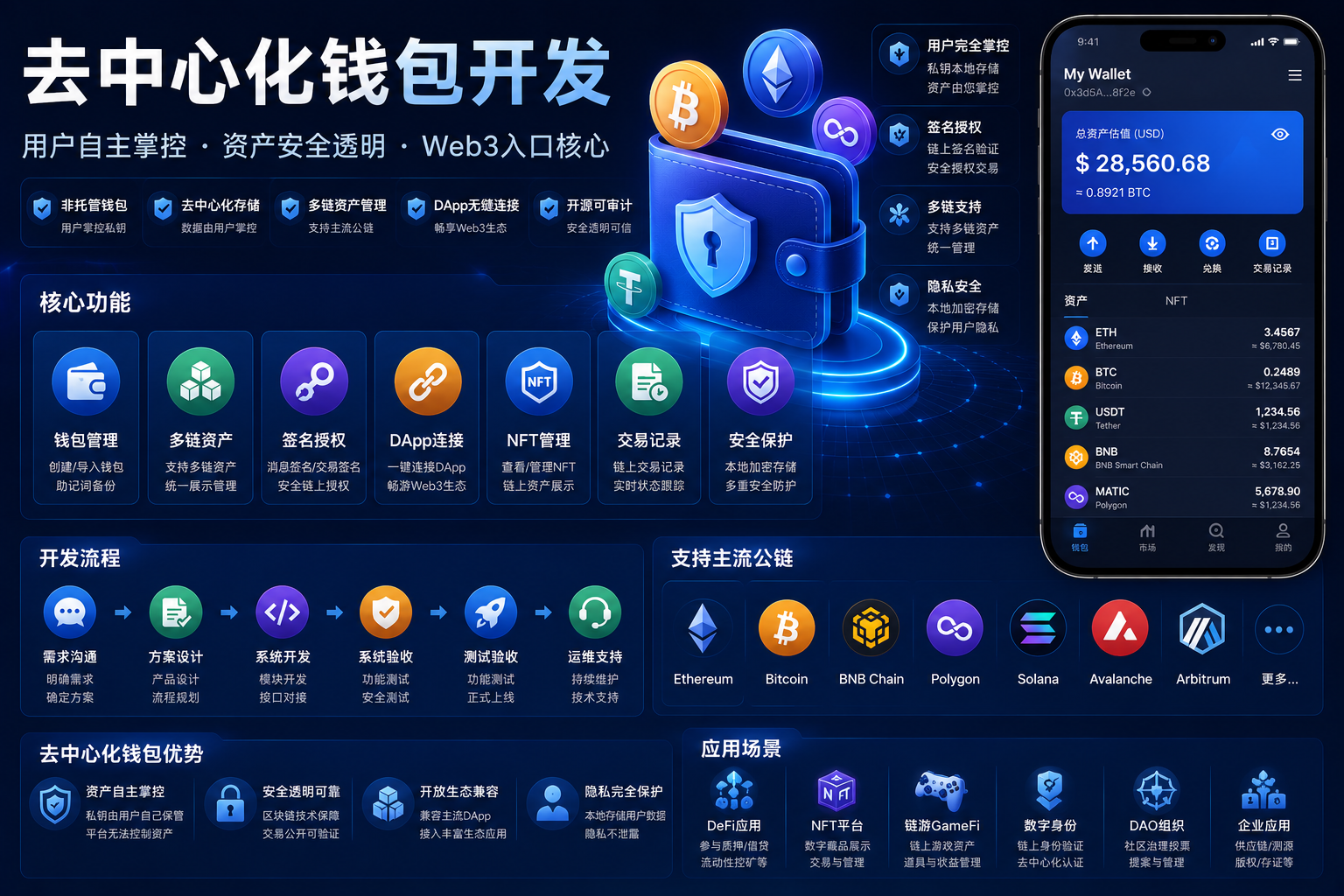
Decentralized Wallet
HK DragonChain provides decentralized wallet development, non-custodial wallet systems, Web3 wallets, private key wallets, mnemonic wallets, multi-chain asset wallets, DAPP connections, signature authorizations, on-chain transactions, NFT asset management, and enterprise-grade decentralized wallet system customization services. Based on project business scenarios, supported chains, security requirements, user experience, and future ecosystem planning, we offer secure, stable, and scalable decentralized wallet development solutions for DAPP platforms, NFT systems, DeFi applications, Web3 projects, and digital asset management platforms.
What Is a Decentralized Wallet
A decentralized wallet is a wallet system where users have autonomous control over their on-chain assets and account permissions. Unlike platform-custodial wallets, decentralized wallets typically do not have the platform centrally storing user private keys. Users can manage their digital assets through mnemonics, private keys, hardware wallets, or on-chain signatures. It emphasizes user autonomy, transparent on-chain interactions, DAPP connections, and multi-chain asset management, serving as a critical foundational entry point in the Web3 ecosystem.
In a decentralized wallet system, wallet addresses can serve both as user identities and asset accounts. Users complete login, signatures, authorizations, transfers, receipts, contract interactions, NFT viewing, and DeFi operations through the wallet. For DAPP applications, NFT platforms, on-chain memberships, digital copyright, DeFi systems, and enterprise blockchain applications, decentralized wallets enable users to participate in business processes with on-chain identities, improving connection efficiency between platforms and blockchain networks.
In the decentralized wallet development process, HK DragonChain prioritizes private key security, mnemonic management, signature authorization, on-chain interactions, risk alerts, multi-chain compatibility, and user experience. We don't just build a simple wallet page. Instead, we comprehensively plan around user asset security, DAPP usage workflows, contract interaction stability, and future extensibility to help projects establish wallet systems truly suitable for long-term operations.
Which Projects Are Suitable for Decentralized Wallets
Decentralized wallets are suitable for projects that require users to autonomously control on-chain identities, digital assets, and authorization operations. If a platform involves DAPP interactions, NFT assets, DeFi protocols, on-chain points, digital copyright, on-chain memberships, digital collectibles, or multi-chain asset management, building a decentralized wallet or integrating a decentralized wallet module should be considered.
DAPP Application Entry
Suitable for decentralized applications, on-chain tools, membership benefits, and smart contract platforms, supporting users through wallet connections, signature logins, authorization confirmations, and on-chain operations.
NFT Asset Management
Suitable for NFT platforms, digital collectibles, on-chain copyright, and virtual asset projects, supporting NFT display, collection details, transfer records, contract information, and on-chain proof queries.
DeFi Application Systems
Suitable for staking, swapping, lending, yield display, and on-chain wealth management scenarios, supporting user autonomous authorizations, contract calls, transaction confirmations, and asset status viewing.
Enterprise Web3 Platforms
Suitable for enterprise on-chain points, digital identities, supply chain attestation, copyright management, and multi-party collaboration platforms, helping enterprises build more open on-chain user entry points.
HK DragonChain Decentralized Wallet Development Services
HK DragonChain provides complete decentralized wallet development services, covering wallet creation, mnemonic management, private key import, address generation, multi-chain asset display, signature authorization, DAPP connections, NFT management, transaction history, risk alerts, admin configuration, and system deployment. We design wallet features based on client project positioning and target users, ensuring the system is both secure and user-friendly.
1. Wallet Creation and Account Management
Decentralized wallet development first requires establishing a clear wallet account system. The system can support wallet creation, wallet import, address generation, account switching, wallet naming, address copying, QR code receipt, and multi-account management. For platforms requiring multi-chain support, corresponding addresses can be generated for different chains and displayed uniformly within the same user interface.
2. Mnemonic and Private Key Management
Mnemonics and private keys are at the core of decentralized wallet security. The system can support mnemonic generation, private key import, wallet backup prompts, local encrypted storage, password protection, security alerts, and recovery process design. During development, HK DragonChain prioritizes security prompts and user guidance to prevent users from risking assets due to not understanding the importance of mnemonics.
3. Multi-Chain Asset Display
Decentralized wallets typically need to support multi-chain asset display, including mainnet coins, token contracts, stablecoins, NFT assets, and more on-chain assets. The system can support balance queries, asset lists, asset details, transaction history, on-chain status synchronization, and equivalent value display. For Web3 projects, multi-chain asset display can enhance the wallet's utility as an entry tool.
4. DAPP Connection and Signature Authorization
Decentralized wallets need to support DAPP connections and signature authorizations. Users can connect to DAPPs through the wallet, completing identity verification, message signatures, transaction signatures, contract authorizations, and on-chain transaction confirmations. The system should display clear prompts before each signature or authorization, informing users what they are authorizing, which contract they are calling, and what potential outcomes may occur.
5. Transfers, Receipts, and Transaction History
The wallet system can support on-chain transfers, receipt QR codes, address books, fee displays, transaction confirmations, transaction hashes, failure prompts, and transaction history queries. Different blockchains have different fees, confirmation speeds, and transaction structures. The system needs to adapt based on chain-specific rules to ensure clear user workflows and traceable transaction statuses.
6. NFT and On-Chain Asset Management
For NFT platforms and digital collectible projects, decentralized wallets can support NFT asset display, collection IDs, contract addresses, on-chain records, transfer statuses, and authorization information. Users can view their held digital assets through the wallet and complete transfers, display, collection, and contract interactions based on project requirements.
Core Functional Modules of Decentralized Wallets
A mature decentralized wallet system needs to balance user-side operations, on-chain interfaces, asset display, security protection, and DAPP interactions. HK DragonChain performs modular development based on actual project requirements, ensuring clear wallet structure, stable features, and future extensibility.
- Wallet Creation: Supports wallet creation, wallet import, mnemonic generation, private key import, account switching, and wallet recovery.
- Address Management: Supports multi-chain addresses, receipt QR codes, address copying, address books, account notes, and address status management.
- Asset Display: Supports mainnet coins, token contracts, stablecoins, NFT assets, balance queries, and transaction history display.
- Signature Authorization: Supports login signatures, message signatures, transaction signatures, contract authorizations, and authorization record viewing.
- DAPP Connection: Supports DAPP entry, contract calls, on-chain transactions, event returns, and interaction status prompts.
- Transfers and Receipts: Supports on-chain transfers, fee displays, receipt QR codes, transaction hashes, status tracking, and failure alerts.
- Security Protection: Supports local encryption, password protection, mnemonic alerts, risk authorization prompts, and abnormal operation alerts.
- Admin Configuration: Supports chain configuration, asset configuration, DAPP entry, contract addresses, API parameters, and data analytics.
- Extensibility: Supports later integration of more public chains, more assets, NFT modules, DeFi modules, and enterprise application scenarios.
Decentralized Wallet Development Process
Decentralized wallet development involves private key security, on-chain assets, DAPP authorizations, and multi-chain APIs. Therefore, wallet type, supported chains, asset scope, user workflows, and security strategies must be clarified before development. HK DragonChain adopts a standardized process to help clients progressively implement from requirements planning to launch and maintenance.
Requirements Gathering
Clarify project type, wallet positioning, supported chains, asset scope, DAPP interaction needs, NFT or DeFi features, and security requirements.
Solution Planning
Plan wallet creation methods, private key management, multi-chain structure, asset display, signature workflows, DAPP connections, and risk alert rules.
Interface Design
Design wallet homepages, asset details, receipt pages, transfer pages, DAPP connection pages, authorization confirmation pages, and NFT display pages.
System Development
Develop wallet creation, address management, asset queries, signature authorization, on-chain transactions, NFT display, DAPP connections, and admin configuration.
Testing & Acceptance
Conduct private key recovery testing, signature testing, transfer testing, multi-chain asset testing, DAPP interaction testing, and exception flow testing.
Launch & Maintenance
Provide post-launch chain expansion, API maintenance, feature upgrades, data monitoring, security optimization, and long-term technical support.
Differences Between Decentralized Wallets and Custodial Wallets
Both decentralized wallets and custodial wallets can be used for digital asset management, but they differ in asset control methods. Custodial wallets are typically managed by the platform for asset management and admin review, making them more suitable for exchanges, OTC platforms, and platform account systems. Decentralized wallets emphasize user autonomy and are suitable for DAPP, NFT, DeFi, and Web3 application scenarios.
| Comparison Item | Decentralized Wallet | Custodial Wallet |
|---|---|---|
| Asset Control | Users control private keys or mnemonics | Platform manages asset custody and accounts |
| Primary Scenarios | DAPP, NFT, DeFi, Web3 applications | Exchanges, OTC platforms, enterprise asset admin |
| User Operations | Users sign, authorize, and confirm transactions | Users submit requests, platform reviews and processes |
| Admin Focus | Chain configuration, DAPP entry, contract management, risk alerts | Deposit monitoring, withdrawal review, asset aggregation, hot/cold wallets |
| Security Focus | Private key protection, mnemonic backup, authorization prompts | Permission controls, review workflows, fund isolation, risk control admin |
Key Considerations in Decentralized Wallet Development
The most important aspect of decentralized wallet development is security prompts and user education. Since users autonomously control asset permissions, mnemonics, private keys, and signature authorizations all require clear risk explanations. The system should prevent users from performing high-risk operations without understanding the authorization content, especially in scenarios such as contract authorizations, asset transfers, NFT authorizations, and DeFi interactions.
Second, multi-chain compatibility and asset synchronization must be prioritized. Different public chains have different address rules, transaction confirmations, fee models, and asset standards. The system needs robust unified APIs and state handling. Asset data displayed to users in the wallet must be as accurate as possible, transaction statuses traceable, and failure reasons clearly indicated to prevent users from mistakenly believing assets are lost.
Additionally, decentralized wallets should not only pursue feature quantity but also prioritize user workflows. Wallet creation, backup, recovery, transfers, signatures, DAPP connections, and NFT viewing should all remain clear and concise. In development, HK DragonChain optimizes page structures based on user journeys to lower the barrier for ordinary users entering Web3 applications.
Why Choose HK DragonChain
HK DragonChain, headquartered in Shenzhen's Longhua District, specializes in blockchain development, decentralized wallet development, Web3 wallets, exchange wallets, multi-currency wallets, DAPP applications, smart contracts, NFT systems, DeFi systems, anti-counterfeit traceability, and digital copyright system customization. In decentralized wallet development, we focus not only on feature completeness but also on user asset security, signature workflows, on-chain interactions, system extensibility, and long-term maintenance.
For DAPP projects, we provide wallet connections, signature authorizations, contract interactions, and on-chain transaction features. For NFT platforms, we provide NFT asset display, collection transfers, and authorization records. For DeFi applications, we provide staking, swapping, yield queries, and contract calls. For enterprise Web3 platforms, we provide on-chain identities, digital assets, membership benefits, and admin configuration features.
We insist on customizing wallet solutions based on actual project business, avoiding unnecessary feature stacking. Clear account structures, secure mnemonic workflows, stable on-chain APIs, explicit authorization prompts, and extensible system architecture are the keys to long-term stable decentralized wallet operation.
Related Blockchain Services
Decentralized wallets are typically used in conjunction with Web3 wallets, multi-currency wallets, DAPP development, smart contract development, NFT platform development, DeFi system development, and public/mainnet chain development. If you are planning a decentralized wallet, non-custodial wallet, on-chain asset wallet, or Web3 application entry point, you can continue to explore HK DragonChain's blockchain development services. We will provide a more implementable decentralized wallet development solution based on your project business processes.
Decentralized Wallet FAQs
Are decentralized wallets and Web3 wallets the same?
They overlap but are not identical. Web3 wallets emphasize connecting to DAPPs and on-chain applications, while decentralized wallets emphasize user autonomy over private keys and assets. Both can be developed together.
Can decentralized wallets support multi-chain assets?
Yes. The system can support multiple public chains, multiple mainnet coins, token contracts, NFT assets, and more on-chain digital assets based on project requirements.
Do decentralized wallets require admin panels?
For enterprise-grade projects, admin configuration capabilities are recommended for managing chains, assets, DAPP entry points, contract addresses, system parameters, and operational data.
Can decentralized wallets integrate NFTs and DeFi later?
Yes. As long as the initial architecture is reasonable, later expansions can include NFT display, DeFi interactions, DAPP entry, multi-chain assets, and more smart contract features.
Get a Decentralized Wallet Development Solution
If you are planning decentralized wallet development, non-custodial wallet systems, private key wallets, mnemonic wallets, multi-chain asset wallets, DAPP connections, NFT wallets, DeFi wallets, or enterprise-grade Web3 wallet entry points, you are welcome to discuss your project requirements with HK DragonChain. We will provide a more implementable decentralized wallet development solution based on your supported chains, asset types, security requirements, and launch plans.