
DAPP Contract Development
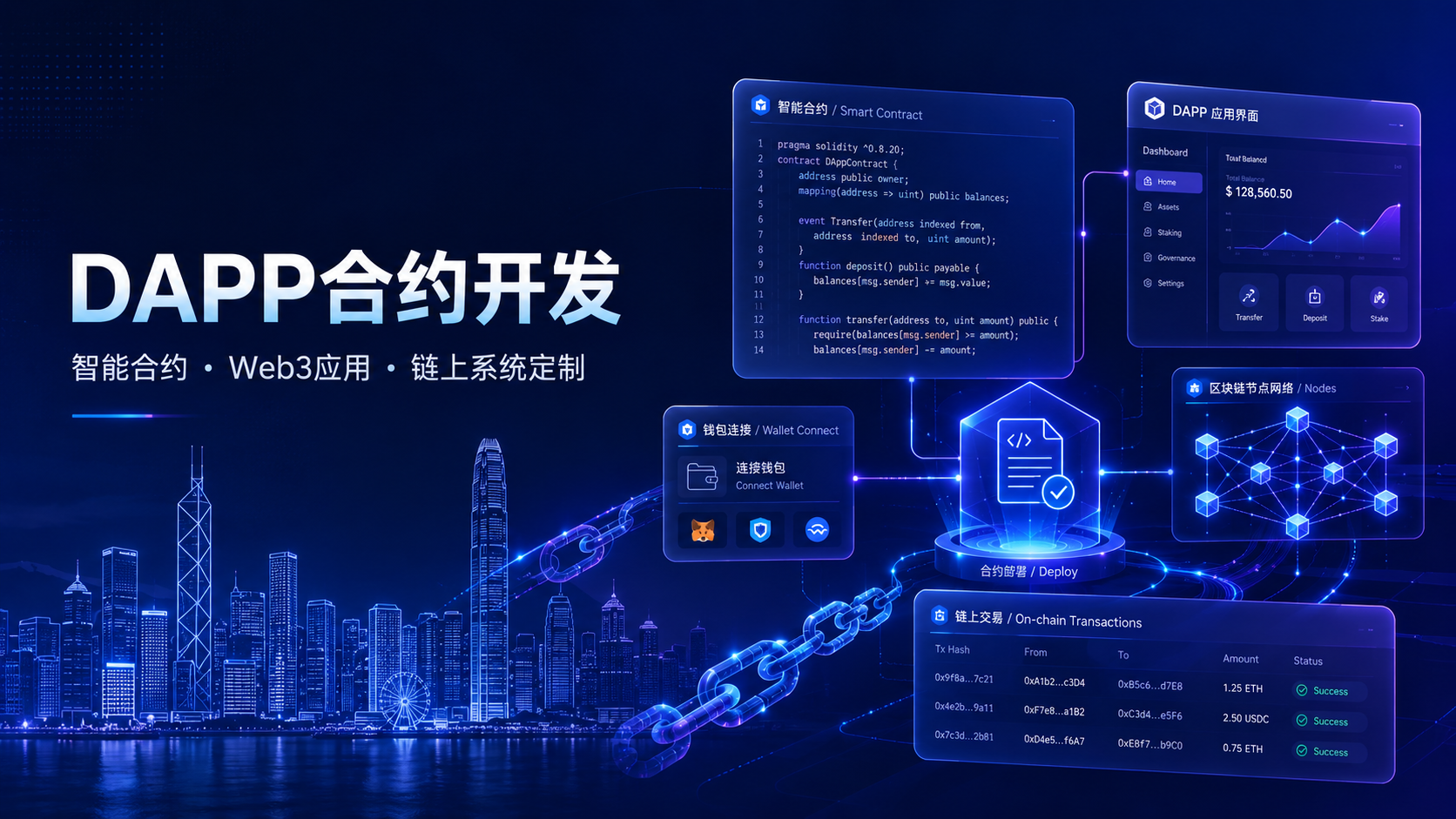
DAPP Contract
HK DragonChain provides DAPP contract development, smart contract development, Web3 application contracts, NFT contracts, DeFi contracts, on-chain points contracts, membership benefit contracts, digital copyright contracts, asset issuance contracts, wallet connection and contract interaction, and enterprise-grade on-chain application system customization services. Based on project business scenarios, contract rules, security requirements, supported chains, admin management, and future operational planning, we offer secure, stable, and scalable DAPP contract development solutions for DAPP platforms, NFT systems, DeFi applications, Web3 projects, and blockchain application platforms.
What Is a DAPP Contract
A DAPP contract is the core business logic layer in decentralized applications, typically running on blockchain networks to handle on-chain assets, user authorizations, transaction confirmations, benefit distributions, data records, and business state changes. When users complete wallet connections, signature authorizations, asset operations, or functional interactions on DAPP pages, smart contracts are often required to execute on-chain operations behind the scenes.
Unlike ordinary internet applications, DAPP contracts are not simply back-end API logic. They need to write critical business rules on-chain, making operation results public, verifiable, and traceable. For NFT platforms, DeFi systems, on-chain points, digital copyright, membership benefits, DAO governance, and Web3 applications, DAPP contracts determine whether the system can operate stably and whether business rules are clear and reliable.
In the DAPP contract development process, HK DragonChain prioritizes contract architecture, asset rules, permission boundaries, on-chain data, wallet interactions, security testing, and future extensibility. We don't just provide simple contract code. Instead, we combine front-end DAPP pages, admin systems, on-chain data services, and project operational requirements to help enterprises build on-chain business systems suitable for long-term operation.
Which Projects Are Suitable for DAPP Contracts
DAPP contracts are suitable for projects that need to write business rules, asset transfers, user benefits, or data credentials onto the blockchain. If a platform involves wallet connections, NFT assets, DeFi protocols, on-chain points, digital copyright, membership benefits, DAO voting, asset issuance, or multi-party collaboration, DAPP contracts can establish clearer on-chain execution mechanisms.
DAPP Application Platforms
Suitable for Web3 applications, on-chain tools, decentralized platforms, and enterprise blockchain applications, supporting wallet login, signature authorization, contract calls, and on-chain data recording.
NFT and Digital Assets
Suitable for NFT platforms, digital collectibles, copyright credentials, membership cards, and brand benefit projects, supporting minting, transfers, burning, royalties, and on-chain rights confirmation.
DeFi Contract Systems
Suitable for staking, swapping, liquidity pools, yield distribution, lock-up releases, and on-chain financial applications, supporting user authorizations, asset interactions, and transaction confirmations.
On-Chain Points and Benefits
Suitable for enterprise memberships, point rewards, activity benefits, discount credentials, and cross-platform benefit transfers, helping enterprises build more open on-chain user systems.
HK DragonChain DAPP Contract Development Services
HK DragonChain provides complete DAPP contract development services, covering contract solution design, smart contract writing, DAPP front-end interactions, wallet connections, admin management, on-chain data synchronization, testnet deployment, mainnet launch, and post-launch maintenance. We design contract features based on client project positioning and business processes, ensuring the system aligns with on-chain execution logic while being convenient for enterprise operations management.
1. Smart Contract Architecture Design
DAPP contract development first requires establishing a clear contract architecture. The system can split asset contracts, business logic contracts, permission management contracts, data record contracts, and upgrade management modules based on business needs. Reasonable contract splitting can reduce later maintenance difficulty and maintain better stability during feature expansion.
2. Asset Issuance and Transfer Rules
If the project involves tokens, NFTs, points, credentials, or other on-chain assets, issuance quantities, transfer conditions, burning methods, freeze rules, fee mechanisms, and permission boundaries need to be designed. HK DragonChain maps asset flows based on actual business to avoid issues such as unclear rules, chaotic permissions, or operational difficulties after contract launch.
3. Wallet Connection and Signature Authorization
DAPP contracts typically need to work with wallet systems. Users can complete identity confirmation, message signatures, transaction signatures, contract authorizations, and on-chain operations through wallets. The system should display clear prompts before each authorization, informing users which contract is being called, what operation is being performed, and what potential outcomes may occur.
4. DAPP Front-End Interaction Development
The DAPP front-end is responsible for displaying contract data and guiding users through on-chain operations. Pages can support wallet connections, network switching, asset display, transaction submission, status queries, operation confirmations, and error prompts. Clear front-end workflows can reduce user errors and improve on-chain interaction success rates.
5. Admin Management System
Enterprise-grade DAPP projects typically require admin management systems for viewing user data, on-chain events, order records, asset records, activity configurations, permission roles, contract addresses, and exception logs. Admin systems help operations teams manage projects more efficiently rather than relying solely on block explorers for queries.
6. Contract Testing and Deployment Maintenance
DAPP contracts require functional testing, permission testing, boundary testing, exception testing, and on-chain interaction testing before launch. HK DragonChain can perform testnet deployment, mainnet deployment, contract review, API integration, and post-launch maintenance based on project requirements, helping reduce launch risks.
Core Functional Modules of DAPP Contracts
A mature DAPP contract system needs to balance on-chain execution, user interaction, admin configuration, data synchronization, and security protection. HK DragonChain performs modular development based on actual project requirements, ensuring clear DAPP contract structure, stable features, and future extensibility.
- Contract Design: Supports business rule mapping, contract module splitting, data structure design, permission boundary planning, and upgrade solution design.
- Asset Rules: Supports tokens, NFTs, points, benefit credentials, issuance quantities, transfer conditions, burning mechanisms, and fee configuration.
- Wallet Interaction: Supports wallet connection, signature login, message signatures, transaction signatures, authorization confirmation, and on-chain transaction submission.
- DAPP Front-End: Supports on-chain data display, transaction status prompts, contract calls, network switching, error alerts, and user operation guidance.
- Admin Management: Supports contract address configuration, asset data, user records, order records, activity parameters, permission roles, and log queries.
- On-Chain Data: Supports event listening, transaction hashes, status synchronization, data indexing, asset records, and on-chain credential queries.
- Security Controls: Supports permission management, multi-signature mechanisms, pause mechanisms, risk alerts, exception handling, and pre-deployment testing review.
- System Extensibility: Supports later integration of more public chains, more assets, NFT modules, DeFi modules, wallet modules, and enterprise application scenarios.
DAPP Contract Development Process
DAPP contract development involves business rules, on-chain assets, wallet signatures, contract deployment, and admin management. Therefore, project type, asset models, user workflows, supported chains, and security strategies must be clarified before development. HK DragonChain adopts a standardized process to help clients progressively implement from requirements planning to launch and maintenance.
Requirements Gathering
Clarify project type, business scenarios, contract features, asset types, wallet connection, admin needs, supported chains, and launch plans.
Solution Planning
Plan contract architecture, asset rules, permission mechanisms, data fields, transaction workflows, event logs, and system extensibility approaches.
Interface Design
Design DAPP homepages, wallet connection pages, contract interaction pages, asset detail pages, transaction confirmation pages, and admin management pages.
System Development
Develop smart contracts, DAPP front-end, wallet interactions, admin management, data APIs, event listeners, and on-chain query features.
Testing & Acceptance
Conduct functional testing, permission testing, signature testing, transaction testing, exception testing, asset flow testing, and on-chain data verification.
Launch & Maintenance
Complete testnet deployment, mainnet deployment, API integration, data monitoring, feature upgrades, security optimization, and long-term technical support.
Differences Between DAPP Contracts and Ordinary Application Back-Ends
Both DAPP contracts and ordinary application back-ends can handle business logic, but their execution environments and trust models differ. Ordinary back-ends primarily run on enterprise servers, suitable for flexible modification and centralized management. DAPP contracts run on blockchain networks, better suited for handling critical rules that require public verification, asset transfers, and on-chain records.
| Comparison Item | DAPP Contract | Ordinary Application Back-End |
|---|---|---|
| Execution Environment | Deployed on blockchain networks, executed by on-chain rules | Deployed on servers, processed by back-end programs |
| Primary Function | Handles asset transfers, authorization signatures, on-chain records, and business rules | Handles account management, content management, order management, and business APIs |
| Data Characteristics | On-chain records are traceable, critical operations are verifiable | Data stored and maintained in platform databases |
| Applicable Scenarios | NFT, DeFi, Web3 applications, on-chain points, digital copyright | Official websites, e-commerce systems, membership systems, management platforms |
| Security Focus | Contract vulnerabilities, permission boundaries, asset flows, signature authorizations | Server security, API permissions, database security, admin risk control |
Key Considerations in DAPP Contract Development
The most important aspect of DAPP contract development is clear business rules. Once a contract is deployed on-chain, modification costs are typically higher than ordinary application code. Therefore, every core process must be clarified before development, including how assets are issued, how users authorize, how transactions are confirmed, how exceptions are handled, how permissions are divided, how the admin is configured, and whether upgrades are needed later.
Second, contract security and user prompts must be prioritized. DAPP projects involving assets and benefits need to avoid issues such as excessive permission concentration, unclear authorizations, unclear fund flows, unsafe external calls, and unhandled exception states. Before signing and authorizing, users should see clear operation instructions to reduce errors and high-risk authorizations.
Additionally, DAPP contracts cannot operate in isolation from actual operations. Enterprises need not only contract execution rules but also admin panels to view data, configure parameters, manage activities, track user operations, and handle exceptions. In development, HK DragonChain combines on-chain contracts with off-chain systems to help projects form complete operational loops.
Why Choose HK DragonChain
HK DragonChain, headquartered in Shenzhen's Longhua District, specializes in blockchain development, DAPP contract development, smart contract development, DAPP applications, Web3 wallets, exchange wallets, multi-currency wallets, NFT systems, DeFi systems, anti-counterfeit traceability, and digital copyright system customization. In DAPP contract development, we focus not only on whether contract code runs but also on business rules, security boundaries, wallet interactions, admin management, and long-term maintenance.
For DAPP projects, we provide smart contract design, front-end interaction development, wallet connections, on-chain transactions, data listening, and admin management. For NFT platforms, we provide minting, transfers, burning, royalties, whitelists, and asset display. For DeFi applications, we provide staking, swapping, yield calculation, lock-up releases, and risk control configuration. For enterprise Web3 platforms, we provide on-chain identities, point benefits, digital copyright, and multi-party collaboration features.
We insist on customizing DAPP contract solutions based on actual project business, avoiding unnecessary feature stacking. Clear contract structures, secure permission mechanisms, stable wallet interactions, accurate on-chain data, and extensible system architectures are the keys to long-term stable DAPP contract operation.
Related Blockchain Services
DAPP contracts are typically used in conjunction with DAPP development, smart contract development, Web3 wallets, decentralized wallets, NFT platform development, DeFi system development, public/mainnet chain development, and blockchain application development. If you are planning a DAPP contract, on-chain application, smart contract system, or Web3 business platform, you can continue to explore HK DragonChain's blockchain development services. We will provide a more implementable DAPP contract development solution based on your project business processes.
DAPP Contract FAQs
Are DAPP contracts and smart contracts the same?
They overlap but are not identical. Smart contracts are on-chain code and rules, while DAPP contracts emphasize integration with decentralized applications, wallet connections, front-end interactions, and admin management.
Can DAPP contracts support multiple public chains?
Yes. The system can support different public chain or consortium chain environments based on project requirements, but contract standards, fees, confirmation speeds, and API methods for different chains need to be adapted separately.
Can DAPP contracts be modified after launch?
Some projects can reserve upgrade capabilities through modular architecture or proxy contracts, but not all businesses are suitable for arbitrary modifications. Whether upgrades are supported needs to be planned during the solution design phase.
Does an enterprise DAPP contract project require an admin panel?
If the project requires long-term operations, an admin management system is recommended for viewing on-chain data, configuring business parameters, managing contract addresses, tracking user records, and handling exceptions.
Get a DAPP Contract Development Solution
If you are planning DAPP contract development, smart contract development, Web3 application contracts, NFT contracts, DeFi contracts, on-chain points contracts, digital copyright contracts, or enterprise-grade blockchain application systems, you are welcome to discuss your project requirements with HK DragonChain. We will provide a more implementable DAPP contract development solution based on your business scenarios, supported chains, contract rules, security requirements, and launch plans.