NFT Contract Development
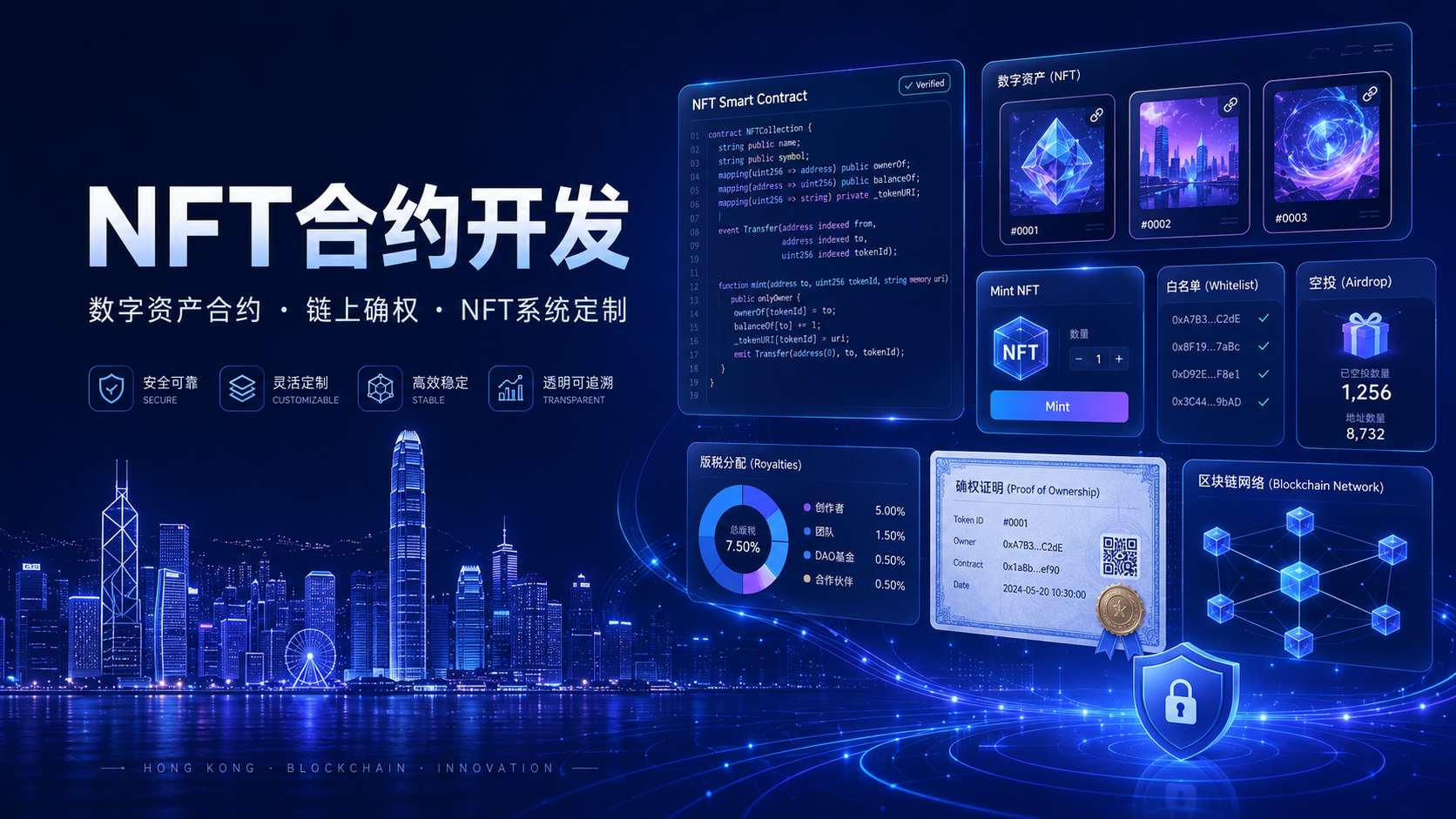
NFT Contract Development: Enterprise Smart Contract Systems from Digital Asset Minting to On-Chain Rights Confirmation
HK DragonChain provides NFT contract development, NFT smart contract development, digital collectible contracts, on-chain copyright contracts, NFT minting contracts, NFT trading contracts, blind box contracts, airdrop contracts, whitelist contracts, royalty split contracts, and enterprise-grade NFT platform contract system customization services. Based on project asset types, issuance rules, on-chain rights confirmation needs, user interaction workflows, security requirements, and future operational planning, we offer secure, stable, and scalable NFT contract development solutions for digital asset platforms, copyright attestation platforms, brand membership systems, Web3 projects, gaming asset platforms, and enterprise blockchain applications.
What Is NFT Contract Development
NFT contract development refers to writing and deploying smart contracts for managing non-fungible digital assets based on project business rules. NFT contracts can define unique asset IDs, holder addresses, minting rules, transfer rules, authorization rules, burning mechanisms, royalty percentages, metadata URIs, and on-chain recording methods, giving each NFT asset a clear on-chain identity and traceable records.
Unlike ordinary images, membership cards, or digital credentials, the core value of NFTs lies not just in content display but in recording asset ownership, transfer processes, and business rules through blockchain contracts. When users complete minting, claiming, purchasing, transferring, authorizing, or viewing assets on NFT platforms, NFT contracts work in conjunction with wallets, DApp pages, admin management, and on-chain data services behind the scenes.
In the NFT contract development process, HK DragonChain prioritizes asset standards, issuance rules, permission boundaries, contract security, on-chain data, user experience, and future extensibility. We don't just provide simple NFT minting code but combine project business scenarios to plan complete system solutions from NFT contracts, DApp front-ends, wallet connections, admin management, to launch and maintenance.
Which Projects Are Suitable for NFT Contracts
NFT contracts are suitable for projects requiring digital asset rights confirmation, on-chain credentials, unique identity identifiers, membership benefits, copyright records, or asset transfers. If an enterprise is planning digital collectibles, digital copyright, brand membership cards, game items, event tickets, on-chain certificates, art issuance, or Web3 community benefits, NFT contracts can establish clearer on-chain asset rules.
Digital Collectible Platforms
Suitable for art works, brand memorabilia, limited digital assets, and themed collectible issuance, supporting NFT minting, display, serial numbering, transfer records, and on-chain rights confirmation.
Digital Copyright Systems
Suitable for images, videos, music, design works, articles, and software content rights confirmation, supporting copyright credentials, authorization records, revenue distribution, and on-chain proof queries.
Brand Membership Benefits
Suitable for membership cards, benefit credentials, event tickets, discount eligibility, and user tier systems, helping enterprises build verifiable on-chain membership assets.
Gaming and Virtual Assets
Suitable for game items, character skins, equipment assets, virtual items, and metaverse scenarios, supporting asset ownership, transfers, display, and cross-platform extensibility.
HK DragonChain NFT Contract Development Services
HK DragonChain provides complete NFT contract development services, covering NFT business rule design, contract architecture planning, NFT minting features, whitelist rules, blind box mechanisms, airdrop distribution, royalty splits, metadata management, wallet connections, DApp interactions, admin configuration, testing and deployment, and post-launch maintenance. We design NFT contract systems suitable for long-term use based on client project positioning and real operational requirements.
1. NFT Contract Architecture Design
NFT contract development first requires clarifying asset standards, issuance methods, contract structures, and business boundaries. The system can design single-series contracts, multi-series contracts, batch minting contracts, permission management contracts, royalty contracts, blind box contracts, and upgradeable extension modules based on project requirements. Reasonable contract architecture allows NFT platforms to add new series, new benefits, and new scenarios more flexibly later.
2. NFT Minting and Issuance Rules
NFT minting is a critical function of NFT platforms. The system can support single minting, batch minting, user-initiated minting, admin issuance, limited issuance, timed issuance, whitelist issuance, and activity claims. HK DragonChain designs issuance quantities, claim conditions, minting prices, start times, end times, and user participation limits based on project operational methods, avoiding chaotic issuance rules after launch.
3. Whitelist and Airdrop Contracts
For projects requiring controlled issuance eligibility, whitelist contracts and airdrop contracts can be developed. Whitelists can be used for priority purchases, exclusive claims, activity eligibility, member exclusivity, and community user rewards. Airdrop functionality can be used for batch NFT asset distribution, brand activity rewards, user incentives, and project operational promotions. The system needs to ensure clear list rules, traceable distribution records, and handleable exceptions.
4. Blind Box and Random Distribution Mechanisms
NFT blind boxes are suitable for digital collectibles, gaming assets, brand activities, and limited series issuance. The system can support blind box purchases, opening, random distribution, rarity configuration, series configuration, and result display. Blind box mechanisms require focus on random rules, asset inventory, opening statuses, user records, and on-chain events to ensure clear and traceable business processes.
5. Royalty and Split Rules
For art works, copyright content, and creator economy projects, NFT contracts can design royalty and split mechanisms. The system can configure creator addresses, platform addresses, split ratios, copyright revenues, and secondary transfer rules based on project requirements. Clear royalty rules help platforms establish more standardized digital copyright revenue systems.
6. NFT Display and On-Chain Data Synchronization
NFT assets need to be displayed on DApp pages, user centers, and admin systems. The system can synchronize NFT IDs, holder addresses, contract addresses, metadata, image information, minting records, transfer records, and authorization statuses. HK DragonChain designs on-chain data listening and admin display methods based on project requirements, enabling both users and operations teams to clearly view NFT asset statuses.
Core Functional Modules of NFT Contracts
A mature NFT contract system is not just about asset minting. It also needs to balance issuance rules, asset display, user interactions, admin management, security controls, and future extensibility. HK DragonChain performs modular development based on actual project requirements, making NFT contract structures clearer, features more stable, and operations more convenient.
- NFT Minting: Supports single minting, batch minting, user minting, admin issuance, limited issuance, and timed issuance.
- Asset Rules: Supports NFT IDs, metadata URIs, series configuration, rarity, issuance quantities, holder records, and on-chain rights confirmation.
- Whitelist Rules: Supports whitelist claims, priority purchases, exclusive eligibility, activity permissions, and user participation limits.
- Airdrop Features: Supports batch airdrops, designated address distribution, activity rewards, community incentives, and distribution record queries.
- Blind Box Mechanisms: Supports blind box purchases, opening, random distribution, inventory management, rarity configuration, and opening result recording.
- Royalty Splits: Supports creator revenues, platform splits, copyright revenues, secondary transfer rules, and revenue address configuration.
- Wallet Interactions: Supports wallet connections, signature authorizations, transaction confirmations, NFT transfers, authorization operations, and on-chain status returns.
- Admin Management: Supports contract addresses, series configuration, asset data, user records, issuance activities, permission roles, and operation logs.
- Security Controls: Supports permission boundaries, pause mechanisms, parameter validation, exception handling, authorization prompts, and pre-deployment testing review.
NFT Contract Development Process
NFT contract development involves digital asset rules, on-chain rights confirmation, wallet interactions, metadata management, platform admin, and deployment. Therefore, the development process needs to be clear and rigorous. HK DragonChain adopts a standardized process to help clients progressively complete NFT contract system construction from requirements planning to official launch.
Requirements Gathering
Clarify project type, NFT asset format, issuance quantities, user workflows, supported chains, wallet connections, admin needs, and launch plans.
Solution Planning
Plan NFT contract structure, minting rules, metadata approaches, whitelist mechanisms, airdrop rules, royalty splits, and security strategies.
Contract Development
Develop NFT minting, transfer, authorization, burning, whitelist, blind box, airdrop, royalty, and permission management contract features.
DApp Integration
Perform integration testing with DApp front-ends, wallet connections, admin APIs, on-chain data services, and NFT display pages to verify complete business workflows.
Testing & Acceptance
Conduct minting testing, transfer testing, authorization testing, whitelist testing, blind box testing, airdrop testing, permission testing, and exception flow testing.
Launch & Maintenance
Complete testnet deployment, mainnet deployment, contract configuration, data monitoring, feature upgrades, security optimization, and long-term technical support.
Differences Between NFT Contracts and Ordinary Digital Asset Systems
Both NFT contracts and ordinary digital asset systems can display digital content, but they differ significantly in asset ownership, data recording, transfer methods, and trustworthiness. Ordinary digital asset systems typically rely on platform databases to record ownership, while NFT contracts can write key asset information and transfer records onto blockchain networks, forming traceable and verifiable on-chain credentials.
| Comparison Item | NFT Contract System | Ordinary Digital Asset System |
|---|---|---|
| Asset Recording | Records asset IDs, holders, and transfer statuses through blockchain contracts | Primarily stores asset information through platform databases |
| User Identity | Typically confirms identity through wallet addresses and on-chain signatures | Typically confirms identity through accounts, phone numbers, or email |
| Transfer Methods | Can complete transfers, authorizations, and on-chain records through contract rules | Asset changes and display statuses controlled by platform admin |
| Applicable Scenarios | Digital collectibles, copyright credentials, membership benefits, gaming assets, on-chain certificates | Ordinary image display, member profiles, content management, and platform points |
| Security Focus | Contract permissions, wallet authorizations, metadata management, asset flows, and on-chain records | Server security, account security, database security, and admin permissions |
Key Considerations in NFT Contract Development
The first consideration in NFT contract development is whether asset rules are clear. Projects need to clarify what rights NFTs represent, whether transfers are allowed, whether burning is supported, whether royalties are needed, whether claim eligibility is restricted, whether blind box mechanisms are required, and whether new series need to be added later. Only with clear rules can contract development and platform operations avoid conflicts.
Second, metadata and asset display must be prioritized. NFTs typically associate with images, videos, text descriptions, attribute information, and external resource URIs. Improper metadata design may affect NFT display, asset queries, and later maintenance. Enterprises need to confirm metadata storage methods, update rules, content display structures, and on-chain/off-chain data correspondences before development.
Additionally, NFT contracts cannot focus only on minting features. Enterprise projects also need to consider wallet connections, user authorizations, admin configuration, on-chain data synchronization, activity operations, asset queries, and exception handling. In development, HK DragonChain combines contracts, DApp pages, and admin systems to help projects form complete NFT business closed loops.
Why Choose HK DragonChain
HK DragonChain specializes in blockchain development, NFT contract development, smart contract development, DApp contracts, DApp applications, Web3 wallets, decentralized wallets, multi-currency wallets, DeFi systems, anti-counterfeit traceability, and digital copyright system customization. In NFT contract development, we focus not only on whether contracts run properly but also on asset rules, copyright scenarios, wallet interactions, admin management, on-chain data, and long-term maintenance.
For digital collectible platforms, we provide NFT minting, collectible display, airdrop distribution, whitelist activities, and admin configuration. For digital copyright projects, we provide copyright credentials, authorization records, on-chain attestation, and revenue distribution. For brand membership systems, we provide NFT membership cards, benefit credentials, activity eligibility, and user identity management. For gaming and virtual asset projects, we provide item assets, transfer authorizations, and cross-scenario extensibility solutions.
We insist on customizing NFT contract solutions based on actual project business, avoiding unnecessary feature stacking. Clear asset structures, secure contract permissions, stable wallet interactions, accurate on-chain data, and extensible system architectures are the keys to long-term stable NFT project operation.
Related Blockchain Services
NFT contract development is typically used in conjunction with NFT platform development, DApp development, DApp contracts, smart contract development, Web3 wallets, decentralized wallets, DeFi system development, public/mainnet chain development, and blockchain application development. If you are planning NFT contracts, digital collectible platforms, on-chain copyright systems, or enterprise digital asset projects, you can continue to explore HK DragonChain's blockchain development services. We will provide a more implementable NFT contract development solution based on your project business processes.
NFT Contract Development FAQs
Is a DApp page always required for NFT contract development?
If NFTs are intended for user claiming, minting, viewing, or transferring, DApp pages and wallet connection features are typically recommended. If it's only for internal asset records, display methods can be decided based on actual business needs.
Can NFT contracts support whitelists and airdrops?
Yes. The system can develop whitelist claims, priority purchases, designated address airdrops, batch distributions, and activity reward features based on project requirements.
Can NFT contracts support royalties?
Yes. For art works, copyright content, and creator projects, royalty percentages, revenue addresses, and split methods can be configured based on business rules.
Does an enterprise NFT contract project require an admin panel?
If the project requires long-term operations, an admin management system is recommended for managing NFT series, contract addresses, issuance activities, user records, on-chain data, and operational configuration.
Get an NFT Contract Development Solution
If you are planning NFT contract development, NFT smart contract development, digital collectible contracts, on-chain copyright contracts, NFT minting contracts, whitelist contracts, airdrop contracts, blind box contracts, royalty split contracts, or enterprise-grade NFT platform systems, you are welcome to discuss your project requirements with HK DragonChain. We will provide a more implementable NFT contract development solution based on your asset types, issuance rules, supported chains, security requirements, and launch plans.