
DeFi System Development
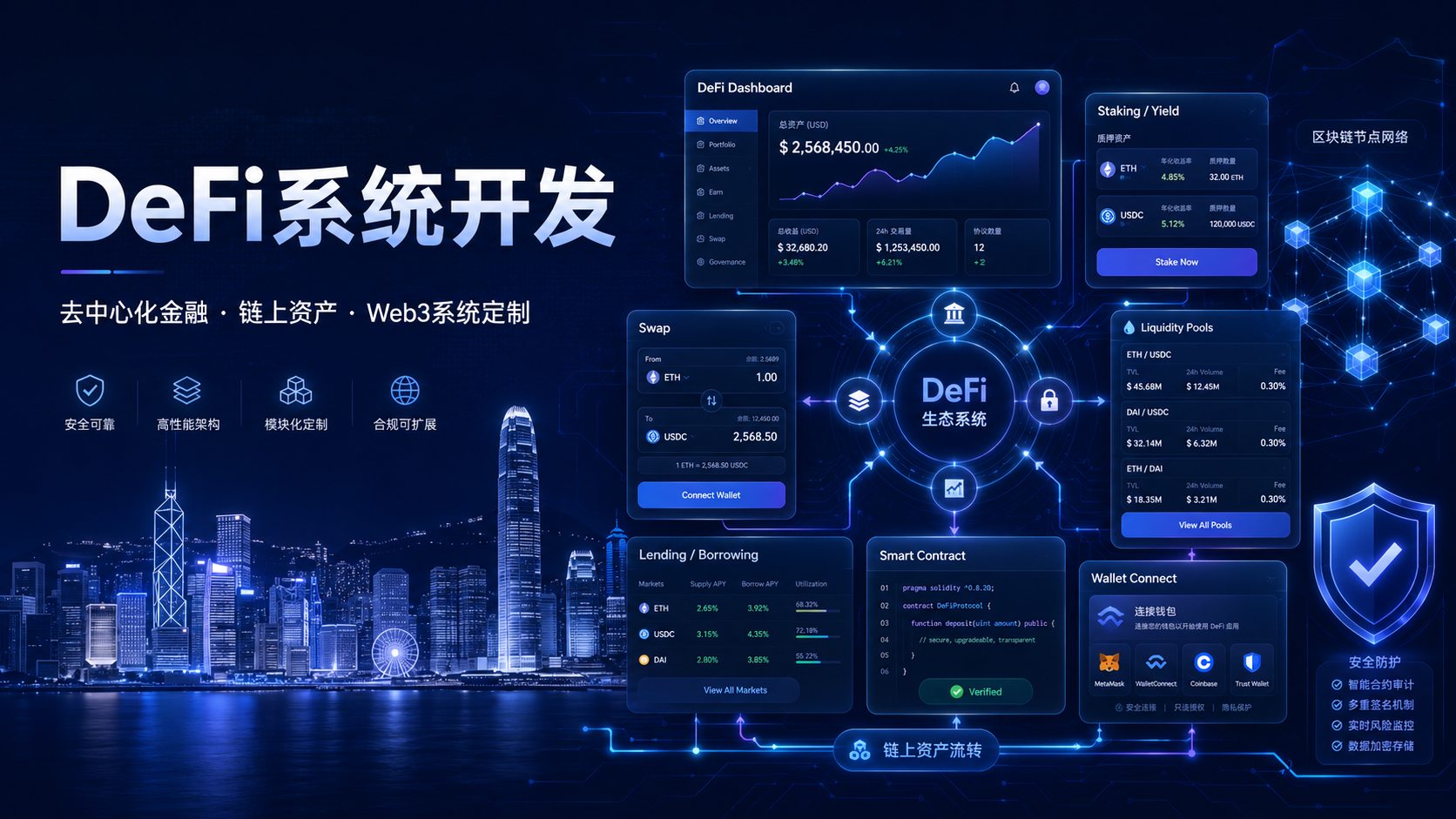
DeFi System Development: Enterprise-Grade Decentralized Finance Application Custom Solutions
HK DragonChain provides DeFi system development, decentralized finance application development, DeFi contract development, staking system development, liquidity mining systems, swap exchange systems, lending protocol systems, on-chain yield systems, wallet connections, smart contract integration, admin management, and enterprise-grade Web3 financial application customization services. Based on project business models, asset rules, supported chains, contract security, user interactions, and long-term operational planning, we offer secure, stable, and scalable DeFi system development solutions for Web3 projects, digital asset platforms, DApp applications, and blockchain finance scenarios.
What Is DeFi System Development
DeFi system development refers to building decentralized financial application systems based on blockchain networks, smart contracts, and wallet interactions. Unlike traditional financial systems, DeFi systems execute core business rules through smart contracts, with users completing authorizations, signatures, transfers, staking, swaps, lending, yield claims, and other operations through wallets, while on-chain records can be queried and verified.
A complete DeFi system is not simply a page display or a standalone contract deployment. Mature DeFi projects typically need to include smart contracts, DApp front-ends, wallet connections, asset management, yield calculations, admin configuration, on-chain data synchronization, security risk control, permission management, and post-launch ongoing maintenance. Only when these modules work together stably can the system support long-term usage by real users.
In the DeFi system development process, HK DragonChain prioritizes clear business rules, clear fund flows, reasonable contract permissions, accurate yield calculations, secure user authorizations, synchronized on-chain data, and convenient admin operations. We customize system solutions based on actual project scenarios rather than simply applying template features.
Which Projects Are Suitable for DeFi Systems
DeFi systems are suitable for projects requiring on-chain asset interactions, automated yield rules, liquidity management, digital asset swaps, or user staking participation. If an enterprise is planning Web3 financial applications, DApp platforms, on-chain asset management, staking mining, swap exchanges, lending protocols, yield aggregators, or digital asset operation platforms, DeFi systems can establish more transparent on-chain business processes.
Staking Yield Systems
Suitable for token staking, lock-up rewards, membership benefits, and on-chain incentive scenarios, supporting user staking, redemption, yield calculation, reward claims, and status queries.
Swap Exchange Systems
Suitable for on-chain asset swaps, token trading, liquidity pools, and DApp asset transfers, supporting wallet authorizations, swap confirmations, slippage settings, and transaction records.
Liquidity Mining Systems
Suitable for projects requiring users to provide liquidity and receive rewards, supporting pool configuration, LP tokens, reward distribution, fee rules, and data analytics.
Lending Protocol Systems
Suitable for on-chain collateral, borrowing, repayment, liquidation, and asset management scenarios, supporting collateral ratios, interest rate rules, risk parameters, and contract execution logic.
HK DragonChain DeFi System Development Services
HK DragonChain provides complete DeFi system development services, covering DeFi business model design, smart contract development, staking contracts, swap contracts, yield contracts, lending contracts, wallet connections, DApp front-ends, admin management, on-chain data synchronization, testing and deployment, and post-launch maintenance. We design more implementable DeFi application systems based on client project positioning and actual operational requirements.
1. DeFi Business Model Design
Before DeFi system development, the business model must be clarified. Projects need to determine asset types, user participation methods, yield sources, fee rules, risk parameters, staking cycles, swap logic, pool structures, and admin configuration methods. HK DragonChain maps complete workflows based on project requirements, ensuring system rules remain clear before development.
2. Staking and Lock-Up System Development
Staking systems are common modules in DeFi applications. The system can support fixed-term staking, flexible staking, lock-up releases, yield claims, early redemption, tiered yields, user levels, and activity rewards. During development, focus is needed on yield calculation, time rules, user balances, redemption limits, and exception states to avoid reward calculation confusion after launch.
3. Swap Exchange and Liquidity Pools
Swap exchange systems can support users completing exchanges between different assets on-chain. The system can design trading paths, slippage settings, fee ratios, pool configurations, price calculations, liquidity additions, and liquidity removals based on requirements. For long-term operational projects, admin parameter management and transaction data analytics are also needed.
4. Liquidity Mining and Reward Distribution
Liquidity mining systems can distribute rewards to users through contract rules. The system can support reward pool configuration, LP tokens, reward release cycles, user share calculations, reward claims, pool statuses, and activity time settings. Reasonable reward rules can help projects establish more stable user participation mechanisms.
5. DeFi Lending Protocol Development
Lending DeFi systems typically involve collateral assets, borrowing limits, interest rate rules, repayment processes, liquidation conditions, and risk parameters. These systems have higher requirements for security and business rules, requiring clear asset valuation methods, collateral ratios, liquidation thresholds, exception handling, and contract permission boundaries before development.
6. Wallet Connection and DApp Interactions
DeFi systems typically require users to complete signature authorizations and on-chain transactions through wallets. The system can support wallet connections, network switching, asset authorizations, transaction confirmations, staking submissions, swap confirmations, yield claims, and failure prompts. Clear interaction workflows can reduce user errors and improve on-chain transaction success rates.
Core Functional Modules of DeFi Systems
A mature DeFi system needs to balance asset interactions, yield calculations, on-chain contracts, user experience, admin management, and security risk control. HK DragonChain performs modular development based on actual project requirements, making system structures clearer and later maintenance and expansion more convenient.
- Staking System: Supports fixed-term staking, flexible staking, lock-up rules, redemption rules, yield calculation, and reward claims.
- Swap Exchange: Supports asset swaps, trading paths, slippage settings, fee configuration, price calculation, and transaction status queries.
- Liquidity Pools: Supports liquidity addition, liquidity removal, LP tokens, pool configuration, share calculation, and reward distribution.
- Lending Protocol: Supports collateral assets, borrowing limits, interest rate rules, repayment processes, liquidation conditions, and risk parameter configuration.
- Wallet Interactions: Supports wallet connections, signature authorizations, contract calls, transaction confirmations, network switching, and exception prompts.
- Admin Management: Supports contract addresses, asset configuration, pool parameters, reward rules, user records, transaction data, and permission roles.
- On-Chain Data: Supports event listening, transaction hashes, asset changes, yield records, user shares, and contract status synchronization.
- Security Controls: Supports permission boundaries, pause mechanisms, parameter validation, reentrancy protection, authorization prompts, and pre-deployment testing review.
- Extensibility: Supports later integration of more public chains, more wallets, more assets, NFT modules, DAO governance, and enterprise application scenarios.
DeFi System Development Process
DeFi systems involve asset transfers, contract execution, yield calculations, and risk parameters, requiring a more rigorous development process than ordinary applications. HK DragonChain adopts a standardized process to help clients progressively complete system construction from requirements planning to launch and maintenance.
Requirements Gathering
Clarify project type, asset models, staking rules, swap rules, lending rules, wallet connections, admin needs, and launch plans.
Solution Planning
Plan DeFi system architecture, contract modules, yield rules, fund flows, permission mechanisms, risk parameters, and data synchronization methods.
Contract Development
Develop staking contracts, swap contracts, liquidity contracts, yield contracts, lending contracts, permission contracts, and data event modules.
DApp Integration
Perform integration testing with DApp front-ends, wallet connections, admin APIs, and on-chain data services to verify complete user workflows.
Testing & Acceptance
Conduct staking testing, swap testing, yield testing, authorization testing, permission testing, exception testing, and asset flow testing.
Launch & Maintenance
Complete testnet deployment, mainnet deployment, parameter configuration, data monitoring, feature upgrades, security optimization, and long-term technical support.
Differences Between DeFi Systems and Traditional Financial Systems
Both DeFi systems and traditional financial systems involve asset management, yield rules, and user operations, but their execution methods differ. Traditional financial systems typically rely on centralized accounts, admin reviews, and internal databases. DeFi systems rely more on wallet addresses, smart contracts, and on-chain transaction records, making them suitable for application scenarios requiring transparent execution and automated rules.
| Comparison Item | DeFi System | Traditional Financial System |
|---|---|---|
| Account Method | Typically through wallet addresses, on-chain signatures, and smart contract interactions | Typically through platform accounts, identity verification, and admin account management |
| Business Execution | Critical rules automatically executed by smart contracts, on-chain records queryable | Primarily processed by platform admin, manual reviews, and server programs |
| Applicable Scenarios | Staking, swaps, liquidity pools, lending protocols, yield aggregators | Payments, account management, fund settlement, traditional wealth management, and business approvals |
| Data Characteristics | On-chain transactions, asset changes, and contract events can be traced and verified | Data primarily stored in platform databases and internal systems |
| Security Focus | Contract vulnerabilities, fund flows, authorization risks, liquidation rules, and permission boundaries | Account security, server security, review workflows, and admin permissions |
Key Considerations in DeFi System Development
The first consideration in DeFi system development is whether fund flows are clear. Projects need to clarify where user assets enter, where they are stored, how yields are calculated, when redemptions are allowed, and how exceptions are handled. If fund paths and contract rules are unclear, operational risks and user disputes are likely after launch.
Second, contract security and permission management must be prioritized. DeFi systems typically involve user assets and yield calculations, requiring avoidance of excessive permission concentration, unsafe external calls, reentrancy risks, abnormal price data, yield calculation errors, unreasonable liquidation rules, and incorrect parameter configurations. Every function involving asset changes should undergo thorough testing and review.
Additionally, DeFi systems cannot focus only on contract features but also need to consider user experience and admin operations. Users need to clearly see staking statuses, yield details, swap results, transaction hashes, and risk prompts. Operations teams need to view pool statuses, user data, contract events, reward distributions, and exception records through admin panels. HK DragonChain combines on-chain contracts with off-chain systems to help projects form complete operational closed loops.
Why Choose HK DragonChain
HK DragonChain specializes in blockchain development, DeFi system development, smart contract development, DApp contracts, DApp applications, Web3 wallets, decentralized wallets, multi-currency wallets, NFT systems, anti-counterfeit traceability, and digital copyright system customization. In DeFi system development, we focus not only on feature availability but also on business models, security boundaries, wallet interactions, yield rules, admin management, and long-term maintenance.
For staking projects, we provide staking contracts, lock-up rules, yield calculations, and reward claims. For swap projects, we provide exchange pages, liquidity pools, slippage settings, and transaction records. For lending projects, we provide collateral rules, interest rate models, liquidation logic, and risk parameters. For enterprise Web3 platforms, we provide on-chain assets, wallet entry points, DApp interactions, and admin configuration features.
We insist on customizing DeFi system solutions based on actual project business, avoiding unnecessary feature stacking. Clear fund paths, secure contract permissions, stable wallet interactions, accurate yield calculations, and extensible system architectures are the keys to long-term stable DeFi project operation.
Related Blockchain Services
DeFi system development is typically used in conjunction with DApp development, DApp contracts, smart contract development, Web3 wallets, decentralized wallets, NFT platform development, public/mainnet chain development, and blockchain application development. If you are planning a DeFi system, staking system, swap exchange, liquidity pool, lending protocol, or enterprise-grade Web3 financial application, you can continue to explore HK DragonChain's blockchain development services. We will provide a more implementable DeFi system development solution based on your project business processes.
DeFi System Development FAQs
Is a smart contract always required for DeFi system development?
Most DeFi systems require smart contracts, especially projects involving staking, swaps, lending, reward distribution, and asset transfers. Contracts handle core rule execution, while DApp pages handle user interactions.
Can DeFi systems support multiple public chains?
Yes. The system can support different public chain or consortium chain environments based on project requirements, but asset standards, fees, confirmation speeds, and API methods for different chains need to be adapted separately.
Can yield rules be adjusted after DeFi system launch?
Whether adjustments are possible depends on the initial architecture design. Some projects can adjust rules through admin parameters or contract permissions, but parameters involving user assets and yields need careful design.
Does an enterprise DeFi system project require an admin panel?
If the project requires long-term operations, an admin management system is recommended for viewing pool statuses, configuring asset parameters, managing reward rules, tracking user records, and handling exceptions.
Get a DeFi System Development Solution
If you are planning DeFi system development, decentralized finance application development, DeFi contract development, staking systems, swap exchange systems, liquidity mining systems, lending protocol systems, or enterprise-grade Web3 financial applications, you are welcome to discuss your project requirements with HK DragonChain. We will provide a more implementable DeFi system development solution based on your business models, asset rules, supported chains, security requirements, and launch plans.